UNESCO World Heritage
Zhangjiajie National Forest Park Audio Guide
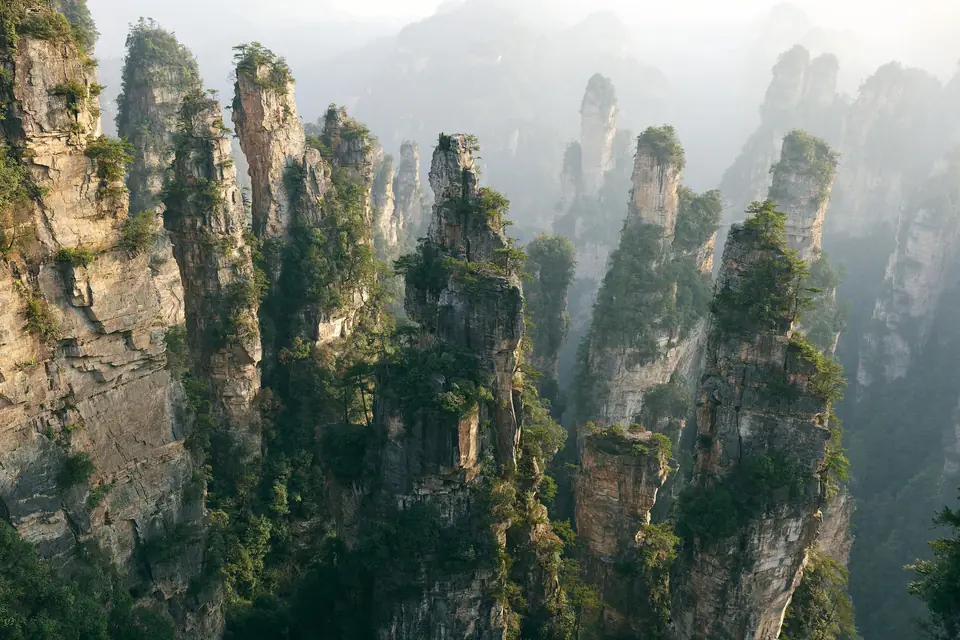
Thousands of sandstone pillars crowned with pines that 380 million years ago were sand on a seashore. Before one of its columns was renamed after a mountain in Avatar, this forest was a forestry farm whose handful of workers swore to make it green again by hand.
- 120 min of audio
- China's first forest park
Zhangjiajie National Forest Park was the first of its kind in China: it was created in 1982 by a State Council order on a forestry farm founded in 1958, whose workers left some 2,000 hectares of hillside green again. Its quartzite sandstone pillars, brown or reddish and topped with pines, are what remains of a coast from 380 million years ago that ice, roots and streams have been taking apart, and they form part of the Wulingyuan scenic area, a UNESCO World Heritage Site since 1992.
Everything else took its name from this forest. In 1994 the city of Dayong was renamed Zhangjiajie; in 2010 an international symposium gave the name “Zhangjiajie landform” to every similar pillar forest in the world, and that same year a column in Yuanjiajie received, with a ceremony, the name “Avatar Hallelujah Mountain”. Not bad for a place that in 1979 received some 13,000 visitors and in 2018 passed 4 million.
Highlights
- 1958 forestry farm — Some 2,000 hectares replanted by hand before the birth, in 1982, of China's first national forest park
- Golden Whip Stream — Sandstone pillars from a coast 380 million years old, split by ice and roots
- Bailong Elevator — 326 metres up the rock face, the tallest outdoor elevator in the world according to Guinness
- Avatar Hallelujah Mountain — The Southern Sky Column, renamed at a ceremony in January 2010
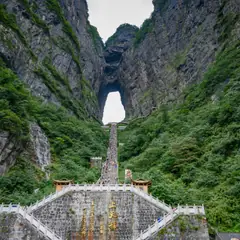
- First Bridge Under Heaven — A natural rock arch between two pillars, hanging over the void
In Zhangjiajie, the Zhangjiajie National Forest Park (张家界国家森林公园) raises a forest of quartzite sandstone pillars, brown or reddish, with pines and shrubs on top and almost vertical walls that drop to the valley floors. It was the first national forest park in China, created in 1982, and it is part of the Wulingyuan scenic area, which was added to the UNESCO World Heritage List in December 1992. Before it was a postcard, however, it was a logging site: in 1958 a state forestry farm was founded here, and much of the thicket that now covers the valleys was planted by its workers, tree by tree.
The history of Zhangjiajie National Forest Park is also written in its names. The name of the place itself is claimed by two Zhang families, one from the Han court and another from the Ming dynasty. Huangshizhai, the great platform in the southwest of the park, owes its name, so the legend goes, to the old man Huang Shigong, the Lord of the Yellow Stone, who is said to have rescued his disciple Zhang Liang up there when government troops had him surrounded; hence the local saying that whoever does not climb Huangshizhai has come to Zhangjiajie in vain. On that same plateau, a round rock hanging over the void is called the Star-Picking Platform: according to the tradition of the local guides, it was named by Zhang Jingfu, a State Councillor, who climbed it at dawn on 8 November 1983, with stars still in the sky, and improvised a few verses before the pillars: “though it is not heaven, it does not seem of this world”.
Its architecture is of rock and nobody built it: water and ice carved it out of an ancient seabed, and a single landscape shows the whole sequence, from plateau to isolated pillar. That backdrop soon attracted cameras. The crew of the series “Journey to the West”, shot from 1982, was the first to come to film in Zhangjiajie, when there were not even railings at the top; according to her husband, Wang Chongqiu, the director Yang Jie slipped in the rain while scouting locations and only a stump halfway down the slope kept her from the precipice. What to see in Zhangjiajie National Forest Park is arranged in five stops, from the south gate to the First Bridge Under Heaven, passing by Golden Whip Stream, the Bailong Elevator and the Avatar column, and it makes full sense when walked with the audio guide.
The city’s other great sandstone landscape is Tianmen Mountain, with its arch opened in the rock face, and the culture of the Tujia, whose villagers in traditional dress unveiled the Avatar sign in 2010, has its showcase in the Tujia Folk Custom Park.
A forest planted by hand and an order copied by hand
South gate of the park
Summary of this stop
The route starts at the south gate, the Senlin Gongyuan entrance, where the first pillars appear above the forest. That forest has a birth date. In autumn 1958 Dayong County created the Zhangjiajie state forestry farm and put Liu Shaohua, aged 28, in charge; he changed his name to Liu Kailin, “Liu Forest-Opener”. With his workers he swore before the portrait of Mao not to come down from the mountain until it had been reforested. Between 1962 and 1965 the farm reforested between 120 and 160 hectares a year, and by 1971 its more than 30,000 mu of hillside, some 2,000 hectares, were completely green again.
The leap to a park came in September 1982, with a State Council order, transmitted by the State Planning Commission, creating Zhangjiajie National Forest Park, the first in China. It was a one-page document, and Zhang Jie, a 26-year-old clerk, had to copy it by hand: the farm had no photocopier.
The name carries its own dispute. The official version attributes it to Zhang Liang, the strategist who helped Liu Bang found the Han dynasty and who, when the new emperor began to distrust those who had put him on the throne, left the court and took refuge in these mountains, then called Qingyan; according to tradition he planted seven ginkgo trees, his descendants stayed to live here and he himself is said to have been buried on the spot. Another, more prosaic version takes it to the Ming dynasty: around 1488-1506 the court rewarded Zhang Wancong, a military commander of the Dayong garrison, with the mountain lands around the park, and the name first appears in writing in the preface of a Zhang genealogy of 1631, signed by one of his descendants. Which of the two families weighs more in the name, and how that name ended up in 1994 replacing that of the city of Dayong, is revealed by the narration, in the shade of the first pillars.
Sand from a Devonian coast, split by ice
Golden Whip Stream
Summary of this stop
Along the valley floor runs Golden Whip Stream (Jinbian Xi), between stone forests on both sides, beside the rock that gives it its name, the Golden Whip Rock (Jinbian Yan). Two kinds of lines can be read on the walls: horizontal strata and vertical fissures, the joints, that run through the rock from top to bottom. Therein lies the key to the whole landscape.
About 380 million years ago, in the Devonian, Wulingyuan was a coast at the mouth of rivers that carried quartz sand; the seabed slowly sank and accumulated more than 500 metres of quartzite sandstone. That rock does not dissolve, so the pillars are not karst: they are formed by physical erosion. Ice that expands in winter inside the vertical cracks and plant roots keep splitting them, and the stream carries off the debris. Across the geopark as a whole, more than 3,000 pillars rise, from a few dozen metres to 400 in height, more than 1,000 of them above 200 metres; for the forest park alone, more than 2,000 are given. In one landscape the whole sequence can be seen: platform, plateau, wall, pillar forest, group of peaks and residual pillars.
Legend has another explanation for the pillar that rises beside the water: it would be the whip with which the First Emperor, Qin Shi Huang, drove the mountains to fill in the sea, and which he dropped here, drunk, to be turned into stone. Next to it, an eagle-shaped peak watches over it night and day, according to tradition, in the scene known as “the divine eagle guards the whip”. How myth and geology live together in the same rock is revealed by listening to the narration beside the stream.
A steel tower against the sandstone wall
Bailong Elevator
Summary of this stop
At the foot of the sandstone wall starts the Bailong Elevator, a steel tower with glass cabins that rises 326 metres to the edge of Yuanjiajie. Its lower section is excavated inside the rock and the upper one is in plain view. Construction began in October 1999, it opened in 2002 and on 16 July 2015 Guinness recognised it as the tallest outdoor elevator in the world. Its presence within a World Heritage Site has been the subject of debate over its environmental impact, and it was shut down for ten months between 2002 and 2003 for safety reasons.
The tower answers a curve of visitors. In 1979, in the days of the forestry farm, some 13,000 came; in 1984 there were 80,000, by 1988 already 560,000 and in 2018 more than 4 million. That torrent had a price: in 1998 the World Heritage Committee gave Wulingyuan a yellow card over uncontrolled tourist development, and from 8 November 2001 hotels, restaurants and illegal facilities inside the scenic area were demolished, almost 200,000 square metres in all.
Wonder and crowds coexist at this stop, at the base of a structure that climbs through a protected landscape. What was gained and what was lost by taking so many people to the top of the pillars is unpicked by the narration at the foot of the tower.
A column with a Hollywood name
Avatar Hallelujah Mountain (Qiankun Column)
Summary of this stop
On the southern edge of Yuanjiajie stands an isolated pillar with vegetation on top: the Southern Sky Column, also called the Qiankun Column. Since 2010 a sign has marked it with another name, “Avatar Hallelujah Mountain”. It is said that in December 2008 a photographer from the Avatar team, accompanied by Li Te of the Digital Media Institute of Hunan University, photographed the pillar forest at Yuanjiajie, and this column among them.
The name change has a date. The idea arose on 19 January 2010 at a meeting of the Zhangjiajie Tourism Association, and on 25 January several villagers dressed in Tujia costume unveiled the new sign at a ceremony. The municipal website confirmed it, but after the backlash online, with 82% against in one Phoenix poll and 90% in another, the authorities denied having renamed the mountain and presented the sign as a way of claiming the model; the press put the operation down to tourism marketing. The name remains in use.
There is no agreement about the model either. In Zhangjiajie it is held to have been this column; James Cameron stated in China that the floating mountains had been modelled on Huangshan, in Anhui, and the designer Dylan Cole cites three Chinese regions, Guilin, Huangshan and Zhangjiajie, in addition to the tepuis of Venezuela and karst formations in Thailand. In January 2010 Deng Daoli, of the local tourism association, went so far as to offer 100,000 yuan to anyone who found a closer model. The most repeated figure is not what it seems either: the 1,080 metres, or 3,544 feet, are the altitude of the summit above sea level, some 1,074 metres, and not the height of the pillar. What weighs more in this column’s fame, the rock or the campaign, is revealed by listening to the narration in front of it.
An arch over the void and a landform with its own name
First Bridge Under Heaven
Summary of this stop
In Yuanjiajie, the First Bridge Under Heaven (Tianxia Diyi Qiao) joins two pillars with a natural rock arch hanging over the void, and very close by the Mihuntai viewpoint looks out over the pillar forest. The bridge shows the same erosion as the stream stop, still at work: the water, ice and roots that separate one pillar from the next.
The fame of the place began with a brush. In late autumn 1979 the painter Wu Guanzhong climbed up to paint the then unknown forestry farm, and on 1 January 1980 the Hunan Ribao published his article “Nobody knows the maiden kept in her chamber: Zhangjiajie, a pearl of scenery”, which brought the place out of anonymity. In 2010 the park decided to erect a bronze statue of him. Recognition followed: in December 1992 Wulingyuan was added to the UNESCO World Heritage List, and on 13 February 2004 Zhangjiajie was approved among the first world geoparks.
That left the name of the landform itself. In the early years it was wrongly classified as danxia, until in November 2010, at an international symposium held in Zhangjiajie, the name “Zhangjiajie landform” was fixed for every similar quartzite sandstone pillar forest anywhere in the world. How a farm that copied its orders by hand ended up giving its name to a city, to a Hollywood mountain and to a type of landform is revealed by the narration, beside the bridge.