Tujia culture
Tujia Folk Custom Park Audio Guide (Tujia Fengqing Yuan)
A walled tusi citadel in the middle of Zhangjiajie, entered after draining a bowl of rice wine and home to a 48-metre wooden house held together without a single nail. The walls are recent; what is celebrated inside, from Qin Hou's robe to the white tiger, is Tujia memory that is still alive.
- 90 min of audio
- Wooden tower without nails
The Tujia Folk Custom Park was born as a showcase for the Tujia, the minority that calls itself Bizika, “native inhabitants”. Its core is the tusi city of Yongding, whose restoration was funded in 1999 by the private entrepreneur Yang Gangnian with 75 million yuan. Presiding over it is the Jiuchongtian, a 48-metre, twelve-storey stilt house, assembled with wooden pegs on an 80-degree slope and entered in the Guinness record in 2002 as the largest in China.
Among the customs it evokes is one of the strangest weddings known: according to tradition, the Tujia bride wept in song for months, sometimes up to a year, accompanied by six or eight unmarried girls. She thanked her parents for raising her, charged her younger brother with caring for them and blamed the matchmaker with mock reproaches. Girls learned to cry before adolescence, and even today a young woman's wit is measured by how she sings her lament.
Highlights
- Jiuchongtian — 48 metres and twelve storeys of wood without a single nail, a 2002 Guinness record
- Dongnan Diyi Gong arch — The largest stone arch in southern China, for 30,000 Tujia warriors
- Baishou Square — Maogusi dances with men dressed in straw, the “living fossil of Chinese theatre”
- Dizhu Pavilion — Five pillars carved with Tujia ancestors, from Lord Linjun to the rebel Qin Hou
- White tiger pillar — 12 metres of stone crowned by the totem of the Tujia
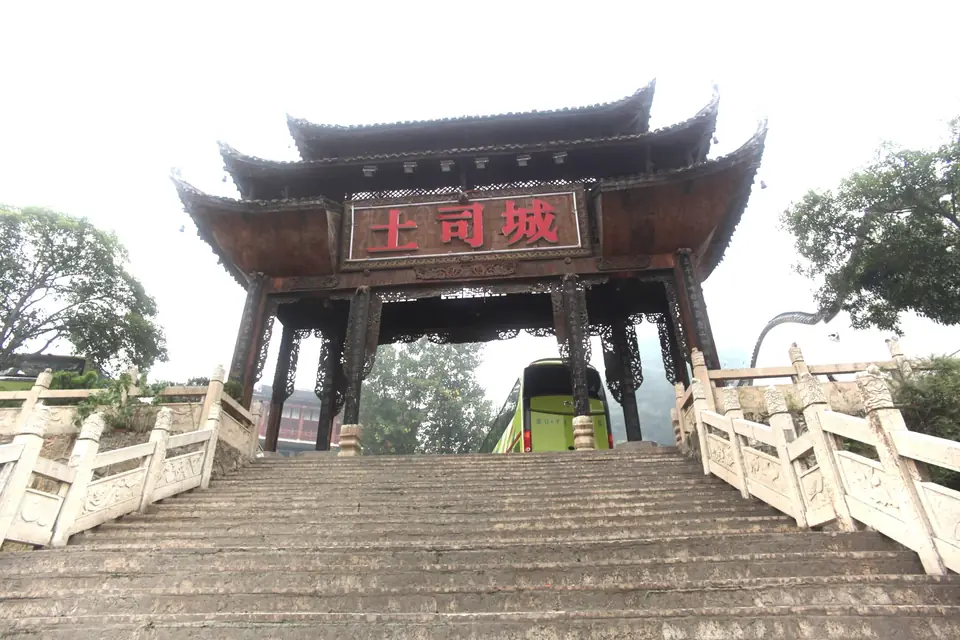
In the middle of the city of Zhangjiajie, thick stone walls enclose the Tujia Folk Custom Park, known in Chinese as Tujia Fengqing Yuan (土家风情园): a tusi-style citadel raised as a showcase for the Tujia. Its core is the tusi city of Yongding (土司城), whose restoration was funded in 1999 by the private entrepreneur Yang Gangnian. The complex covers more than 809 mu, about 54 hectares according to most sources, and cost 75 million yuan. Inside await a mountain village with the Embroiderers’ Tower, the Sheba building and the Prince’s Pond between covered bridges, and the Bizika Sacred Fire Hall, opened in 2003, where “Tu feng Miao yun” is performed, a three-act Tujia and Miao song and dance show: blessing, customs and wedding.
The history of the Tujia Folk Custom Park has two layers that are best not confused. On the age of the site the sources do not agree: a Chinese entry presents it as an old restored tusi city and attributes the great tower to the Peng tusi clan, a local guide in English dates the castle to 1730 under the tusi king Qin Chunyi and another gives the park as built in 2000. Everything points, however, to a recent work: the same Chinese entry attributes the design of the tower to a present-day craftsman. What is celebrated inside is something else: the rebel Qin Hou, executed in 1372 and remembered every sixth day of the sixth lunar month in a festival that Zhangjiajie included in 2008 in its first intangible heritage list; the Maogusi straw dance; or the white tiger that the Tujia venerate as a totem since the myths of the ancient Ba.
The architecture of the Tujia Folk Custom Park culminates in the Jiuchongtian, a diaojiaolou, the stilt house typical of these mountains, taken to 48 metres in height and twelve storeys without a single iron nail. What to see in the Tujia Folk Custom Park is arranged in five stops, from the welcome wine to the white tiger column, and the meaning of each, between modern set and ancient memory, is completed by walking it with the audio guide.
In the same urban centre, some two and a half kilometres away, Puguang Temple holds the history of the old military town of Dayong; outside the city rise Zhangjiajie’s two great landscapes, Tianmen Mountain and the pillars of Zhangjiajie National Forest Park.
A bowl of wine before the threshold
Tusi city gate
Summary of this stop
The entrance to the tusi city of Yongding is not a simple ticket check. Before the gate, between thick stone walls, the welcome comes with drums and horns, and with the Lanmenjiu (拦门酒), the “wine that bars the door”: Tujia girls sing and offer rice wine, and only after draining it is the threshold crossed. The sound of the drums bounces off the stone and marks the passage from the modern street to the enclosure.
That same wall holds the key to reading the whole park. The citadel is not a fortress inherited intact from the old tusi chiefs, but a private restoration: in 1999 the entrepreneur Yang Gangnian put up the money to rebuild the tusi city of Yongding, the walled core of a complex of more than 809 mu, and the work reached 75 million yuan.
From the esplanade that opens before this gate there also sets out, every year, the procession of the sixth day of the sixth month. How a welcome ritual, a new enclosure and an ancient festival fit together is revealed by listening to the narration right there, with the wine still in hand.
Thirty thousand warriors under a stone arch
Dongnan Diyi Gong arch
Summary of this stop
Just inside, a great stone arch with the inscription 东南第一功, Dongnan Diyi Gong, “first merit of the southeast”, greets the visitor. It is the largest stone arch in southern China and honours the 30,000 Tujia warriors whom the tusi king of western Hunan led against the Japanese pirates in the Jiajing era of the Ming dynasty, in a four-year campaign. The stone thus celebrates a war fought very far from these mountains.
Under this arch passes every year the offerings procession of the sixth-day-of-the-sixth-month festival. It leaves from the esplanade before the tusi city gate, crosses the Dragon Gate, goes through the Dongnan Diyi Gong and circles Baishou Square before the sacrifice, a route that has been part of the festival since Zhangjiajie included it in 2008 in its first intangible heritage list.
The feat has, according to local tradition, a domestic and disputed echo. The Tujia of Zhangjiajie celebrate the New Year’s Eve dinner before dawn: they get up around three, sit down to the table around four and try to finish before it gets fully light, because the more light enters while eating, the brighter the year will be. One explanation links it to this campaign: the recruitment order is said to have arrived on the 29th of the last lunar month and the men moved the dinner forward in order to leave on time. Another, less heroic, speaks of dining before dawn to shut themselves in at home before the bandits came down from the hills. Which of the two weighs more is left open in the narration, in the shade of the arch.
Straw dancers and a rebel carved in wood
Baishou Square
Summary of this stop
South of the small square that follows the arch rises the ancestral sacrifice hall, with a great gilded statue, stone tripods and dragon columns. Facing it opens Baishou Square, the open space for ancestor worship, where the Baishou and the Maogusi are danced, with regular sessions at 10:00 and 16:00. The Maogusi, called the “living fossil of Chinese theatre”, recreates the life of the first Tujia: the men cover themselves in straw and the women in leaves and bark.
In September 2002, at the same time as the record of the park’s great tower, more than a thousand dancers performed the Maogusi together inside the tusi city, and the park thus added a second Guinness record. The counterpoint to the festival is in the Dizhu Pavilion, held up by five great wooden pillars, each carved with a Tujia ancestor: Lord Linjun of Ba, Lord Peng, the official Xiang, the hero Tian and the tusi king Qin Hou.
Qin Hou (1309–1372), Tujia tusi chief of Cili, rose up in 1370 against the requisition of great nanmu logs and forced labour, in the time of the first Ming emperor, Zhu Yuanzhang. He was executed in Nanjing on the sixth day of the sixth lunar month of 1372, and on that date the Tujia air their clothes in the sun in the “drying of the dragon robe”. According to tradition, his blood splashed the clothes he wore and the Tujia rescued that war robe and carried it back to their mountains; the custom is also called, bluntly, “drying Qin Hou’s skin”. Another version that circulates in the park itself speaks of blankets spread in the sun, in a gesture that imitates covering the body of the flayed chief. The airing also coincides with the humid heat of summer. What changes on looking at Qin Hou’s pillar knowing all this is revealed in the narration, in the square itself.
Nine heavens of wood without a nail
Jiuchongtian
Summary of this stop
The Jiuchongtian, “nine layered heavens”, clings to an 80-degree slope: 48 metres high and twelve storeys spread over nine levels, all assembled with wooden pegs, without a single iron nail. It was designed by Li Hongjin, a Tujia folk craftsman, and on 22 September 2002 it entered the Guinness record as the largest, tallest and most complete wooden stilt house in China; some travel guides present it as the tallest in the world, although the record refers to China.
The tower can be visited inside. Its interior is divided into six themed halls, and in the Yizheng hall, the administration one, a wax figure of Qin Chunyi, the last tusi king, presides over ancestral tablets and nuo masks of Tujia sacrifices. Other halls show carved windows of the Ming and Qing periods and the recreated bedchamber of a tusi princess.
On 6 April 2001 Premier Zhu Rongji visited the park and praised the building: “that a group of folk craftsmen raise such a splendid stilt house, and solve the mechanical problems besides, is no simple matter”. That the tower is a work of today and not an inheritance from the tusi kings is precisely what explains its record and that praise, and that revelation recasts the entire route when one listens to the narration at the foot of its twelve storeys.
The ancestor who became a tiger
White tiger totem pillar
Summary of this stop
At the centre of the park rises a stone totem pillar 12 metres high and 1.2 metres in diameter, topped by a seated white tiger, the totem of the Tujia. Its origin is an ancient myth: the Tujia of the Qingjiang River venerate as a remote ancestor Lord Linjun, chieftain of the ancient Ba, and legend says that on his death his soul turned into a white tiger. He is the same Lord Linjun whose figure is carved on one of the five pillars of the Dizhu Pavilion.
The myth has a sombre reverse. The Book of the Later Han tells that the tiger drank human blood and that the Ba offered it human sacrifices; hence the cult of the white tiger and the historical epithet of “white tiger barbarians”. Centuries later, a Tang-dynasty text describes the Ba honouring their ancestors with drums and songs and proclaiming themselves “descendants of the white tiger”.
In the park, the Tiger stele reproduces the character 虎 that the Tujia general Liu Mingdeng, military chief in Taiwan, wrote in 1867; it measures 100 by 40 centimetres and the original is still on the historic Caoling trail, in New Taipei. Tradition has it that, on reaching the Caoling pass, a gale broke out, and that the general, remembering the phrase from the Book of Changes “wind follows tiger”, pulled up a stalk of silver grass, used it as a brush and traced the character on the spot to subdue the wind and protect the walkers. How that emblem travelled so far with its people closes the circle of the tiger in the narration, at the foot of the column.