Ming Buddhist monastery
Puguang Temple Audio Guide (Puguang Chansi)
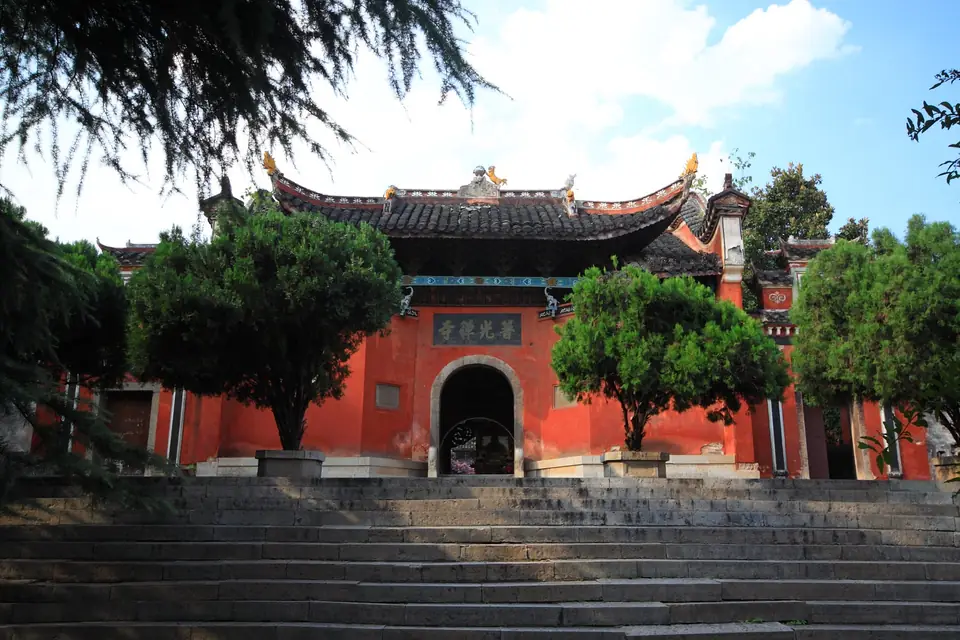
Behind a red gateway on Jiefang Street still stands, with monks and incense, the monastery that a Ming garrison commander founded in 1413. It is the last great ancient complex in the urban centre of Zhangjiajie, a survivor of the ceremonial heart of the old military town of Dayong.
- 45 min of audio
- Buddhist monastery since 1413
Puguang Temple is a Buddhist monastery of the Linji school of Chan, Nanyue branch, built in 1413, year 11 of the Yongle era, under the direction of Yong Jian, commander of the Yongding garrison. Facing south over more than 8,000 square metres, it opens its gate onto Jiefang Street and steps its halls northwards, from the Mahavira Hall to the Arhat Hall and the Jade Emperor Pavilion. The great restoration of 1733 fixed much of what is seen today, and in 2013 the complex was declared a national monument.
The route holds two very particular oddities. Between the Mahavira Hall and the second Buddha hall, one pond stays dry in every season while its twin never empties. Further up, the 16 wooden columns of the Arhat Hall are all leaning and the hall still stands, as a local saying boasts: “crooked columns, slanted beams, but the house does not lean”.
Highlights
- Great Gate — A red-lacquered gateway on Jiefang Street, with stone lions and the guardians Heng and Ha
- Mahavira Hall — Double eaves, openwork gilded dragons and a sign calligraphed by Zhao Puchu
- Water and fire ponds — Two twin basins: one dry in every season, the other never empty
- Arhat Hall — 16 leaning wooden columns and 18 arhats, each with a different gesture
- Jade Emperor Pavilion — Three storeys at the highest point of the temple, facing Tianmen Mountain
In the urban centre of Zhangjiajie, on Jiefang Street, a red gateway guards Puguang Temple, whose official name is Puguang Chansi (普光禅寺). Long before it was called what it is today, this city was a Ming-dynasty military town: the Dayong garrison, later renamed Yongding, was installed here behind a wall of a little over two li in perimeter. In 1413, year 11 of the Yongle era, the commander of that garrison, Yong Jian, directed the construction of the monastery. More than six centuries later it is still an active temple, with monks, incense and an axis of courtyards and halls that climbs the hill.
The history of Puguang Temple reads in layers: the military foundation of 1413; the Arhat Hall, raised in 1456 and rebuilt in 1776; the great restoration of 1733 by the officer Shi Cheng; the ordination assemblies that between 1919 and 1943 drew the faithful from four provinces; and the declaration as a national monument in 2013. The dating of its style remains open: some sources attribute Song and Yuan features to it, while the national declaration places it in the Ming-Qing period. Its architecture follows a south-facing axis that climbs from the street northwards, hall after hall, to the Jade Emperor Pavilion, the highest point of the complex, facing Tianmen Mountain. In the same compound live together the Linji school of Chan Buddhism, a hall dedicated to the bodhisattva Guanyin and a Taoist place of worship, the Gaozhen Guan. What to see at Puguang Temple is arranged in five stops, from the red gate to the top of the hill, and it makes full sense when walked with the audio guide.
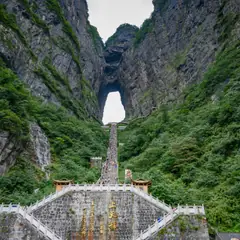
Its highest pavilion looks to Tianmen Mountain, which a cable car climbs from the centre, and some two and a half kilometres away, also in the urban centre, the Tujia Folk Custom Park gathers the memory of the Tujia minority.
A red gateway in the city of soldiers
Great Gate of Puguang Temple
Summary of this stop
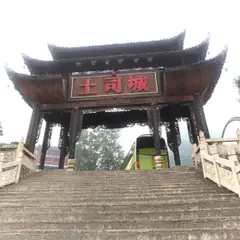
The Great Gate, or Da Shanmen, opens directly onto Jiefang Street: a red gateway with the four gilded characters “普光禅寺”, two thick wooden leaves lacquered red and a pair of stone lions, flanked by the guardian figures Heng and Ha. The location is no accident. The temple was raised on the north side of the eastern stretch of today’s Jiefang Street, inside the city that the Ming dynasty had turned into a garrison: first Dayong, then Yongding, enclosed in a wall of a little over two li.
That the founder was a soldier says a lot about the place. Yong Jian, commander of the Yongding garrison, directed the work in 1413, in the time of the Yongle emperor, and the monastery was built into a much larger ceremonial core: a Confucian temple, a military temple or Wumiao, a City God temple and the Songliang academy. Of all that only Puguang, the Wumiao and the Wenchang shrine survive; the rest disappeared through war, fire or destruction.
East of the gate, the stone Jiexiao memorial arch and the Wenchang shrine are the visible remains of that old quarter. What is missing weighs as much as what remains, and what that ceremonial heart of the military city was like is reconstructed by the narration, in front of the gate.
Golden dragons and a courtyard of shining hairpins
Mahavira Hall
Summary of this stop
Past the entrance, the halls climb in steps northwards, as befits a south-facing monastery of the Linji school of Chan Buddhism, Nanyue branch. The first great stop is the Mahavira Hall, or Daxiong Baodian, the largest in the temple: five bays across the front, double eaves and a hip-and-gable roof, on an earthen platform. In front of it, two columns carry coiled gilded dragons carved in openwork, and under the eaves hangs the sign with the characters “Mahavira Hall”, calligraphed by Zhao Puchu, a former leader of the Buddhist Association of China.
This courtyard was the scene of crowds. Between 1919 and 1943 the temple hosted the Longhua assemblies, attended by almost a thousand Buddhists from Hunan, Hubei, Sichuan and Guizhou to receive ordination, and hence its fame as a “famous temple south of the Yangtze”. The figures vary by source: a tourist source speaks of six assemblies and thousands of worshippers, while the most recent chronicle stays at almost a thousand.
Long before, the city already filled the temple in spring. According to a documented tradition, the Huazhao festival, the “birthday of the flowers”, drew crowds of women in their finery who came to pray before the Buddha. Some popular verses from Yongding, in the zhuzhici genre or “bamboo branch songs”, paint the old temple of white clouds open beside the mountain, the great Yongle stele covered in green moss and, each year at Huazhao, the glitter of hairpins and coiffed temples arriving like clouds. How the city lived that courtyard in festival is brought back by the narration, before the hall.
Two twin ponds and a hall rebuilt ten times
Water and fire ponds
Summary of this stop
Behind the Mahavira Hall, a corridor in the shape of the character “工” joins it to the second Buddha hall. Beside that corridor appear two basins: the “fire pond”, dry in every season, and the “water pond”, which never empties. Two twin ponds that behave in opposite ways, and the fact stands on its own, with no need for added symbolism.
The main hall that rises beside them has passed through many hands. It has been rebuilt more than ten times, and its last significant maintenance dates from 1989. The great intervention came in 1733, year 11 of the Yongzheng era, when the officer Shi Cheng, with the rank of xiezhen, restored the temple; most of what is seen today belongs to that Ming-Qing work.
Between two ponds that do not change with the seasons and a hall rebuilt again and again, this corridor condenses the material history of Puguang Temple. What belongs to each period is unpicked in the narration, beside the ponds.
Crooked columns, straight house
Arhat Hall
Summary of this stop
The Arhat Hall is the one that puzzles most. It was raised in 1456, year 7 of the Jingtai era, and rebuilt in 1776, year 41 of the Qianlong era. Its 16 great wooden columns are all leaning, plain for anyone to see, and yet the hall is still standing.
From that paradox came a local saying that sums up the city’s pride in its temple: “crooked columns, slanted beams, but the house does not lean”. Among those columns wait 18 arhats, each with a different gesture, so that the hall is looked at twice: once towards the figures and once towards the structure that shelters them.
The feeling of imbalance on crossing the threshold is part of the visit. What that saying tells of the city and its monastery is revealed by listening to the narration inside the hall.
A white goat, gold and 108 lost stars
Jade Emperor Pavilion
Summary of this stop
The axis ends at the top. East of the Guanyin hall and above the Gaozhen Guan, the Taoist building in the compound, rises the Jade Emperor Pavilion, or Yuhuang Ge: three storeys with railings, brackets and a gabled roof, the highest point of the temple, facing Tianmen Mountain. The pavilion housed 108 images of the Tiangang and Disha stars, now destroyed; on its third floor the Jade Emperor and his two attendants still receive incense.
From here the other name of the place makes sense. Legend says that when the temple was about to be built, the hillside was covered in white goats. The commander Yong Jian went after one of them, the animal sank into the earth and vanished, and digging at that spot turned up stones and, beneath them, a deposit of gold. With that gold the work would have been paid for, and the court, informed on its completion, granted it the name “Puguang”, “light that reaches everywhere”. The hill is called Baiyang, “white goat”, and the monastery is also known as the old White Goat Temple.
Recent history is less legendary. In 1983 the complex entered the fifth batch of protected properties of Hunan province, and on 5 March 2013 it was declared a national monument, in the seventh batch, as the “ancient architecture complex of Puguang Monastery”. In 2018 it was still undergoing restoration work, led by the masters Shi Yifei and Shi Xinyi, without ceasing to be an active monastery. How a white goat fits with six centuries of monks and incense is told in the narration, at the top of the hill.