Coast of the sunrise
Sanur Beach and Le Mayeur Museum Audio Guide (Pantai Sanur, Museum Le Mayeur)
A Belgian painter who came to Bali for eight months and stayed for ever, a legong dancer who ended up giving her house to the State and a ten-storey hotel that persuaded a whole island never to grow taller than a coconut palm. It all fits in a stroll along sand facing the sunrise.
- 60 min of audio
- House-museum by the sea
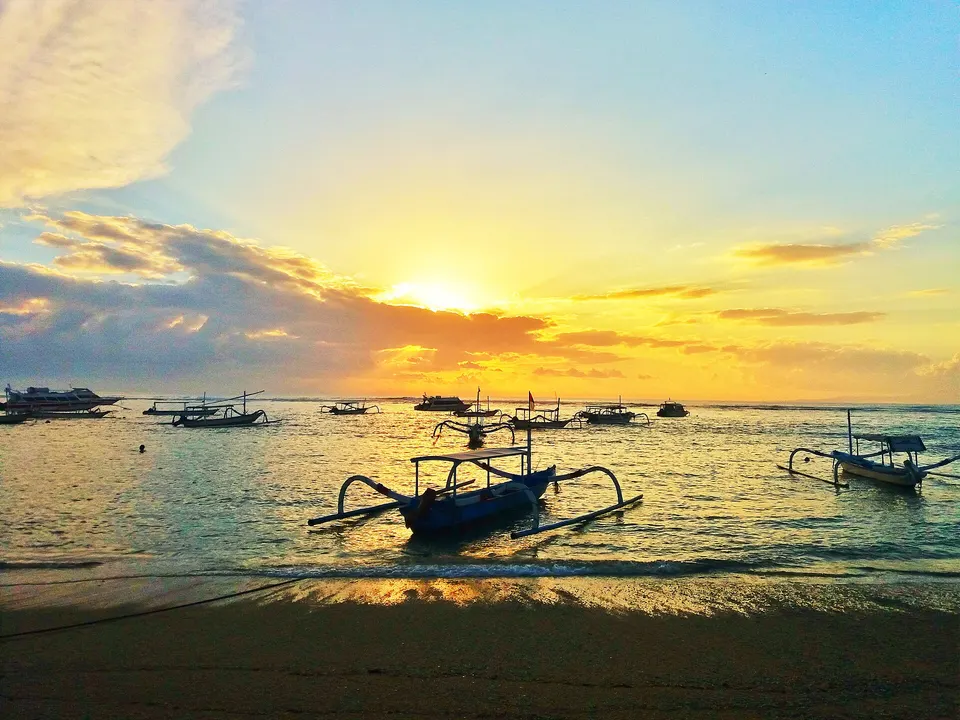
Sanur is Bali's sunrise beach: it faces east and a reef off the shore keeps the water of its lagoon calm, with jukung boats drawn up on the sand and Nusa Penida on the horizon. Here the painter Adrien-Jean Le Mayeur built his house after a successful exhibition in Singapore in 1933, and here in 1966 the Bali Beach Hotel opened, the island's first internationally managed five-star hotel.
The same quiet sand holds a less peaceful memory: in 1906 the northern part of the beach was the landing point of the Dutch invasion troops. Six decades later, a ten-storey hotel paid for with Japanese war reparations preceded the 1971 rule that banned new hotels taller than 15 metres in Bali, roughly the height of a mature coconut palm.
Highlights
- Sunrise lagoon — An east-facing beach, with the reef that calms the water and Nusa Penida on the horizon
- Jukung boats — Outrigger fishing boats, painted in bright colours, drawn up on the sand
- Le Mayeur Museum — The home of the painter and Ni Pollok, with some 88 paintings and carved shutters telling the story of Rama and Sita
- Painting on mats — Wartime pictures painted on woven grass mats, when no canvas was to be had
- Bali Beach Hotel — Ten storeys and 566 rooms opened in 1966, the origin of the coconut palm rule
On the east coast of Denpasar, Sanur Beach (Pantai Sanur) stretches before a sea where the sun rises every morning. A reef close to the shore slows the swell and leaves inside a lagoon of still water, through which the jukung boats set out with Nusa Penida in the background. It is Bali’s first tourist coast, and its history is told through three proper names: a Belgian painter, a Balinese dancer and a hotel that changed the building rules of the whole island.
The history of Sanur Beach and the Le Mayeur Museum begins in 1932, when Adrien-Jean Le Mayeur de Merprès, born in Ixelles (Brussels) in 1880, arrived in Bali by way of Singaraja with the idea of staying eight months. He never left. He met Ni Nyoman Pollok, a 15-year-old legong dancer, who became his model and, from 1935, his wife. After a successful exhibition in Singapore in 1933, the painter built his house on the sand of Sanur; today it is a museum and holds around 88 paintings, the tomb of Ni Pollok and an architecture of red terrazzo floors, carved stone walls and shutters carved with the story of Rama and Sita.
South of the museum, the Bali Beach Hotel of 1966, with its ten storeys, remains the tallest building on the coast. What to see at Sanur Beach and the Le Mayeur Museum is arranged in three stops along the seafront promenade, from the lagoon’s boats to the painter’s house and the hotel of the coconut palm rule, and the walk gains its full meaning heard right there with the audio guide.
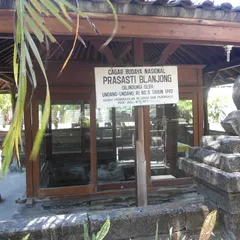
On the same Sanur coast stands Pura Blanjong, with the oldest pillar in Bali. The Bajra Sandhi Monument lies some 3.3 kilometres away in a straight line, and Pasar Badung, some 6.1.
The sunrise lagoon: quiet sand, memory of a landing
Sanur Beach
Summary of this stop
The first stop is on the sand, north of the museum, among the jukung: outrigger fishing boats, painted in bright colours, resting drawn up on the beach and heading out to a gentle lagoon thanks to a reef that cuts the waves offshore. Sanur faces east, and that is why it is Bali’s sunrise beach; Nusa Penida stands out on the horizon.
That calm hides layers. In 2008 a 5.1-kilometre stretch of shoreline was restored, from Matahari Terbit beach to Mertasari beach. And long before, in 1906, the northern part of this same beach was where the Dutch invasion troops landed. The contrast between that date and the postcard of boats and sunrise is what the narration unfolds with feet in the sand.
The painter and the dancer: a house given to the State
Le Mayeur Museum
Summary of this stop
At the entrance of the Le Mayeur Museum, two stone busts beside the beach path greet the visitor: they are Le Mayeur and Ni Pollok. Behind them opens the Balinese-style house that the painter built after his Singapore exhibition, with red terrazzo floors, carved stone walls and carved shutters that tell the story of Rama and Sita. The collection gathers around 88 paintings, among them 28 oils on canvas and 25 oils on panel, and the tomb of Ni Pollok lies in the grounds.
Among the pictures is one that sums up its author’s character. According to a documented tradition, when in the war years no canvas could be found, Le Mayeur went on painting on woven grass mats; “The Garuda Dance”, of 1942, watercolour and paint on mat, is kept in the museum.
The end of the story is as singular as the beginning. On 28 August 1957 the painter ceded all his property by deed to Ni Pollok, and she passed it to the Indonesian State; that is the date given as the founding of the museum. Le Mayeur died in Belgium on 31 May 1958, aged 78. Ni Pollok went on living in the house until her death, on 18 July 1985, aged 68.
No taller than a coconut palm: the hotel that set Bali’s rule
Bali Beach Hotel
Summary of this stop
South of the museum, from the seafront promenade, the Bali Beach Hotel appears: ten storeys and 566 rooms that remain the tallest building on the coast. Its construction began in 1963, under President Sukarno and with Japanese war reparations funds, and it opened in 1966 as Bali’s first five-star, internationally managed hotel.
That block on the beach had a consequence felt across the island. In 1971 the governor of Bali banned new hotels from exceeding 15 metres in height, roughly what a mature coconut palm measures, and Bali chose to stay low and green. A few steps away, the house of Le Mayeur, who lived in Sanur until 1958, recalls the coast from before the tower.