Bali's oldest inscription
Pura Blanjong Audio Guide (Prasasti Blanjong)
Behind the wall of a neighbourhood temple in southern Sanur is kept the oldest dated object in Bali: a stone pillar of the year 914 on which a king wrote down his own name.
- 25 min of audio
- Inscription of the year 914
Pura Blanjong is a village temple in Banjar Blanjong, Sanur Kauh, and its reason for being is the Blanjong pillar. The inscription is dated to the year 835 of the Saka era, which the scholar Louis-Charles Damais matched with 4 February 914, and it was commissioned by King Sri Kesari Warmadewa, considered the first ruler of the Warmadewa dynasty. It is the first known Balinese inscription in which a king records his name.
The pillar was discovered in 1932, the same year the Belgian painter Le Mayeur arrived in Bali, and it was W.F. Stutterheim who studied and published its text. It still stands in the same place, inside a protective enclosure, and on its surface two scripts and two languages coexist, Sanskrit and Old Balinese, to tell of victories at Gurun and Suwal that no one has managed to place with certainty on the map.
Highlights
- Blanjong pillar — Andesite 177 cm tall and 62 cm in diameter, dated 4 February 914
- Sri Kesari Warmadewa — The first king of Bali to leave his own name in writing
- Two scripts and two languages — Sanskrit and Old Balinese, with a Nagari-type script from India and the local kawi script
- Gurun and Suwal — The king's victories over places whose location is still debated
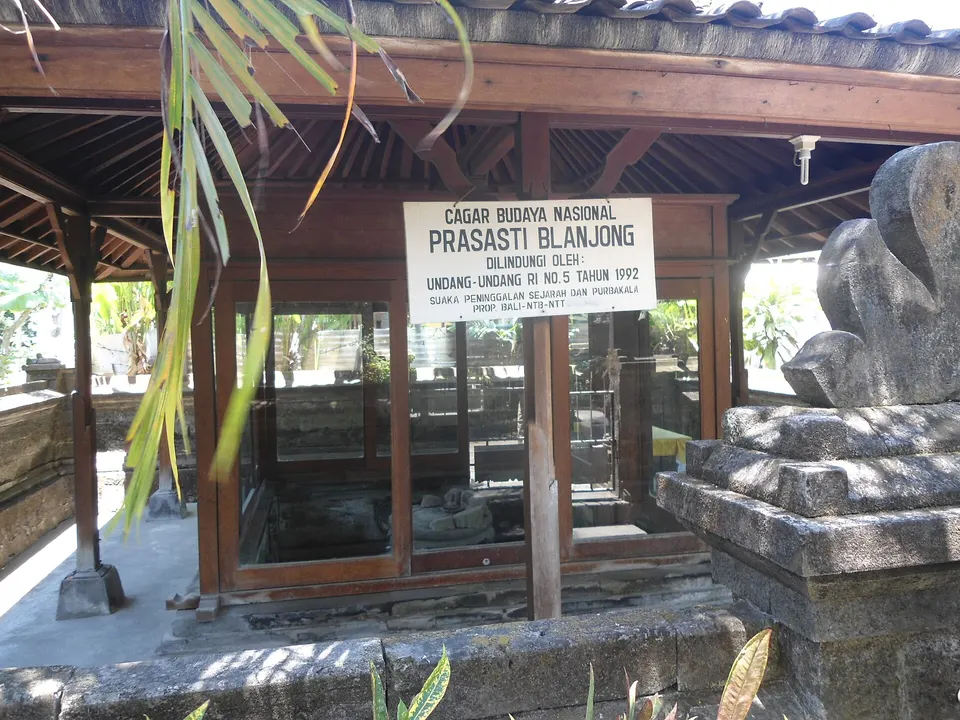
- Protective pavilion — A tiled roof and glass case over the pillar, with a national heritage sign
In southern Sanur, in Denpasar, an unpretentious village temple guards one of the key pieces of Bali’s history. Pura Blanjong keeps the Blanjong pillar (Prasasti Blanjong), described as the oldest dated object made by human hand on the island. Its inscription bears the Saka date 835, which the scholar Louis-Charles Damais placed at 4 February 914, and it is signed by King Sri Kesari Warmadewa, regarded as the first ruler of the Warmadewa dynasty. It is the first known Balinese inscription in which a king writes his own name: the moment when the island’s history begins to have protagonists with names.
Anyone looking for what to see at Pura Blanjong finds a short, dense route: the temple gate in a neighbourhood alley, the pavilion that protects the pillar and the lines of writing in two languages that are still debated. The history of Pura Blanjong fits in a 177-centimetre andesite stone, and the audio guide goes through it stop by stop, in front of the pillar itself.
It lies on the same Sanur coast as Sanur Beach and the Le Mayeur Museum. The island’s oldest dated inscription relates to the origins of Bali gathered in the archaeological collections of the Bali Museum.
An alley in Banjar Blanjong
Temple gate
Summary of this stop
The walk begins on Jalan Belanjong, before a small gate with guardian statues that leads into the temple courtyard. Nothing in the street announces that, on the other side of the wall, in Banjar Blanjong, Sanur Kauh, the oldest dated object in Bali is preserved. The pillar remains in situ, in the same neighbourhood temple, inside a protective enclosure.
As in any Balinese temple, the visit calls for a sarong and a sash tied at the waist, and the shrines are not climbed. That entrance ritual marks the passage from an everyday alley to a space where the neighbourhood’s religious life goes on, with shrines and offerings around the pavilion. The narration, heard right there, explains why an eleven-century-old document ended up kept in so discreet a place.
The king who wrote his name
The pillar
Summary of this stop
In the centre of the courtyard, under an open pavilion with a tiled roof and a national heritage sign, stands the pillar: a round andesite column 177 centimetres tall and 62 in diameter, covered with inscriptions and protected by a glass case. The engraved date, Saka 835, corresponds according to Louis-Charles Damais to 4 February 914.
The author is Sri Kesari Warmadewa, considered the first king of the Warmadewa dynasty, and what makes the stone a landmark is that it is the first known Balinese inscription in which a king records his own name. The pillar came to light in 1932, the same year the Belgian painter Le Mayeur arrived in Bali, and it was W.F. Stutterheim who studied and published its text. More than a thousand years separate the carving from the discovery, and this stop joins the two moments.
Two languages and a victory without a map
Reading the stone
Summary of this stop
Beside the case, the lines of writing reveal the architecture of Pura Blanjong in its most literal sense: a text built from two scripts and two languages. One part is in Sanskrit and another in Old Balinese, with a Nagari-type script from India and the kawi script native to the island. Which script corresponds to which language is a matter on which sources disagree.
The text tells that the king, from the palace of Sanghadwala, defeated his enemies at Gurun and Suwal. Where those places were remains debated: Gurun could be Nusa Penida, across the strait, although some place them on islands further east, such as Lombok. The victories are certain; their map is not. For the historian George Coedès, the Balinese inscriptions of this period show an Indo-Balinese society independent of Java. What came before, the island’s past without writing, is kept in the Bali Museum, in Denpasar, with Bronze Age objects such as a ceremonial drum. The audio guide closes the walk before the stone, with that thousand-year-old boast about a war that no one knows where to place.