Bali's state temple
Pura Jagatnatha Audio Guide (Pura Agung Jagatnatha)
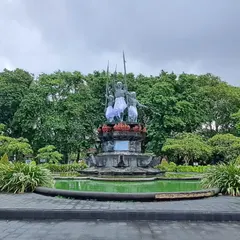
An empty white coral throne for a formless God, raised on a turtle able to make the world tremble: such is Bali's state temple, the one that belongs to no village or family, but to everyone.
- 30 min of audio
- Balinese Hindu temple
Pura Agung Jagatnatha stands beside Puputan Square, in the very centre of Denpasar. The Parisada, the council of Balinese Hindu religion, proposed building it on 20 November 1961; Governor Anak Agung Bagus Sutedja approved it on 5 February 1963, and the works, interrupted by the political upheaval that followed 30 September 1965, culminated in its consecration on 13 May 1968.
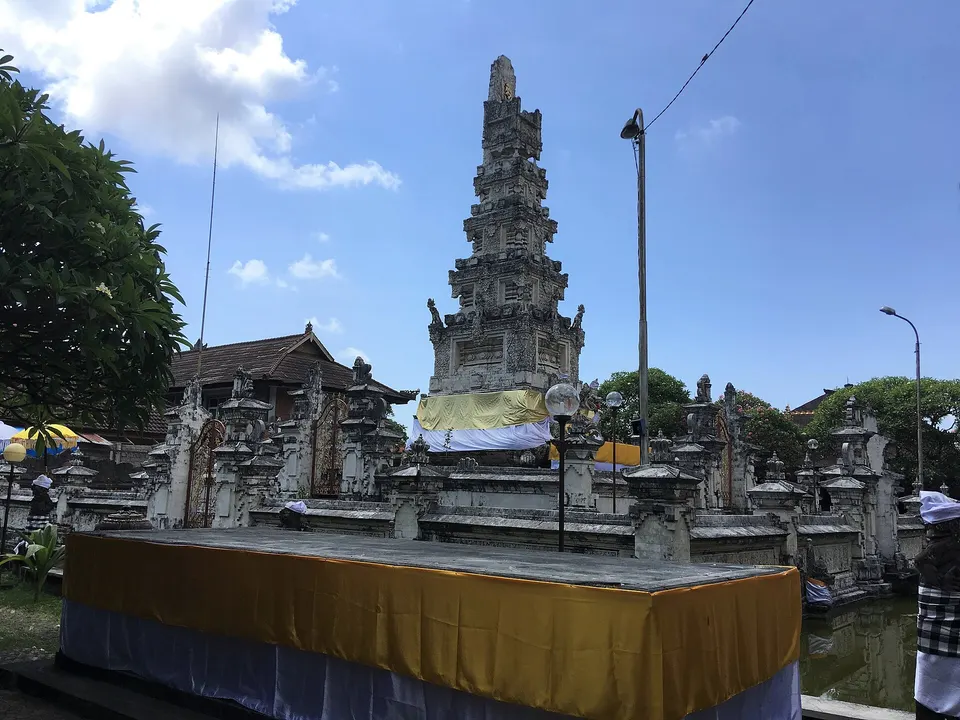
It is a Kahyangan Jagat, a public temple dedicated to Ida Sang Hyang Widhi Wasa, the supreme God, with no tie to any village, clan or family. In its inner courtyard, a white coral padmasana some 15 metres tall displays the carved face and hands of Bhoma and rests on the turtle Bedawang Nala and two serpents.
Highlights
- Padmasana — a white coral lotus throne some 15 metres tall
- Bedawang Nala — the cosmic turtle and the serpents Anantaboga and Basuki
- A temple for all — consecrated in 1968 to the supreme God Sang Hyang Widhi Wasa
- Galungan — around 5,000 worshippers in a single festival
- Canang sari — daily offerings of flowers, rice and incense
On an island where almost every village, every clan and every family has its own shrine, Pura Agung Jagatnatha was born with a different idea: a temple for everyone. Around 86-87% of Bali’s population is Hindu, and this compound beside Puputan Square in Denpasar is dedicated to what that faith shares above all: Sang Hyang Widhi Wasa, the supreme and formless God, also called Acintya.
The history of Pura Jagatnatha is that of a young republic looking for its own temple. The project was proposed in 1961, approved in 1963, interrupted by the political upheaval that followed 30 September 1965 and consecrated on 13 May 1968. What to see at Pura Jagatnatha comes down to three scenes: a split gate that marks the threshold, a courtyard where offerings sustain the world’s balance and a white coral tower that keeps an empty seat. The full experience unfolds by walking it with the audio guide, stop by stop.
The state temple stands on the east side of Puputan Square, neighbour of the Bali Museum on the same front of the square. Some 730 metres in a straight line away lies Pasar Badung.
A temple that belongs to everyone, born between 1961 and 1968
Temple gate
Summary of this stop
The visit starts before the candi bentar, the split gate flanked by guardian statues that marks the entrance to the temple. What lies on the other side is unusual in Bali: a Kahyangan Jagat, a public temple consecrated to Ida Sang Hyang Widhi Wasa that belongs to no particular village, clan or family.
Its origin is recent and well documented. On 20 November 1961, the Parisada, the council of Balinese Hindu religion, proposed building a great temple in Denpasar; on 5 February 1963, Governor Anak Agung Bagus Sutedja gave his approval. The works stopped with the political turmoil that followed 30 September 1965 and were then resumed, until the consecration of 13 May 1968.
That chronology holds a deeper story about what it meant to build a common temple in those years, and it is right there, before the gate, that the narration reveals it.
Offerings and the three harmonies of the outer courtyard
Outer courtyard
Summary of this stop
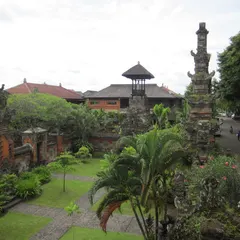
In the outer courtyard, beside the kulkul pavilion, the drum tower, the temple shows its daily life. A sarong (kain) and a sash (selendang) tied at the waist are required to enter, and inside up to 500 worshippers fit in a single prayer session, guided by some 20 pemangku priests. At Galungan around 5,000 people attend.
On steps and shrines appear the canang sari, small trays of palm leaf with flowers, rice and incense. A woman of the household usually prepares and presents them, normally each morning and each afternoon, in a minimal gesture that connects with a greater idea: Tri Hita Karana, “the three causes of well-being”, harmony with the divine, among people and with nature.
What looks like a simple floral decoration works as the everyday machinery of those three harmonies, and the audio guide explains in the courtyard itself why.
The lotus throne on the cosmic turtle
Padmasana
Summary of this stop
In the inner courtyard rises the central piece of Pura Jagatnatha’s architecture: a padmasana some 15 metres tall, raised in white coral and carved with the face and hands of Bhoma. A padmasana, or “lotus throne”, is a shrine tower crowned by an empty seat for Sang Hyang Widhi Wasa, often with a gilded figure of Acintya, the formless God. This type of shrine reached Bali in the 16th century with the Javanese priest Dang Hyang Nirartha.
At the base appear the turtle Bedawang Nala and the serpents Anantaboga and Basuki, who keep the world stable. Balinese cosmology holds in legend that the turtle carries the earth on its shell, held by the serpents, and that when it stirs, the earth trembles.
The whole white tower therefore rests on a turtle that might shrug. What that empty throne says about the Balinese way of understanding God is discovered by listening to the narration at its feet.