Memory of independence
Bajra Sandhi Monument Audio Guide (Monumen Perjuangan Rakyat Bali Bajra Sandhi)
A priest's bell turned to stone, 45 metres tall, in the middle of the great Renon lawn. Its gates, pillars and height spell out a date, and inside, 33 dioramas tell how Bali chose to die rather than surrender.
- 60 min of audio
- Independence monument
The Monument to the Struggle of the Balinese People began as an idea of Governor Ida Bagus Mantra around 1980. A year later the architect Ida Bagus Gede Yadnya won the design competition; work began in 1987, was interrupted before completion, and the monument was not inaugurated until 14 June 2003 by President Megawati Sukarnoputri. It stands on 13.8 hectares, with 4,900 square metres of built area, on the lawn that opens in front of the Bali government headquarters.
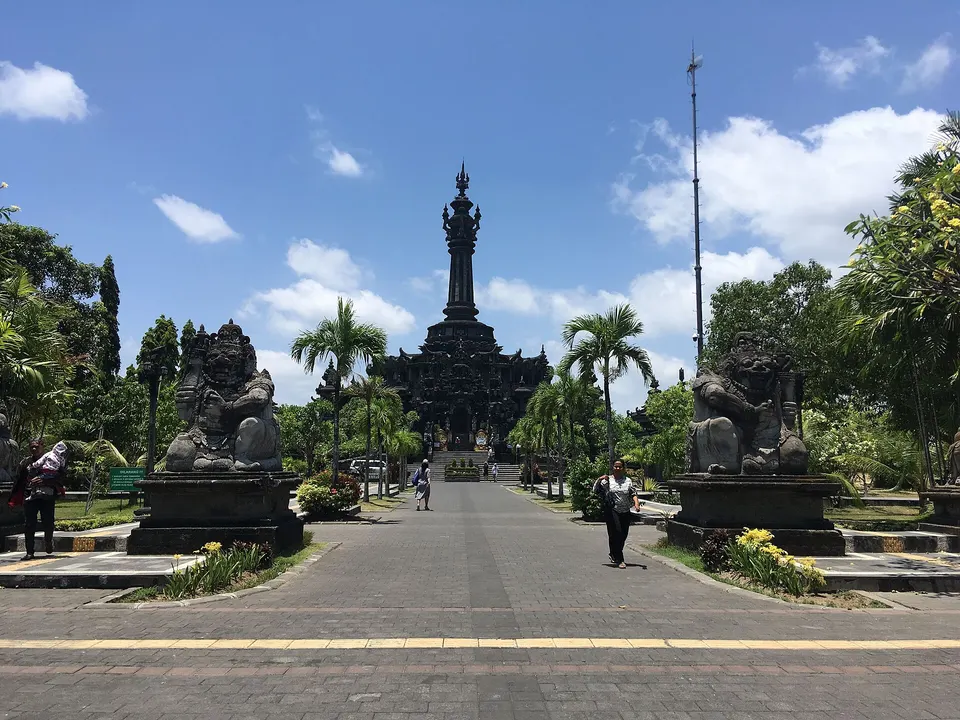
The whole building is a date. The 17 entrance gates, the 8 main pillars and the 45 metres of height make up 17-8-45, the 17th of August 1945 on which Indonesia proclaimed its independence. And the silhouette is no whim: it reproduces the bajra, the bell that the Balinese Hindu high priest rings while reciting his mantras, surrounded by a pond that evokes Ksirarnawa, the sea of milk of Hindu myth.
Highlights
- Bell-shaped tower — 45 metres of stone in the silhouette of a high priest's bajra
- Gates and pillars — 17 gates and 8 pillars that spell out 17 August 1945
- Pond at the base — Water evoking Ksirarnawa, the sea of milk of Hindu myth
- Diorama floor — 33 scenes of the Balinese struggle, from prehistory to independence
- Summit viewpoint — A spiral staircase up to an open view over Denpasar
In the Renon district, opposite the Bali government headquarters, the lawn that maps call Lapangan Puputan Margarana has at its centre a stone tower shaped like a bell. It is the Bajra Sandhi Monument, officially Monumen Perjuangan Rakyat Bali Bajra Sandhi, the monument to the struggle of the Balinese people. It stands 45 metres tall, occupies a 13.8-hectare site with 4,900 square metres of built area, and holds inside 33 dioramas that narrate the island’s history from prehistory to independence.
The history of the Bajra Sandhi Monument is that of a long undertaking. The idea came from Governor Ida Bagus Mantra around 1980; in 1981 the architect Ida Bagus Gede Yadnya won the design competition; construction began in 1987 and was interrupted before it was finished. President Megawati Sukarnoputri inaugurated it on 14 June 2003. Some Indonesian sources give 14 June 2013 as the date, but Megawati was president only between 2001 and 2004, which is why 2003 is taken as the reference date.
The architecture of the Bajra Sandhi Monument works like a code: gates, pillars and height spell out the day Indonesia was born, and the shape of a priest’s bell turns the whole into an offering. What to see at the Bajra Sandhi Monument is arranged in three stops, from the arrival lawn to the dioramas and the platform at the top, and the meaning of each is completed by walking it with the audio guide.
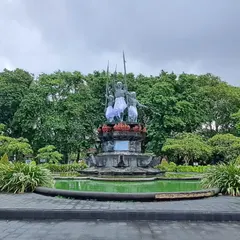
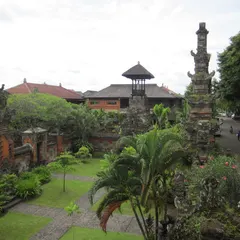
Together with Puputan Square, the place of the puputan, it forms a pair of monuments to Balinese resistance: this one is the museum of the struggle. The Bali Museum lies some 2.3 kilometres away in a straight line, and Sanur Beach and the Le Mayeur Museum, some 3.3.
A building that is a date
Arrival across the lawn
Summary of this stop
The approach is on foot across the lawn, from the south, towards the main gate. From there the tower shows what it is: a bajra, the bell that the Balinese Hindu high priest shakes while reciting his mantras, with a shaft rising from a wide base. Around it, a pond surrounds the base; the water is compared to Ksirarnawa, the sea of milk of Hindu mythology.
The site also encloses a number. The 17 entrance gates, the 8 main pillars and the 45 metres of height form 17-8-45, 17 August 1945, the date of Indonesia’s proclamation of independence. The design came from the competition won in 1981 by Ida Bagus Gede Yadnya, on an idea of Governor Ida Bagus Mantra, and took more than two decades to be seen finished: work began in 1987, stopped, and the inauguration came in 2003.
A religious bell for a monument to a struggle, and a date written in stone and water. How that double message reads from the lawn is revealed by listening to the narration right there.
Thirty-three windows onto the end
The dioramas
Summary of this stop
Inside the tower, on the upper floor, 33 paintings and dioramas run in chronological order through the history of the Balinese people’s struggle, from prehistory to independence. Among them are the puputan of Badung and of Klungkung. The word comes from Balinese puput, “to end”, and denotes a last desperate attack or a collective ritual death rather than surrender. In Denpasar, on 20 September 1906, the raja’s procession, dressed in white, fell under Dutch fire.
Two years later, on 18 April 1908, Dewa Agung Jambe, raja of Klungkung, led a final sortie against the Dutch with some 200 followers. When he fell, his six wives took their own lives with their krisses and the rest of the retinue followed them. The third ending came at Margarana, in Tabanan, on 20 November 1946: the independence fighter I Gusti Ngurah Rai led the last puputan against the Dutch troops who had returned, and died fighting beside his men. Today Bali’s international airport bears his name.
A documented tradition preserves his reply when the Dutch officer ter Meulen proposed negotiating: a letter in which Ngurah Rai refused any compromise and demanded, in the name of the people, that the Dutch leave Bali. Three puputan in forty years, and a letter of refusal that ended up as the script of the last.
What the ending was for
Viewpoint
Summary of this stop
A spiral staircase climbs to the platform at the top, from which the view opens over Denpasar. Below lies the Renon lawn in front of the Bali government headquarters, the same space that maps record as Lapangan Puputan Margarana, and the 13.8-hectare site in which the monument occupies 4,900 square metres of built area.
From above, Denpasar’s place in this history becomes clear: the city of the 1906 puputan became in 1958 the seat of the government of the province of Bali, and the administrative district around the monument is the visible form of that capital. After the dioramas, the everyday scene on the lawn answers what the rooms below tell, and that answer is completed by listening to the narration at the top of the tower.