Memory of the 1906 puputan
Puputan Square Audio Guide (Lapangan Puputan Badung I Gusti Ngurah Made Agung)
Denpasar's central park occupies the ground where, on 20 September 1906, the raja of Badung and his court walked out dressed in white to meet the Dutch army and chose death over surrender.
- 35 min of audio
- Colonial history and memory
Puputan Square is the green heart of Bali's capital and the point from which the city is measured: on its northwest corner, the statue of Catur Muka marks Denpasar's kilometre zero. To the north rises the monument to the puputan of Badung, with three figures dressed in white; to the east, the red brick walls of the Bali Museum and the white tower of Pura Jagatnatha. Since 2009 the field has officially borne the name of the king who died here, I Gusti Ngurah Made Agung.
The contrast is brutal. Today it is a quiet lawn surrounded by mature trees, benches and paths, but in 1906 it was the stage of the puputan, the ritual ending in which an entire court, in cremation clothes and keris in hand, advanced against the Dutch rifles. At least a thousand Balinese died and the royal palace burned; on its site now stands Jaya Sabha, the residence of the governor of Bali.
Highlights
- Catur Muka statue — A nine-metre granite four-faced Brahma, made by I Gusti Nyoman Lempad in 1973
- Denpasar's kilometre zero — The orientation point where Gajah Mada, Veteran, Surapati and Udayana streets meet
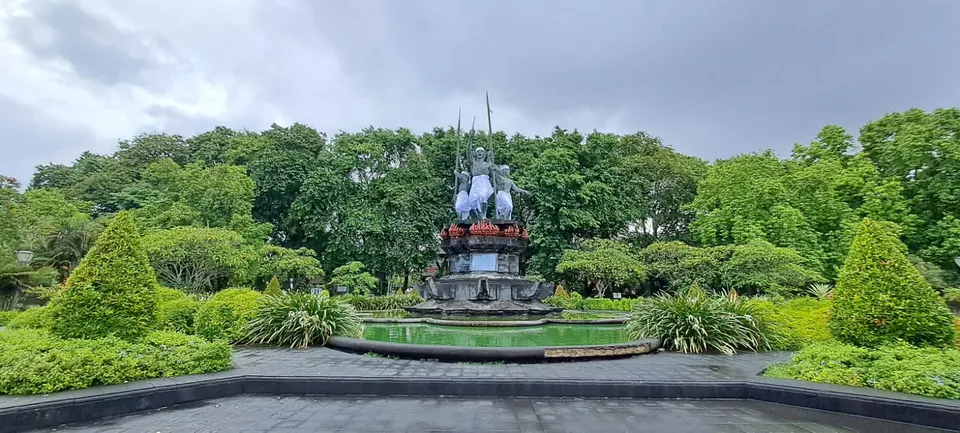
- Monument to the puputan of Badung — A man, a woman and a child in white, with keris and spear
- Jaya Sabha — The governor's residence, on the site of the royal palace destroyed in 1906
- The poet king — I Gusti Ngurah Made Agung, author of six literary works and National Hero of Indonesia since 2015
Puputan Square (Lapangan Puputan Badung I Gusti Ngurah Made Agung) is the central park of Denpasar, the capital of Bali: a large lawn surrounded by trees, benches and paths in the very centre of the city. Its name holds the key to its history. On 20 September 1906, when the Sixth Dutch Military Expedition reached Denpasar, the raja of Badung, I Gusti Ngurah Made Agung, came out of his palace in procession, dressed in white, together with his whole court. At a sign from him, a priest wounded him with a keris and the court followed him in a puputan. At least a thousand Balinese died.
The history of Puputan Square begins two years earlier and at sea. On 27 May 1904, the Chinese schooner Sri Kumala was wrecked on the reef near Sanur and looted. The Dutch demanded compensation of 3,000 silver dollars and the raja refused to pay. That was the pretext: on 14 September 1906 the expedition landed at the northern end of Sanur beach and marched inland almost without resistance. Six days later, the kingdom of Badung ended on this field.
To know what to see at Puputan Square, the audio guide covers the park in three stops and 35 minutes, from the Catur Muka statue at kilometre zero to the puputan monument and the centre of the lawn, with the Bali Museum and Pura Jagatnatha to the east. The thread that joins them is the very meaning of the word: the end of a kingdom, the memory built afterwards and the birth of modern Denpasar.
The Bali Museum occupies the site of the palace razed in the puputan of 1906, and Pura Jagatnatha stands on the east side of the square. The Bajra Sandhi Monument completes the memory of Balinese resistance: if the square is the place of the puputan, that one is the museum of the struggle.
Four faces at kilometre zero
Catur Muka
Summary of this stop
On the roundabout at the park’s northwest corner, among fountains, rises the Catur Muka statue: a four-faced Brahma in granite, nine metres tall, raised in 1973 by the Ubud artist I Gusti Nyoman Lempad. Each face looks to a cardinal point and has its own name and virtue: Sanghyang Iswara to the east, wisdom; Mahadewa to the west, compassion; Wisnu to the north, strength; and Brahma to the south, tranquillity.
The statue is not merely a city ornament. It marks Denpasar’s kilometre zero and serves as the city’s orientation point, right where Gajah Mada, Veteran, Surapati and Udayana streets meet. Bali’s capital, in other words, is measured from a four-faced god.
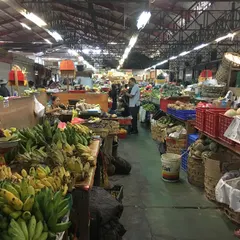
Even the city’s name has its explanation here. Denpasar comes from Balinese den, north, and pasar, market: the town grew as a market village on the spot now occupied by the Kumbasari market. Behind the calm of this park, however, lies a far harsher history, and it is beside the roundabout that the narration begins to tell it.
The procession in white
Puputan monument
Summary of this stop
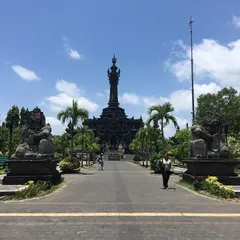
On the north side of the square, on a pedestal, rises the monument to the puputan of Badung: three statues of a man, a woman and a child dressed in white, wielding a keris and a spear. The ensemble was revitalised and reopened renewed in 2025. The figures recall the morning of 1906 when the raja and his court left the palace to meet the Dutch rifles.
The puputan, from puput, “to end”, was according to documented tradition a last ritual resistance: the court dressed in the white clothes of cremation, carried the keris and preferred death to the humiliation of surrender. For a long time Dutch accounts presented it as a fanatical collective suicide, while Balinese and Indonesian memory recalls it as heroic resistance; the decree that in 2015 named the raja a national hero fixed Indonesia’s official reading.
To the north of the square, Jaya Sabha, the official residence of the governor of Bali, occupies the site of the old Puri Agung Denpasar, the royal palace that the Dutch destroyed in 1906. On that ground they later installed their administrative centre for south Bali. Opposite the monument, the audio guide reconstructs the procession step by step.
A poet king and a living field
The lawn
Summary of this stop
In the centre of the lawn, surrounded by mature trees, the square stops being a battlefield and becomes the living heart of the capital. The man who died here was 30 years old. I Gusti Ngurah Made Agung was born on 5 April 1876, was crowned king of Badung in 1902 and on 5 November 2015 was declared a National Hero of Indonesia by Presidential Decree 116/TK/2015.
He was also a man of letters. He wrote six literary works in Balinese, among them the Geguritan Dharma Sasana, and the popular song Ratu Anom is attributed to him. Since a municipal decree of 10 September 2009, the field has officially borne his name: Lapangan Puputan Badung I Gusti Ngurah Made Agung.
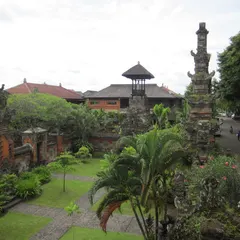
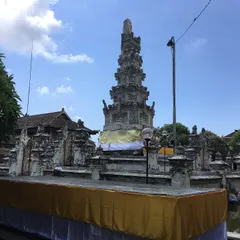
To the east can be seen the red brick walls of the Bali Museum and the white padmasana tower of Pura Jagatnatha, beside it. The museum was built near the site of the royal palace burned in 1906, so the memory of the lost kingdom still surrounds the park. In the middle of the lawn, the narration closes the circle between the poet king and the city that grew over his ending.