Bali's oldest museum
Bali Museum Audio Guide (Museum Bali)
Four years after Denpasar's royal palace burned in 1906, Balinese builders and princes raised beside it a house for their own culture. The Bali Museum looks at once like a palace and a temple: split gates, a drum tower and pavilions that speak with the accent of each region of the island.
- 75 min of audio
- Palace and temple architecture
The Bali Museum is the oldest on the island. It was promoted in 1910 by W.F.J. Kroon, Dutch assistant resident for south Bali, and that same year its first building, the Gedung Arca, was finished, paid for by the Balinese royalty of Tabanan, Buleleng and Karangasem. It was built by the Balinese master builders (undagi) I Gusti Gede Ketut Kandel and I Gusti Ketut Rai together with the German architect Curt Grundler, and opened to the public on 8 December 1932.
The compound stands beside the site of the old royal palace of Denpasar, burned during the Dutch intervention of 1906, and that palace served as the model for its outer walls and courtyards. Of the original palace, architectural sketches remain in the museum's own collection; of its smoking ruins, the paintings of a Dutch artist.
Highlights
- Candi bentar — A gate split into two halves of brick and stone on Jalan Mayor Wisnu
- Kulkul tower — A tall brick tower holding a split wooden drum under a small roof
- Three courtyards — Jaba, jaba tengah and jeroan, some 2,600 square metres laid out like a palace and a temple
- Regional pavilions — Tabanan, Karangasem and Buleleng: theatre masks, instruments, sculptures, paintings and textiles
- Archaeology pavilion — A Bronze Age ceremonial drum, a bronze spearhead and a statuette of Acintya
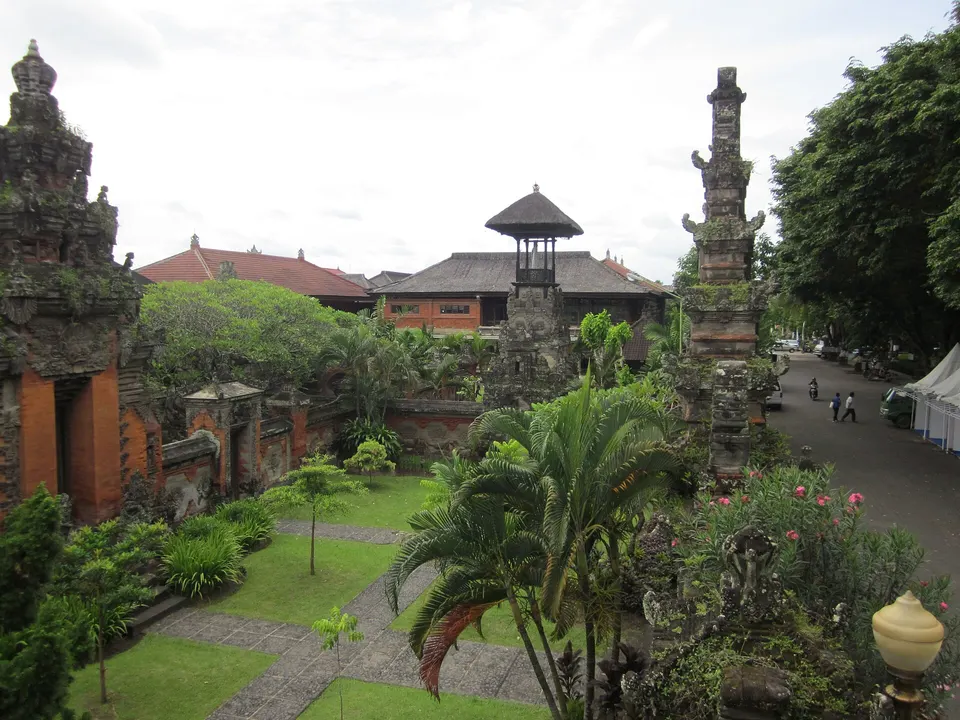
On the east side of Taman Puputan, Denpasar’s central square, stands the Bali Museum (Museum Bali), the oldest museum on the island. From outside it does not look like a museum: brick walls, split gates, a drum tower and pavilions make up a compound laid out like a palace and a temple at once. It is no accident. The complex covers some 2,600 square metres spread over three courtyards, beside the site of the old royal palace of Denpasar, the one that burned during the Dutch intervention of 1906, and it was that palace that served as the model for its walls and courtyards.
The history of the Bali Museum begins in 1910, when the Dutch assistant resident W.F.J. Kroon promoted the project and the first building, the Gedung Arca, was finished. It was funded by Balinese royal houses and built by master builders of the island with a German architect. It opened to the public on 8 December 1932, with a foundation created by W.F. Stutterheim, of the archaeological service, to manage the collection. In 1965 it passed to the central government and in 2000 returned to the provincial government of Bali. What to see at the Bali Museum is best understood courtyard by courtyard, with the 75-minute audio guide that accompanies the walk from the street gate to the oldest pieces.
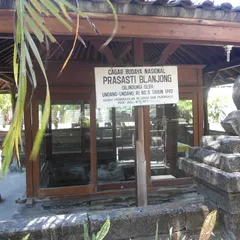
The museum occupies the site of the palace razed in the puputan of 1906, beside Puputan Square, and shares its frontage with Pura Jagatnatha. Its archaeological collections connect with the origins of Bali preserved at Pura Blanjong, with the island’s oldest dated inscription.
A gate that could belong to a palace or a temple
Museum gate
Summary of this stop
The walk begins in the street, on Jalan Mayor Wisnu, before a candi bentar: a gate in the form of a tower split into two halves of brick and stone. It is the threshold of a building that plays at being a palace and a temple at the same time.
Behind that gate lies a date that weighs heavily. In 1910, four years after the destruction of the Denpasar palace, the assistant resident W.F.J. Kroon set the museum in motion and the Gedung Arca, its first building, was finished. It was paid for by the Balinese royalty of Tabanan, Buleleng and Karangasem, and built by the undagi, Balinese master builders, I Gusti Gede Ketut Kandel and I Gusti Ketut Rai, together with the German architect Curt Grundler. Builders and rulers of the island thus raised a house for their own culture, and the meaning of that gesture, at that moment, is revealed in the narration beside the gate.
The drum tower and the vanished palace
Kulkul tower
Summary of this stop
In the outer courtyard rises the kulkul tower, a tall brick tower that keeps under a small roof a split wooden drum. The compound is organised in three courtyards, jaba, jaba tengah and jeroan, each with its own gate, between candi bentar and candi kurung, laid out like a palace and a temple.
That layout is, to a large extent, a memory in brick. The museum stands beside the site of the old royal palace of Denpasar, burned in the Dutch intervention of 1906, and that palace was the model for its outer walls and courtyards. The collection itself keeps architectural sketches of the original Puri Agung Denpasar.
There is also a documented tradition: the Dutch artist W.O.J. Nieuwenkamp arrived in Bali after the intervention of 1906 and painted the ruins of Denpasar destroyed by the Dutch troops, leaving the last images of the old capital. The only images of the palace the museum imitates are thus paintings of its smoking ruins.
Masks, textiles and a struggle that never ends
Regional pavilions
Summary of this stop
In the central courtyard the regional pavilions are scattered, each with the name and architectural style of a region of the island. Tabanan keeps theatre masks and musical instruments; Karangasem, sculptures and paintings; Buleleng, textiles. Each pavilion speaks with its own accent.
This courtyard is also the place of the two central figures of Balinese ritual drama: Barong, a lion-like protector and king of the good spirits, and Rangda, the witch queen. In the Barong dance their eternal battle ends with Barong’s victory and Rangda’s flight, and she always returns. A struggle that teaches balance more than triumph, and whose meaning is told calmly among the pavilions.
A bronze drum and the unthinkable God
Archaeology pavilion
Summary of this stop
In the eastern pavilion, the archaeology one, the oldest pieces await: a Bronze Age ceremonial drum, a bronze spearhead and a statuette of Acintya. Acintya, also called Sang Hyang Widhi Wasa, is the supreme, formless God of Balinese Hinduism, the religion with which around 86-87% of Bali’s population identifies.
The hall also closes the story of the museum itself. On 5 January 1965 it passed to the central government and, with regional autonomy, returned to the provincial government of Bali in 2000: a property that travelled to Jakarta and came back. How to represent a God who has no form is the question the audio guide leaves for the end of the walk.