Traditional market
Pasar Badung Audio Guide
Bali's largest traditional market, rebuilt after the fire of 2016, looks across the Badung river to the art market where the city that bears its name was born.
- 45 min of audio
- Market and Balinese offerings
Pasar Badung is Denpasar's great market and the largest traditional market on the island. It moved in 1907 from Jalan Gajah Mada to its present site beside the river, burned down completely on 26 February 2016 and reopened on 22 March 2019 in a new four-storey building of almost 15,000 square metres, with escalators and lifts, which operates around the clock.
Across the Tukad Badung, joined by a large bridge and two small ones, stands the Kumbasari art market. That is where it all began: the name Denpasar joins den, north, and pasar, market, because the city was born as a market village on the site that Kumbasari now occupies. Between the two, the riverbank, renovated in the image of a Seoul stream, has earned the river the nickname Tukad Korea.
Highlights
- Four-storey market — Almost 15,000 m² reopened in 2019 after the 2016 fire, with fresh produce on the ground floor
- Market by day and by night — From early morning to late afternoon and from afternoon to dawn, with tukang suun porters carrying purchases in baskets on their heads
- Tukad Korea — Some 420 metres of riverbank with steps, fountains and coloured lights inspired by Seoul's Cheonggyecheon stream
- Bridges over the Badung river — The watercourse along which the Dutch column advanced on 20 September 1906
- Pasar Kumbasari — Art and crafts market on the west bank, the site where Denpasar was born
In the heart of Denpasar, on the banks of the Badung river, beats the market that gave the city its name. Pasar Badung is the largest traditional market in Bali, and its history is made of moves and fire: in 1907 it left Jalan Gajah Mada to settle beside the river, and on 26 February 2016 it burned down completely. Trading then took refuge in an abandoned supermarket, the former Tiara Grosir on Jalan Cokroaminoto, until, after some three years of works, on 22 March 2019 the market reopened in a new building, with the president at the ceremony and some 1,600 local vendors.
What there is to see at Pasar Badung goes beyond its stalls. Opposite, across the Tukad Badung, rises the Kumbasari art market, and between the two runs a riverbank renovated between 2017 and early 2019 that is known as Tukad Korea. The history of Pasar Badung is also that of Denpasar: its name joins den, north, and pasar, market, because the city began as a market village on the site that Kumbasari now occupies. That city has been since 1958 the seat of the government of the province of Bali, was constituted as a city by Law No. 1 of 15 January 1992 and at the end of 2024 had 670,210 inhabitants.
The audio guide covers the market district in three stops and 45 minutes: from the chillies and offering flowers of the ground floor to the bridge over the river and the textile and craft stalls of the west bank.
The market of the old kingdom of Badung lies a few streets from Puputan Square, and some 730 metres in a straight line from Pura Jagatnatha.
A market reborn from its ashes
Pasar Badung
Summary of this stop
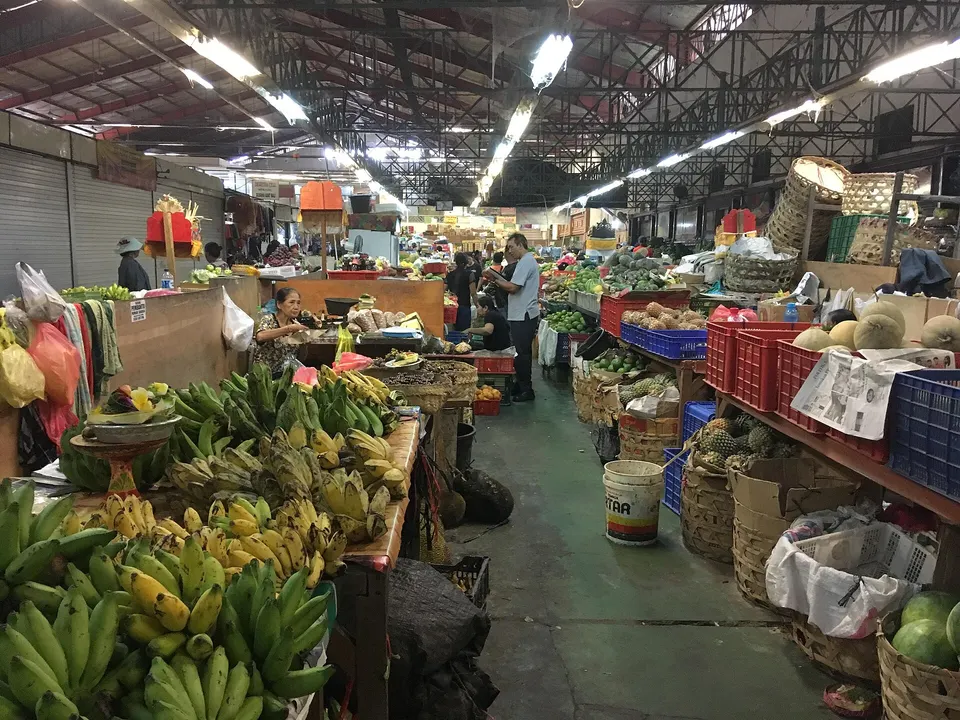
The first stop is on the ground floor of the new Pasar Badung, among the stalls of chillies and fresh produce. The architecture of Pasar Badung answers to the scale of the island’s largest market: a building of four storeys and almost 15,000 square metres, linked by escalators and lifts, with fresh produce below and textiles, souvenirs and clothing on the upper floors. The market runs around the clock: the day market opens at about 5 in the morning and closes at about 5 in the afternoon, and the night market takes over from 3:30 in the afternoon until 6 in the morning.
Among the aisles move the tukang suun, women who carry purchases in baskets on their heads in exchange for about five to ten thousand rupiah. And at many stalls the raw material of the city’s religious life is sold: young palm leaf, flowers and incense for the canang sari, the small daily offering, whose trays women weave by hand at the stalls themselves. It is a documented custom: thousands of offerings begin each day here, as leaves and petals bought before dawn.
This market feeds the kitchens and the altars of Denpasar at once. Among the ground-floor stalls, the narration tells how it rose again from the ashes of 2016.
The river between the two markets
Bridge over the Badung river
Summary of this stop
The second stop is on one of the pedestrian walkways that cross the Tukad Badung. The two markets are joined by a large bridge and two small ones, and on both sides crafts, religious offerings, spices, textiles and souvenirs are sold. The river is about 22 kilometres long and rises in the Abiansemal district, some 12 kilometres north of the city.
Beneath the bridges stretches the bank renovated between 2017 and early 2019: some 420 metres of steps, fountains and coloured lights, at a cost of about 7.6 billion rupiah. The design was inspired by Seoul’s Cheonggyecheon stream, hence the nickname by which the stretch is known, Tukad Korea.
The same watercourse keeps a far graver memory. On 20 September 1906, during the Puputan Badung, it was the route of the Dutch expeditionary column advancing from Denpasar towards the Pemecutan palace, where that same day a second puputan took place, after the one at the Denpasar palace. From the bridge, the audio guide joins those two faces of the river.
North of the market
Pasar Kumbasari
Summary of this stop
The last stop enters Pasar Kumbasari, the art and crafts market on the west bank, among stalls of textiles, carvings, basketry and offerings. It is the place where Denpasar began: the city was born as a market village on this site, and its very name, den pasar, means north of the market.
The offerings sold here point to a domestic gesture repeated throughout the city: the canang sari is usually prepared and presented by a woman of the household, normally each morning and each afternoon. From that market village came the provincial capital of 1958 and the city of 1992, which at the end of 2024 exceeded 670,000 inhabitants. Among the cloths and baskets of Kumbasari, the narration closes the walk with the story of how a market ended up giving its name to a capital.