Beach and climbing
Railay West Beach Audio Guide
A white-sand beach wedged between limestone walls, with no roads or pier, reached by long-tail boat and wading the last metres. The rock that isolates it is the same one that draws climbers from all over the world.
- 60 min of audio
- Climbing and karst limestone
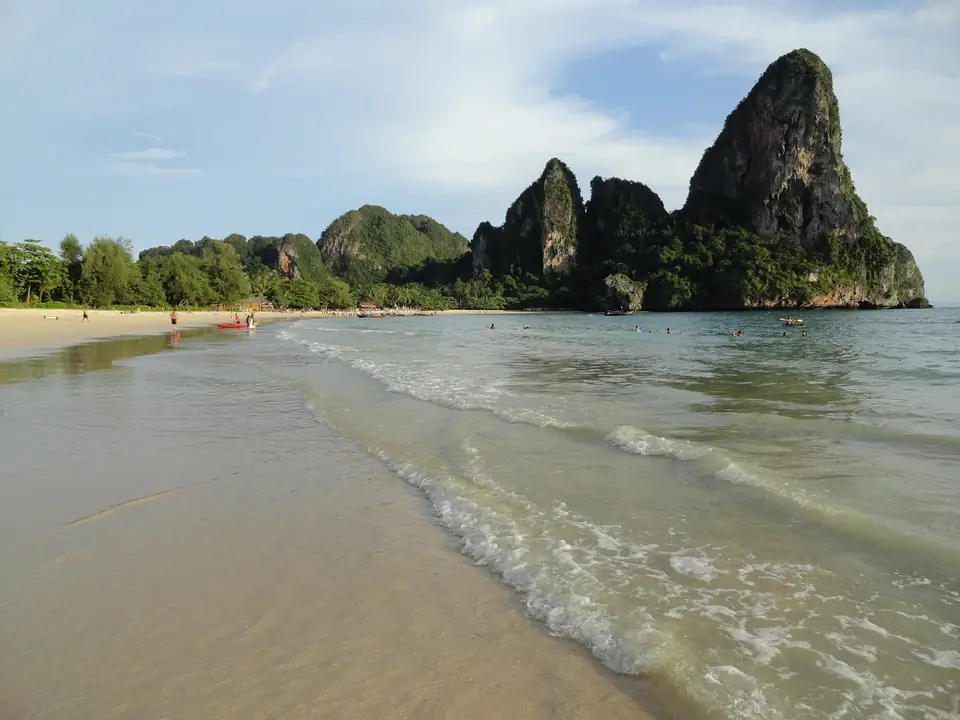
Railay West opens at the tip of a peninsula joined to the mainland but closed off by the Khao Nang massif, so there are no cars or roads and it can only be reached by sea. The cliffs around it are karst limestone of the Ratburi Formation, a carbonate platform that began to be deposited in the Early Permian. That geography explains the landing on foot, the scarcity of land and the singular character of the beach.
The shore works at once as beach, port and climbing school. Ferries to the Phi Phi Islands and Phuket depart from here, while to the south the great Thaiwand wall holds roped teams several pitches up. At dusk the cliffs turn into black silhouettes against the sunset, and around midnight the sands are usually almost deserted.
Highlights
- Landing by wading from long-tail boats, with no pier
- Thaiwand wall and the route “Lord of the Thais”
- More than 600 equipped climbing routes in 45 sectors
- Permian limestone of the Ratburi Formation
- Sunset and the silhouette of the Sleeping Indian
What to see at Railay West Beach begins with understanding what makes it different from any other beach in Krabi: a peninsula without roads, a stretch of sand without a pier and a limestone wall that has turned isolation into a worldwide draw for climbing. The history of Railay West starts in the Permian rock of the Ratburi Formation and reaches a shore where long-tail boats, travellers with suitcases waiting for the ferry and roped teams hanging dozens of metres up all coexist. The full experience, of about 60 minutes, is best enjoyed by walking the shore with the audio guide. The long-tails leaving Ao Nang Beach bring you here, and a few steps away, on the same peninsula, lies Phra Nang Cave Beach; inland, some 16 km away, the Tiger Cave Temple rises at the foot of the same kind of limestone cliff.
Wading to a beach with no road
Beached long-tail boats
Summary of this stop
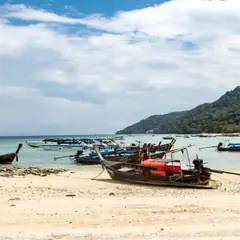
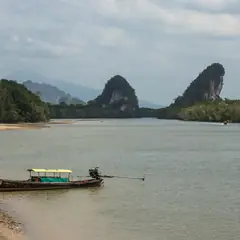
At the landing shore, the long-tail boats arriving from Ao Nang ground themselves directly on the sand. There is no pier: passengers wade the last metres with water up to their knees. The line of anchored boats, with decorated bows and long propeller shafts, is the only access from Ao Nang.
This way of arriving is not folklore but geography. Railay lies at the tip of a peninsula joined to the mainland but closed off by the Khao Nang massif, and the cliffs and islets around it are karst limestone of the Ratburi Formation, a carbonate platform that began to be deposited in the Early Permian. Hence there are no cars or roads here.
The same shore holds another side. According to local tradition, at night the bioluminescent plankton in Railay’s waters lights up blue when the water is stirred, a spectacle missed by anyone who only steps on the beach between one boat and the next. The most surprising detail is saved for the narration at the spot itself.
From backpacker refuge to port beach
Entrance of the walking street
Summary of this stop
At the mouth of the walking street, a short pedestrian lane with restaurants and shops that crosses to Railay East, the paradox of the place can be appreciated. Tourism began to develop in Railay in the 1970s, with the arrival of backpackers and hippies, and today the beach also serves as a port.
Railay West is the departure point for ferries to the Phi Phi Islands and Phuket. With no pier or terminal, groups of travellers with suitcases wait in the shade on the sand itself.
The scarcity of free land has kept the big hotel chains out. The only large luxury resort, Rayavadee, occupies at once the fronts of Railay West, Railay East and Phra Nang. Sources do not agree on its date: a 2018 CNN report speaks of almost 25 years in operation, while Travelfish places its construction in the early 2000s.
Thaiwand: the wall that devours steel
Thaiwand Wall
Summary of this stop
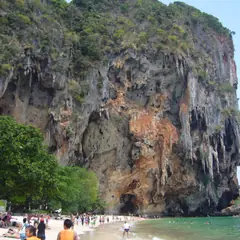
The great Thaiwand wall closes the south end of Railay West and is one of the best-known climbing walls on the peninsula. Roped teams can often be seen hanging several pitches up. Multi-pitch routes dominate it, and the most famous is “Lord of the Thais”, reputed to be one of the most beautiful lines in the world.
From the shores of Railay one can reach more than 600 equipped climbing routes, spread over 45 sectors, although the figure varies by source: about 700 according to Travelfish and more than 700 according to Wikivoyage. On the white and grey limestone, yellow and reddish veins can be made out, along with stalactites hanging from the overhangs.
The rock is also an enemy of metal. Humidity, salt and wet calcareous flow corrode even marine steel, and stainless-steel anchors last only 1 to 4 years, which is why titanium is the norm. An episode from the season that ended in March 2000 shows how makeshift everything was: the boat trip from Ao Nang had just gone up from 30 to 40 baht, bananas and pineapple were sold at many route bases, monkeys and squirrels multiplied and there were several accidents from loose rock, careless belayers and unreliable anchors. That same year, Shamick and Sam Lightner Jr. re-equipped many sectors with chemical resin anchors. The audio guide keeps the rest of the story for the foot of the wall.
The Sleeping Indian and the wave of 2004
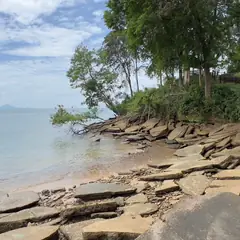
Rocks at the south end of the beach
Summary of this stop
From the south end, looking north, the beach closes with its living ritual. By day, the pastime on the sand is following the manoeuvres of the climbers hanging from the rock; as evening falls, Railay West is the peninsula’s beach for watching the sunset, with Coco’s, the only bar on the shore, in the middle of the sands. The cliffs turn into black silhouettes that give the place an almost supernatural air.
Across the bay and beyond Ton Sai, the “Sleeping Indian” can be made out, a one-kilometre massif whose silhouette recalls a man lying on his back with his hands crossed over his belly, clearer at dusk.
The memory of the tsunami of 26 December 2004 gives weight to that calm. According to the UKClimbing report of 30 December 2004, a 6-metre wave broke offshore opposite Railay and another of at least 1.5 metres reached the beach, with serious damage and victims on the sand. Other sources, such as Wikipedia, state without citing a source that the beach was not seriously affected, and the account remains disputed. Around midnight, the sands are usually almost deserted.