Shrine and beach
Phra Nang Cave Beach Audio Guide (Hat Tham Phra Nang)
Six hundred metres of white sand wedged between limestone cliffs, with a cave where fishermen leave carved phalluses for a drowned princess while climbers hang from the wall next door.
- 60 min of audio
- Shrine and climbing
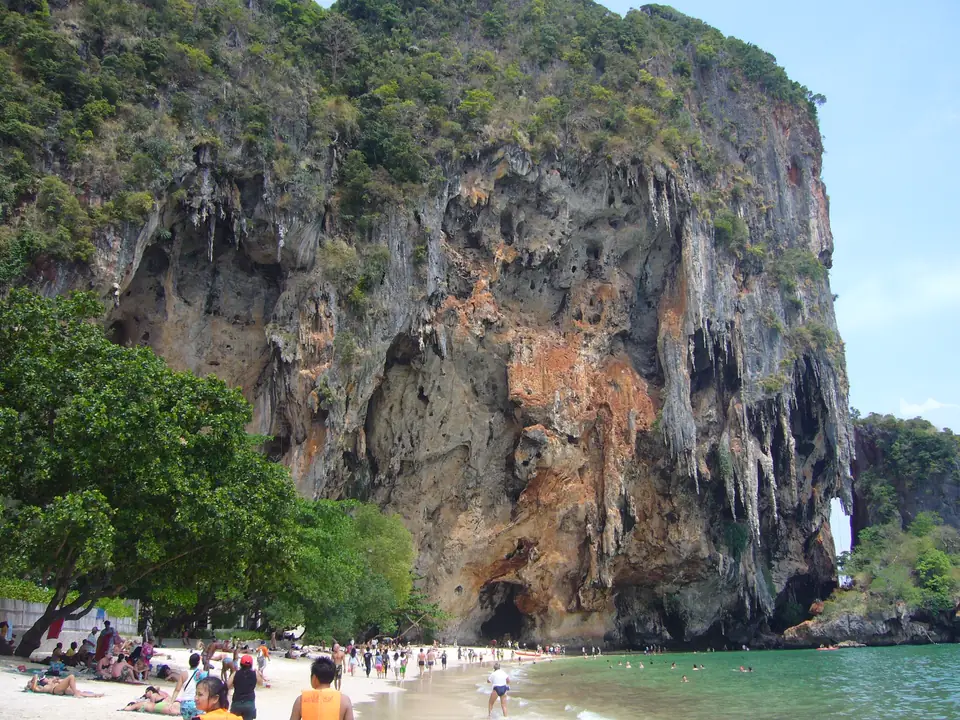
At the tip of the Railay peninsula, Phra Nang Beach is closed off at both ends by limestone walls in shades of ice blue and burnt orange. It is reached by a public path that winds beneath overhanging cliffs from Railay East. Its name honours Phra Nang, the princess to whose spirit the shrine of a small cave at the edge of the sand is dedicated.
The contrast is part of the landscape: on the same shore live side by side a shrine with hundreds of phallic offerings, a restaurant with tables set on the sand inside another cave and roped teams of climbers on the rock. Behind it all looms a story of feuding families, a serpent spirit who claims the bride and a dispute over access to the beach.
Highlights
- Shrine cave with hundreds of wooden phalluses offered to Princess Phra Nang
- 600-metre beach closed off by limestone cliffs with ice-blue and orange veins
- The Grotto, a restaurant with tables on the sand inside a cave
- Year-round climbing on a sheltered sector of the wall
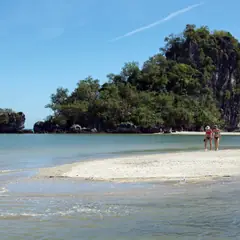
- Ko Rang Nok islet, wadeable at low tide
What to see at Phra Nang Cave Beach, at the tip of Railay, is largely a matter of contrasts: 600 metres of sand between karst limestone walls, a phallic shrine dedicated to a princess of the sea, a resort that owns the whole beachfront and climbers who use it as a vertical school. The history of the beach mixes legend, fishing devotion and a struggle over public access that was resolved in the early 2000s. The full experience is best enjoyed by walking it with the audio guide, which saves for each point the detail hardest to guess at a glance. It shares a peninsula with Railay West Beach, and Princess Phra Nang gives her name to the bay of Ao Nang Beach.
The overhang that hides a lingam
Path beneath the limestone overhang
Summary of this stop
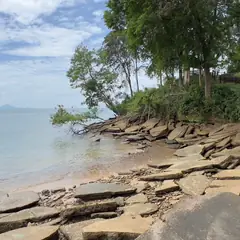
The arrival on foot works as a threshold. From the south end of the Railay East promenade a public path sets off, winding beneath overhanging limestone cliffs, among roots and rock, and comes out onto the beach on the shrine side. The walls flanking it belong to the Ratburi Formation, a great carbonate platform deposited since the Early Permian, with white and grey rock stained with yellow veins and hanging concretions.
Very near the path, in another cave beside the trail, a stalagmite rising from the floor is venerated as a sacred lingam. It is the first hint of what awaits on the sand. How this find ties in with the rest of the beach is calmly told in the narration, on the spot.
Hundreds of phalluses for a drowned princess
Phra Nang Cave
Summary of this stop
The beach owes its name to Phra Nang, the drowned princess to whose spirit the shrine of a small cave is dedicated. Tham Phra Nang Nok, the Princess Cave, is in fact two adjoining hollows some 3 to 4 metres deep, at the foot of the cliff and at the edge of the sand. Inside, hundreds of carved wooden phalluses pile up, many with red-painted tips, alongside garlands and other offerings. Some exceed a metre in height and 30 centimetres in thickness, and part of the cave’s rock resembles a vulva.
Local fishermen offer a phallus to Phra Nang, also called Mae Nang, to secure a good catch, and offerings are also made to ask for fertility. Most Thais who visit Railay stop by here to pay their respects to her. According to the documented account, these phalluses have a name of their own, palad khik, and are not a beach joke: a monk or an expert in magical lore consecrates them with incantations before use, and their lineage goes back to the lingam of Shiva. The paradox of that amulet is revealed in the audio guide.
There is also a matter that maps often confuse: “Phra Nang Cave” designates two different caves, this beach shrine and the so-called Diamond Cave, inland between Railay East and West. And guides disagree on whether the shrine lies at the north end or in the south corner of the beach; both place it at the foot of the cliff, at one of the ends, and the difference depends on how the beach is oriented.
A cave with tables and a disputed beach
The Grotto
Summary of this stop
The name of the peninsula, Rai Le (today Railay), means “orchard by the sea” in the dialect of southern Thailand and comes from the few fishing families who lived and farmed there before tourism arrived in the 1970s. Against that image, in another cave on the same beach stands The Grotto, the best-known restaurant of the Rayavadee resort, with tables and chairs set directly on the sand. The resort, opened around 1993, has 96 two-storey pavilions and five villas.
Rayavadee owns the whole beachfront, and in the early 2000s its owners tried to cut off all public access by land to Haad Phra Nang. They gave in after continued protests in front of a sister hotel in Bangkok. Those protests coincided with a run of misfortunes that many locals attributed to Phra Nang, the local goddess whose spirit resides in the cave of phalluses. The exact chronology is the subject of some disagreement between sources, since the attempted closure is placed during the construction of the resort and yet the opening is dated around 1993.
Climbers, boats and the sea’s rival
Cliffs at the west end
Summary of this stop
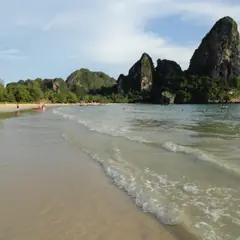
From the west end, the beach opens like a 600-metre amphitheatre closed on both sides by cliffs with long fingers of rock in ice-blue and burnt-orange tones. Climbers scale them, visible from the sand at any time of year. A sheltered sector of the wall allows climbing at Railay all twelve months, one of the reasons Satarpon Dindang, owner of the Krabi Rock Climbing school, ranks Railay among the best climbing destinations in the world.
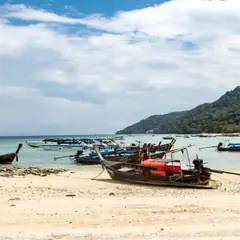
The rhythm of the beach changes with the hours. At 7:00 it is usually empty; from mid-morning until close to 17:00 waves of day-trippers arrive by boat and, in high season, the beached longtails take up almost the whole shore except for the corners. Facing the beach, to the south, rises the karst islet of Ko Rang Nok, which can be reached by wading at low tide to see the beach from the sea.
Looking towards the open sea, the popular legend of Phra Nang takes on another meaning: it is said that two feuding families made peace when Boon and Nang fell in love, but a powerful serpent spirit who lives in these waters also desired Nang and wanted her to go out to sea to marry him. Here, Phra Nang is always a female fertility spirit, although there is no canonical version of who she was: there is talk of an Indian princess drowned in a shipwreck, of a woman of the sea gypsies abandoned in the cave or of the bride disputed by the sea serpent. How the tale ends is left to the narration.