Fossils of Laem Pho
Fossil Shell Cemetery Audio Guide (Su San Hoi)
A coastal limestone platform made of millions of fossilised freshwater snails: the bed of an ancient lake that now laps against the Andaman Sea, with a name that preserves an age science has already corrected.
- 40 min of audio
- Freshwater fossils
At Laem Pho, beside the Andaman Sea, the grey slabs look like a concrete pavement. In reality they are a mass of snails averaging 2 cm, cemented by calcite, the remains of a freshwater lake or marsh that dried up all at once. The site has been known since 1964, when Phumwan Komonlarachun found thick layers of fossil shells.
The popular name speaks of 75 million years, a figure that predates scientific dating and is still alive in local speech and on signage. The study of the pollen and spores trapped in the rock places the site between about 40 and 20 million years ago, in the Tertiary. The route is built around that difference, the 2004 tsunami and the monsoon swell.
Highlights
- Laem Pho 2 slabs — a natural pavement made of fossil snails
- A corrected age — from the 75 million of the name to about 40–20 million
- Platform tilted towards the sea, broken by the 2004 tsunami
- Rocks on the shore where the spirals can be read clearly
- Three sectors and more than 2 km of protected coast
What to see at the Fossil Shell Cemetery of Krabi, known locally as Su San Hoi: a rocky terrace at Laem Pho, inside Hat Noppharat Thara–Mu Ko Phi Phi National Park, created in 1983 and covering some 388 km². At first glance the ground looks like concrete poured in layers; up close, the stone is an accumulation of freshwater fossil snails. The story of this site mixes a discovery in 1964, an age figure that did not withstand science, a lake that vanished and a sea that is now slowly carrying off the platform. The full experience is best enjoyed by walking it with the audio guide. The coast around it shares limestone and sea with Nopparat Thara Beach and Ao Nang Beach, and about 7 km away lies Khao Khanab Nam, another place where the rock keeps the mark of a different sea.
A sign of 75 million years that is wrong
Shell Cemetery 75 million years sign
Summary of this stop
In front of the visitor centre, the sign and ticket booth for the “Shell Cemetery 75 million years” keep the figure that gives the place its name. It is the original designation, predating scientific dating, and it is still alive in local speech and on signage even though it is now known to be too high.
The site was discovered in 1964 (Buddhist year 2507) by Phumwan Komonlarachun, who found thick layers of freshwater fossil snails. Later, the study of the pollen and spores of ancient plants trapped in the rock placed the whole between about 40 and 20 million years ago, in the Tertiary. Some sources speak of more than 70 million and others round it to about 40, so the age is a matter on which the figures do not agree.
This first stop serves to compare the sign with current dating: an age younger than the one in the name, but just as dizzying. The full explanation is kept for the narration at the spot itself.
Snails from a lake that dried up
Su San Hoi Shell Cemetery
Summary of this stop
On the Laem Pho 2 slabs, reached by a flat walkway, large grey plates extend, stacked like a natural pavement. On the side faces of each slab the mass of cemented snails can be seen in cross-section, just as visible as on the top surface.
The shells are mostly freshwater snails of the families Viviparidae, Thiaridae and Turritellidae, averaging about 2 cm long. According to the explanation of the Department of Mineral Resources, a great lake or marsh dried up all at once because of a climate change and the snails, unable to escape, died en masse. Dissolved calcite cemented millions of shells into a hard slab about 40 cm thick interbedded with shales and lignite, which the movement of the earth’s crust later pushed to the coast. Other sources describe instead a marine flood and a tectonic uplift, and the debate over its formation remains open.
A documented tradition also brings the rock closer to the table. The Viviparidae family, the snails called hoi khom in Thailand, is still alive: it is sold in the country’s ordinary markets, gathered in canals, ponds and rice paddies and cooked in stews such as kaeng khua hoi khom or kaeng om hoi khom.
The edge the sea keeps breaking
Sea edge of the platform
Summary of this stop
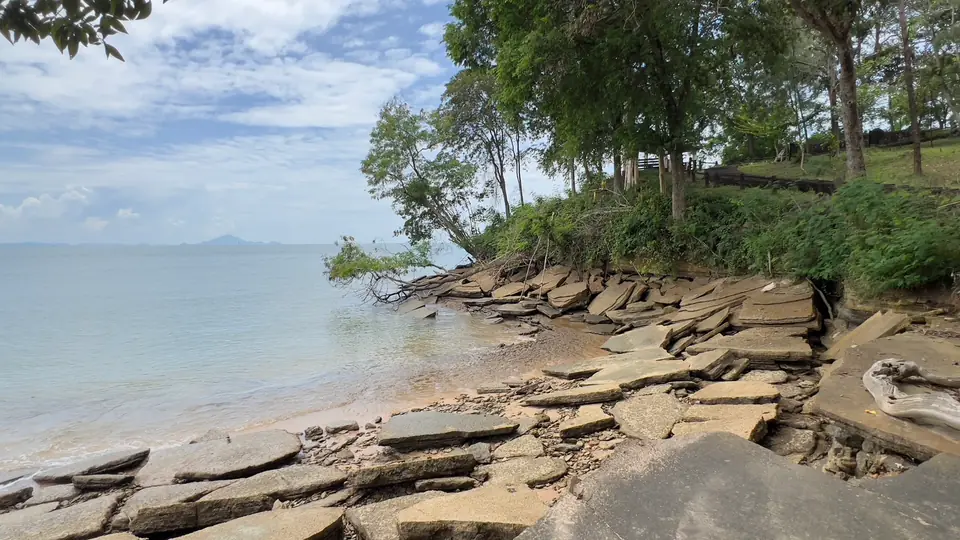
The platform runs for more than 2 km of coast from west to east. The limestone slabs, stacked in layers between 0.5 and 1 m thick, tilt about 10 degrees between the shore and dry land and form a rocky-terrace beach instead of a sandy one. Some sources speak of a fossil layer of about 40 cm and others of slabs up to a metre, so the thickness varies depending on the description.
The edge that reaches into the water is the most fragile part. After the tsunami of December 2004 more cracks opened and fossil plates 5 m wide broke off and fell into the sea. The fractures and gaps that remained are still visible on the broken edges of the terrace.
Monsoon waves also dig tunnels under the platform. The rangers, with Komate Plodkhao at the head of the protection unit, sealed them with rock and cement grout and built a breakwater at low tide, which the swell ended up damaging in 2012. The most striking detail of this struggle between stone and sea is told in the audio guide, on the ground.
Crisp fossils against the TikTok mockery
Shore rocks with fossils
Summary of this stop
By around 2022 the current had almost completely erased the outline of the shells on the part of the platform that advances towards the sea. On the rocks near the shoreline, less battered, the fossils are seen crisply and the spirals of the snails read clearly.
That difference between smooth stone and legible stone fed a notable episode in December 2022. According to the documented tradition, two young people who said they were from the neighbouring province of Phang Nga filmed their visit and posted a mocking video on TikTok: the slabs looked like cement poured layer upon layer and, they said, the entrance money was better spent on bread. The reaction in Thailand was widespread criticism, with reproaches for not having informed themselves and for damaging the tourist image of the province, and there was even talk of possible complaints. On 15 December 2022 the Department of Mineral Resources responded with a public clarification about the site.
The close of the route broadens the view. The shell cemetery has three sectors: Laem Pho 1 west of the visitor centre, Laem Pho 2 beside the centre (the one known as “the 75-million-year one”) and Laem Pho 3, 1 km to the east, reached along the beach at low tide. Since 18 August 2017 the site has been registered as a protected fossil site under the Fossil Protection Act of 2008, through three official announcements.