Meditation monastery
Tiger Cave Temple Audio Guide (Wat Tham Suea)
A meditation monastery born of a vision in 1975, with a cave of tigers, a rock shelter inhabited since prehistory and a staircase of 1,237 steps up to a golden Buddha above the clouds.
- 120 min of audio
- Vipassana meditation
Founded in 1975 by the vipassana meditation monk Ajahn Jamnian Silasettho in the Khiriwong valley, the forest retreat gained official recognition as a wat in 1985. Today it is a temple of the Mahanikaya order in the Krabi Noi subdistrict, with some 200 rai (about 32 hectares) of land at the foot of a karst cliff.
The contrast is set by the meditation itself: in the main cave hang photographs of internal organs and opened corpses, and skeletons and decorated skulls appear around the grounds, reminders of the impermanence of the body. Above, after a climb that demands of the legs what the spirit preaches, wait a great golden Buddha and a replica of the Buddha's footprint.
Highlights
- Tiger Cave — natural rock shaped like a paw
- Rock shelter — stone tools and prehistoric pottery
- Khao Kaeo staircase — 1,237 steps, with stretches of up to 45 degrees
- Great bell-shaped chedi — 90.90 metres high
- Summit — golden Buddha, Buddha's footprint and a sea of clouds at dawn
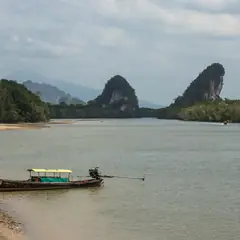
What to see at the Tiger Cave Temple, Wat Tham Suea in Krabi, is a question with several layers. The history of this temple begins in 1975, when a vipassana meditation monk founded a retreat in a valley of dense jungle, and reaches back to prehistory, because the rock shelter in the grounds was already inhabited. The architecture combines a cave, a limestone cliff, a bell-shaped chedi still under construction and one of the most demanding staircases in the region. The full experience is best understood by walking it with the audio guide, stop by stop. The limestone cliffs and caves surrounding the town of Krabi link this temple with Khao Khanab Nam, and about 12 km away the Fossil Shell Cemetery completes that reading of the rock.
A monastery that began with a vision
Wat Tham Suea
Summary of this stop
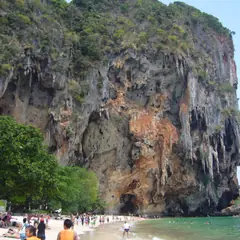
The entrance esplanade, facing the cliff, is the starting point of a story that begins with a dream. At the start of 1975, Ajahn Jamnian Silasettho had a vision of a new monastery west of the town of Krabi, ringed by mountains and with a cave called Tham Suea. With his disciples he searched for it for months until he found it in the Khiriwong valley.
On 25 March 1975 he arrived with 53 monks and novices and 56 nuns from Wat Sukhontawat and founded a monastic retreat called Samnak Song Na Ching, after the name of the village. That community is the origin of the present-day temple.
The grounds also hold the great bell-shaped chedi, 58 metres wide at the base and 90.90 metres high. It was designed to house the largest bell in the world, with five floors (museum of antiquities, assembly hall, the bell, museum of ancient Buddhas and museum of relics), for more than 100 million baht. According to local custom, it was still under construction in April 2016 and advances with the donations of devotees, who leave their offering as an act of Buddhist merit; with a contribution of 99 baht, the image of a famous monk is stamped, to be placed in the crypt beneath the base. The details that best explain this place are saved for the narration at the site itself.
The stone paw and the opened bodies
Paw-shaped rock of a tiger
Summary of this stop
The Tiger Cave, at the foot of Khao Kaeo, gives its name to the temple and the village. Inside is preserved a natural rock shaped like a tiger’s paw. The name Tham Suea, “tiger cave”, comes from the tigers that villagers saw going in and out when the area was dense jungle. The origin of the name admits other versions: the tigers the founder saw prowling while he meditated in 1975, a single enormous tiger said to have lived in the cave or the supposed paw prints. In 1975 Ajahn Jamnian settled here to meditate and saw tigers prowling around him.
Wat Tham Suea is a vipassana meditation centre, and the main cave works as a school of impermanence. Photographs of internal organs and opened corpses hang there, and around the grounds there are human skeletons and decorated skulls. They are objects of meditation on the fragility of the body, meant to be looked at without turning away.
A rock roof thousands of years old
East-facing rock shelter
Summary of this stop
Beneath the limestone wall stretches a long east-facing rock shelter, about 5 metres above the ground. The monastery did not inaugurate anything at this point: the shelter is an archaeological site of two periods, prehistoric and protohistoric.
Stone tools, votive tablets of unfired clay, pottery decorated with cord impressions and three-legged pots turned up there. The objects found were left in the custody of Ajahn Jamnian Silasettho himself, president of the Tham Suea monastic community, so that the founder of the temple is also the guardian of the remains of those who lived under the same rock long before him.
The macaques’ toll
Khao Kaeo staircase
Summary of this stop
Two contrasts coexist in this stretch. Inside the grounds of a Theravada temple stands a 5-metre statue of Guan Yin, the bodhisattva of compassion of Chinese Buddhism. And at the start of the Khao Kaeo staircase wait the unofficial guardians: crab-eating macaques who occupy the first flights and the grounds, even with mothers nursing their young.
The usual warning is not to get too close, because the monkeys poke about and meddle with visitors’ belongings. If they are respected, they stay hanging around and resting on the staircase and in the jungle, indifferent to the pilgrims.
The climb to the summit adds up to 1,237 steps in under 1 kilometre of route, with two or three stretches of slope of up to 45 degrees. Some risers exceed 30 centimetres in height, and the end of the climb is at 278 metres above sea level. The number of steps varies by source: 1,237 on the historic sign, while other counts reach 1,239 or more. In another part of the grounds, 184 steps lead to the skirts area where monks live in caves, among trees hundreds of years old.
The Buddha’s footprint above the sea of clouds
Golden Buddha at the summit of Khao Kaeo
Summary of this stop
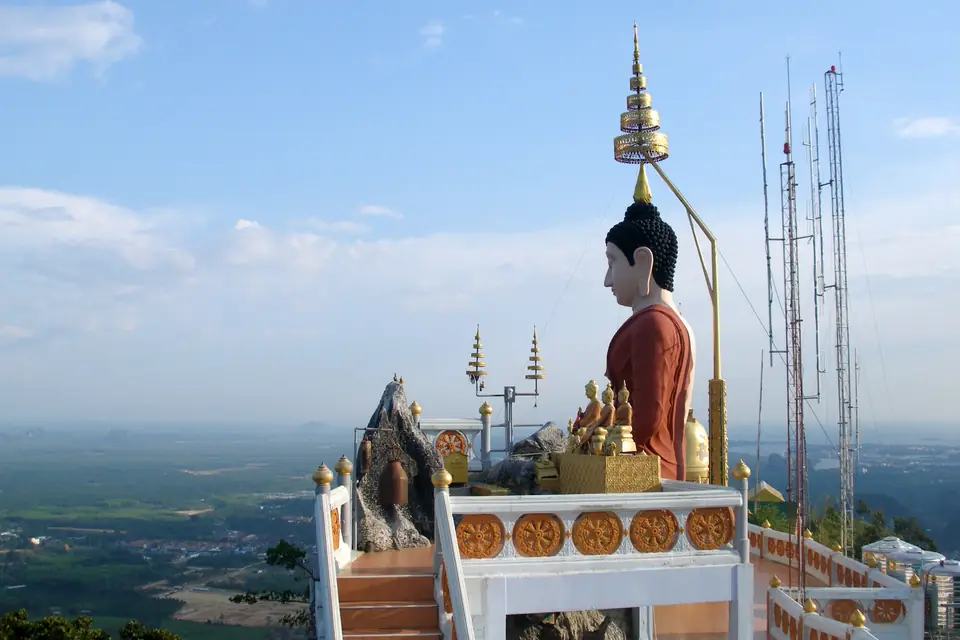
On the summit of Khao Kaeo, beside a great golden Buddha, a replica of the Buddha’s footprint is venerated. The view takes in the town of Krabi and the karst ridges, in a space of open light that makes up for the effort of the staircase.
After the rains a sea of clouds forms there which, since the COVID-19 crisis, draws numerous visitors at dawn. From the heights, the forest retreat of 1975 reads as what it came to be: an official temple since 1985, of about 32 hectares, in a valley that keeps century-old forest and caves with names of their own such as Tham Khon Than, Tham Lod, Tham Chang Kaeo, Tham Luk Thanu and Tham Phra, home to groups of wild monkeys.