Contemporary architecture
Metropol Parasol Audio Guide (Setas de Sevilla)
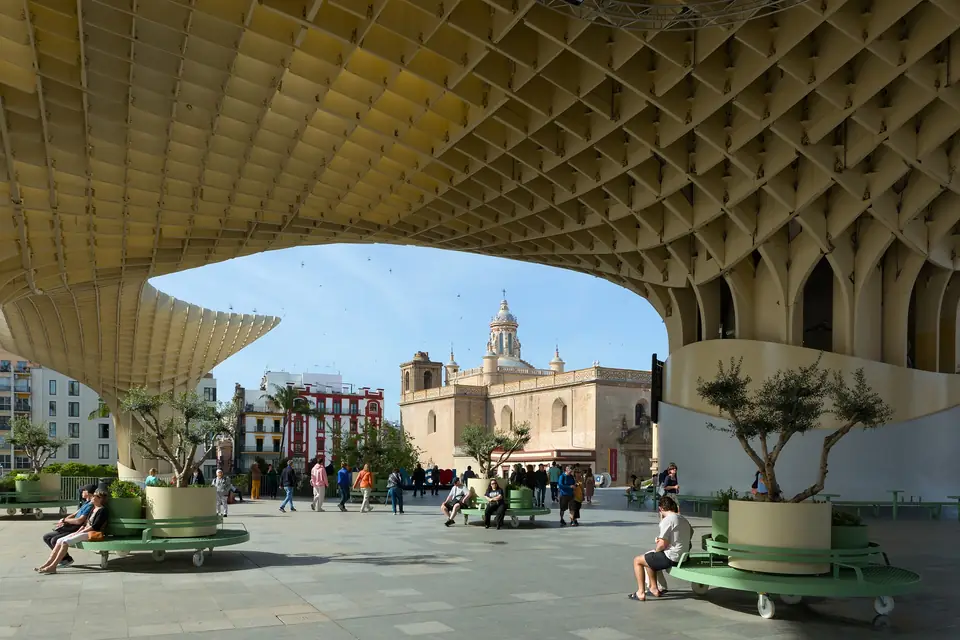
Six timber parasols 26 metres high cover Plaza de la Encarnación like a forest without leaves: below, a food market and Roman and Almohad houses a few metres under the street; above, a walkway that winds over the rooftops until it faces the Giralda. What looks like a ship settled into the old town is the latest layer of a site that was a convent, a market and a car park, and that almost never came to exist.
- 30 min of audio
- Viewpoint over the old town
The Metropol Parasol project was born in 2004, when the Berlin architect Jürgen Mayer won the international ideas competition to redevelop Plaza de la Encarnación out of 65 entries. Work began on 26 June 2005 with a budget of 50 million euros and a promise of completion in 2007; it opened on 27 March 2011, after archaeological finds froze the excavation and a report from the engineering firm Arup declared the structure unworkable as designed. The final cost was around 100 million. The result is a grid of laminated veneer timber 150 metres long and 70 wide, resting on six pillars and shielded from the Seville sun by a polyurethane skin two or three millimetres thick.
The site has four levels and each one is a different era. Underground, the Antiquarium preserves over 4,500 m² of 1st-century Roman houses and 12th-century Islamic remains, with the mosaic of the Loves of Neptune as its major piece. At street level the food market continues, heir to the one that occupied the square from the 19th century until its demolition in 1973. And on top, two levels of terraces and an undulating walkway. Even the name has a history: the city called the project “Las Setas” (the mushrooms) from day one and, as the story goes, in 2013 the nickname became the official signage because the serious name was registered as a trademark.
Highlights
- Six parasols — 150 x 70 metres of laminated timber on six pillars, 26 metres high
- Antiquarium — 1st-century Roman houses and Almohad remains under the square: over 4,500 m² to visit
- Neptune mosaic — The loves of the sea god, the piece that halted a 50-million-euro project
- Over 3,000 joints — Glued steel bars that a 2007 report called into question
- Walkway and viewpoint — The undulating path over the canopies, with the Giralda opposite
The Metropol Parasol in Seville, known locally as the Setas de Sevilla (the Seville mushrooms), covers Plaza de la Encarnación with six parasols of laminated veneer timber about 26 metres high, 150 long and 70 wide, resting on six pillars that widen upwards like trunks. The project was signed by the Berlin architect Jürgen Mayer, who won an international ideas competition in 2004 with 65 entries. Work began on 26 June 2005, with an estimated cost of 50 million euros and completion planned for June 2007; the official opening came on 27 March 2011, although some references give the work as finished in April, and the bill had tripled to about 100 million. In between came an excavation that uncovered Roman houses and a report from the engineering firm Arup, from May 2007, that declared the structure technically unworkable as designed.
The history of the Metropol Parasol begins long before the concrete and timber. The square takes its name from the convent of the Encarnación, of the Order of Saint Augustine, pulled down during the French invasion in the early 19th century to open up the space. In its centre a food market was built in the 19th century, mutilated in 1948 and demolished in 1973 for its ruinous state; for more than three decades the site was a surface car park and bus depot. What is seen today is the latest layer of that palimpsest, with four levels that are four eras: the Antiquarium underground, the market at street level and two floors of panoramic terraces above.
The architecture of the Metropol Parasol is an orthogonal grid of Kerto-Q timber pieces of 1.50 by 1.50 metres, joined at more than 3,000 nodes by glued steel bars and protected by a polyurethane coating two to three millimetres thick. It is promoted as the largest timber structure in the world, a label more commercial than certified record. What to see at the Metropol Parasol is arranged in four stops, from the south staircase to the balcony facing the Giralda, passing through the archaeological site and the walkway, in a route that goes down to the basement and up to the viewpoint without retracing steps, and that makes full sense when listened to there with the audio guide. From April to October, moreover, the timber changes skin at dusk with the “Aurora” light show, from 21:30 until one in the morning.
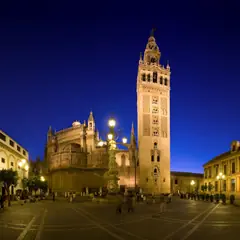
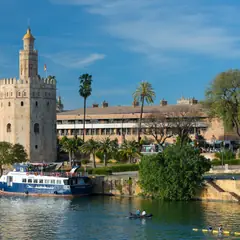
About ten minutes on foot to the south waits Seville Cathedral, whose Gothic converses with this 21st-century timber. The other great viewpoint of the city, the medieval one, is the Torre del Oro, beside the river.
A site with four lives before the mushrooms
Plaza de la Encarnación
Summary of this stop
At the foot of the south staircase, the first glance goes up, to the timber mesh and the pillars that open like mushroom stems. But the ground underfoot has a longer biography than the structure covering it. Here stood the convent of the Encarnación, of the Order of Saint Augustine, until the French invasion pulled it down in the early 19th century to open the square that now bears its name. In the gap a 19th-century food market was built, which in 1948 lost its southern third and in 1973 was demolished entirely as a ruin.
What came after was nothing: more than thirty years of surface car park and bus depot in the middle of the old town, the most famous empty site in Seville. The building that filled it is organised on four levels, like strata of an excavation in reverse: the Antiquarium underground (level 0), the market at street level (level 1) and, above it, two levels of panoramic terraces.
The newly opened square also had a lightning political life. In May 2011, barely two months after the opening, the Seville camp of the 15-M movement set up under the canopies and renamed the place “Plaza 15 de Mayo”: marches of more than 20,000 people set out from here at the end of that month, and in June another ended at this same spot, at 36 degrees, with umbrellas loaded with slogans for shade. How a newly opened tourist icon became the home of the indignados within weeks is the episode that opens the narration under the canopies.
First-century houses beneath the fish stall
Antiquarium
Summary of this stop
A few metres below the market, the Antiquarium preserves what halted the works. When the machines began to excavate the site in 2005, with a 50-million budget and delivery planned for June 2007, Roman and Andalusi ruins appeared, and the project froze. The find, instead of being erased, became the heart of the building: a site of more than 4,500 m², the largest open to visitors in Seville, walked along raised walkways above walls, pavements and the remains of houses.
The time span is enormous for a single basement. The oldest houses are Roman, from the 1st century AD, with their mosaic floors; the latest remains are Islamic, from the 12th century, of Almohad Seville. Twelve centuries of domestic life superimposed, a few metres below the market stalls.
The piece that draws the eyes is the mosaic of the Loves of Neptune, the museum’s main attraction. What scenes make up that pavement and what history the house it belonged to holds is what the narration unpacks in front of it.
The timber a report declared impossible
Walkway over the parasols
Summary of this stop
Above the parasols, the walkway lets visitors tread on the structure itself: an orthogonal grid of Kerto-Q laminated veneer timber pieces of 1.50 by 1.50 metres, joined at more than 3,000 nodes by glued steel bars, a system designed by Arup and Finnforest Merk. Because the timber is exposed to the elements under the Seville sun, the entire surface is covered with a polyurethane coating two to three millimetres thick that keeps water out but lets vapour breathe: that pale, continuous skin is what the visitor touches.
This forest nearly failed to hold up. In May 2007 the engineering firm Arup told the City Council that the structure, as designed, was technically unworkable; the solution with glued reinforcement was not developed until early 2009. According to the record, the municipal government of Alfredo Sánchez Monteseirín did not make that report public until two years later. And in 2010, with the work about 80% advanced, the then mayoral candidate Juan Ignacio Zoido proposed dropping the timber roof and four of the six mushrooms to save 20 million euros and open sooner.
In the end there were six, but late and at a price that tripled the estimate: about 100 million euros at the time of the opening, on 27 March 2011, a figure that fuelled a long controversy in the city. What exactly was wrong with the original design and how it was solved joint by joint is the part the narration tells about the timber itself.
A street nickname that ended up on the sign
Panoramic balcony on the walkway
Summary of this stop
The walkway winds to a panoramic balcony with the Giralda opposite and the rooftops of the old town all around. From here the scale of the whole is clear, 150 metres long by 70 wide and about 26 high, and so is its logic: the shape Jürgen Mayer devised in 2004, winner among 65 projects, has two very close Seville models. One is the cathedral vaults seen in the distance; the other, the enormous Ficus macrophylla trees of Plaza del Cristo de Burgos, around the corner, whose shade works just like these canopies.
What looked like a spaceship landed in the centre turns out, seen from above, to be a tribute to the city around it. And the city answered in its own way: the official name was Metropol Parasol, but the people of Seville promptly renamed it “Las Setas”. As the story goes, the architect had registered the project’s name as a trademark and would charge for its use, so in 2013 the City Council chose to make the popular nickname official and sign the work as “Setas de Sevilla”.
It is rare for a name born in the street to end up on a monument’s official sign. Why it happened here, and what Gothic vaults and century-old fig trees have to do with the most photographed silhouette of modern Seville, is what the narration rounds off in front of the Giralda.