Almohad tower
Torre del Oro Audio Guide
Twelve faces of rammed mortar planted on the bank of the Guadalquivir in 1220-1221, the last bastion of the Almohad wall toward the river. The Torre del Oro saw the bridge of boats broken in 1248, survived two earthquakes and two attempts at demolition, and its gold was never gold: it was a coating of lime and straw.
- 25 min of audio
- Almohad detached tower
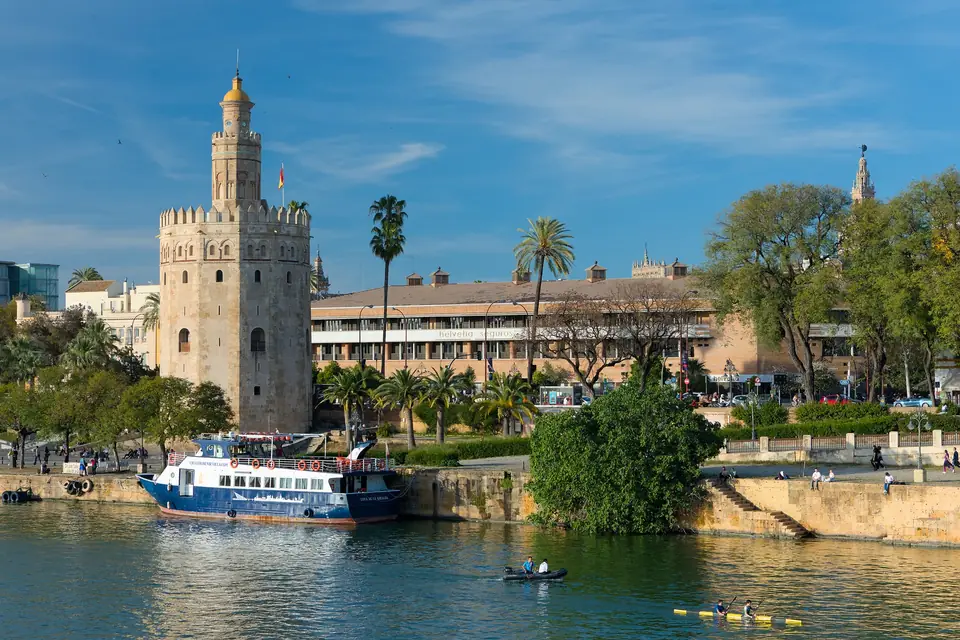
The Torre del Oro was built between 1220 and 1221 as an Almohad detached tower, the end of the walled passage that ran down from the Alcázar to the Guadalquivir. It is 36.75 metres high and 15.20 in diameter, and combines three bodies from three different centuries: the Almohad twelve-sided base, a Mudéjar body from the time of Peter I and the lantern with a gilded-tile dome added in 1760, after the Lisbon earthquake.
Its name deceives. It neither guarded the gold of America, kept in the Casa de la Contratación, nor had gilded tiles: José Gestoso looked for them in 1900 and found none. The 2005 research attributes the shine to a yellowish coating of lime and pressed straw. What did exist was a wall, pulled down in 1830, and eight days in March 1866 when the tower was officially for sale.
Highlights
- Twelve-sided Almohad body — Rammed mortar of 1220-1221, the last bastion of the wall toward the river
- Lantern of 1760 — A gilded-tile dome raised after the Lisbon earthquake
- Flood tiles — Three water marks on the west façade: 1856, 1876 and 1892
- Torre de la Plata — The octagonal sister of the walled passage, separated by the wall pulled down in 1830
- Naval Museum — Models, nautical charts and navigation instruments since 1944
The Torre del Oro (Tower of Gold) in Seville was raised in the year 617 of the Hijra, between March 1220 and February 1221, as an Almohad detached tower on the eastern bank of the Guadalquivir. Its Arabic name, Burj al-Dhahab, already spoke of gold, and for centuries there has been debate over where that shine came from: the treasures of Peter I, gilded tiles or the gold of America. The 2005 research points to something far humbler, a coating of lime and pressed straw barely four or five centimetres thick that made it gleam in the sun above the river. Today it is 36.75 metres high and 15.20 in diameter, and since 1944 it has housed the Naval Museum, facing the Triana district.
The history of the Torre del Oro is that of a survivor. It was the end of a walled passage that ran from the Alcázar down to the water; in 1248 it watched the fleet of Ramón de Bonifaz pass, which broke the bridge of boats during Ferdinand III’s siege; it served as a prison for nobles and jurors; it was damaged by the Carmona earthquake of 1504 and, after the Lisbon one of 1755, came close to being demolished. In 1830 it lost the wall that joined it to the city, in 1866 it spent eight days for sale and in 1871 its demolition was raised again. It still stands, and in 2021 it turned 800 with a postage stamp showing it dressed in flags for the 500th anniversary of Magellan and Elcano’s departure from Seville.
The architecture of the Torre del Oro reads from the bottom up as three layers of time: the Almohad twelve-sided mortar base, a second Mudéjar body from the time of Peter I with blind horseshoe arches and paired small arches, and the cylindrical lantern with a gilded-tile dome added in 1760. What to see at the Torre del Oro is arranged in four stops, from the Torre de la Plata to the viewing terrace, passing the bank facing Triana and the Naval Museum rooms; the route makes full sense when listened to with the audio guide at the foot of the tower.
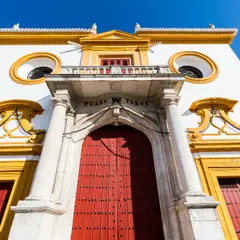
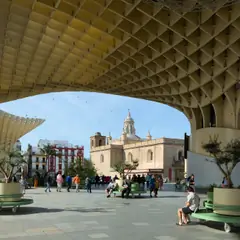
Five minutes upriver, along Paseo de Colón, stands the Maestranza Bullring, in the same Arenal district. And to compare viewpoints, the Metropol Parasol offers the contemporary view of the city from above.
The silver sister and the wall that is gone
Torre de la Plata
Summary of this stop
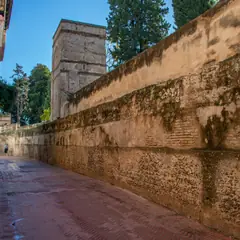
A few steps from the Torre del Oro, squeezed between buildings, stands the Torre de la Plata, octagonal and much more discreet. Both are survivors of the same work: the Almohad walled passage, a stretch of wall that ran down from the southern corner of the Alcázar to the river, defended by several towers, and ended at the water with the Torre del Oro, built between 1220 and 1221 as a detached tower. The Torre del Oro, therefore, was not born alone or freestanding: it was the last link in a chain of stone.
That stretch of wall did not reach the 20th century. In 1830, with José Manuel Arjona as mayor, Seville pulled down the wall joining the tower to the Alcázar and left it isolated on the bank of the Guadalquivir, as seen today. Between the two towers remains a gap that Seville’s imagination has filled on its own: legend says that, facing the Christian conquest of 1248, the Almohad authorities hid great riches beneath the tower before fleeing, and that a secret tunnel joined it with the Torre de la Plata, perhaps even with the Alcázar, as an escape route.
What there really was between these two towers, and why one got the gold and the other the silver in its name, is what the narration unpacks in front of the Torre de la Plata.
The day a ship broke the Triana bridge
Torre del Oro
Summary of this stop
From the bank, with Triana opposite, the tower shows its full scale and the façade that faces the river. On the far shore ended the Almohad bridge of boats that joined Seville with Triana, and there the siege of 1248 was largely decided: the Castilian fleet of Admiral Ramón de Bonifaz sailed up the Guadalquivir and one of its ships broke the bridge, while arrows rained down from the tower onto the vessels as they passed. Seville was cut off from Triana and Ferdinand III drew near to victory.
Trophies of that day remain far from Seville. In the Nativity nave of the church of Santa María de la Asunción in Laredo hang chains held to be a trophy of the capture of the city; in 2021 the Complutense University of Madrid dated them to around 800 years, with a margin of half a century. The scene of the ship breaking the chain beside the Torre del Oro appears on the coats of arms of Laredo, Santander, Avilés and, since 1984, Cantabria. Exactly which chain it was is debated: tradition speaks of a great chain stretched from the tower to the other bank, while other readings hold that the broken chain was the one that held the boats of the bridge together.
The water has charged the tower many times since. On the west façade, facing the river, three tiles mark the height reached by the floods of 21 January 1856, 8 December 1876 and 10 March 1892. How high the Guadalquivir rose and what path the chain followed to Laredo is told in the narration, looking toward Triana.
Neither tiles nor treasure: a gold of lime and straw
Naval Museum rooms
Summary of this stop
Inside, the Naval Museum rooms gather navigation instruments, models, engravings and nautical charts about Seville, the river and the sea. The Navy held the tower in usufruct from 7 January 1870, as the port’s command and captaincy, and in 1944 Julio Guillén opened the Maritime Museum here, a branch of the Naval Museum in Madrid, with some four hundred pieces brought from the capital.
Among the display cases the riddle of the name is also solved. Luis de Peraza spoke in 1535 of shining tiles and the treasures of Peter I; in the restoration of 1900 José Gestoso looked for original gilded tiles and found none; the legend of America’s gold kept here does not hold up either, because that gold was kept in the Casa de la Contratación and in the Alcázar. The 2005 research attributes the shine to a layer of yellowish stucco four or five centimetres thick, mortar of lime and pressed straw, which gave the tower its golden glow against the whitewashed Torre de la Plata.
Before filling with models, the tower was a prison. In the early 15th century it held nobles, and in 1597 the Royal Audiencia jailed in it and in the Puerta de Triana the chief magistrate Sebastián de Carvajal and the 24 jurors of the council for taking a woman prisoner out of jail to flog her. And, according to legend, it served as a refuge for the ladies Peter I courted, the most famous Doña Aldonza Coronel, sister of María Coronel and wife of the nobleman Alvar Pérez de Guzmán, who would have lived guarded within these walls while the king resided in the Alcázar; the Duke of Rivas brought the story to the stage in El Alcázar de Sevilla (1834). How much of that tale has documents behind it is a matter for the narration, among the museum display cases.
Three bodies, an iron belt and eight days for sale
Viewing terrace
Summary of this stop
From the viewing terrace the view takes in the Guadalquivir, the Triana bridge, the Triana district and the historic centre. But the tower itself, read from the bottom up, tells as much as the landscape: 36.75 metres high and 15.20 in diameter divided into three bodies, the Almohad twelve-sided one at the base, the Mudéjar one from the time of Peter I, in the 14th century, and the cylindrical lantern of 1760, with its oculi and its small dome of gilded tiles.
Each body is a scar. After the Carmona earthquake of 5 April 1504 the tower was damaged and was girdled with a thick iron belt to keep it from opening; in October 1538 the French blacksmith Juan Abel was paid for a new one. After the Lisbon earthquake of 1 November 1755, the master builder Francisco Sánchez de Aragón proposed in 1757 pulling it down entirely or leaving only the first body. Instead, on 17 March 1760 the restoration began: the ground floor was filled in, the windows of the second body were blocked, between 14 June and 27 July the lantern was raised and in August six large openings with iron balconies were cut. Who signed that project is still debated, between Ignacio Moreno and the engineer Sebastián Van der Borcht.
The danger did not end there. On 9 March 1866 the Royal Household and Patrimony ordered the deputy warden of the Alcázar to sell the Torre del Oro; eight days later, on 17 March, an order from Isabella II suspended the sale and the tower remained public. In 1871 its demolition was raised again, and the Royal Academy of Fine Arts of San Fernando asked on 17 May that it be neither sold nor pulled down. Why Seville so often wanted to get rid of its best-known tower, and what saved it each time, is what the narration closes with at the top, the river in the background.