Ibero-American Exposition of 1929
Plaza de España Audio Guide
A 230-metre semicircle of brick and tile that symbolically embraces America, with a navigable canal, two towers that worried the Academy and 48 benches that tell the history of each province. The greatest work of the 1929 Exposition hides a bench out of its alphabetical place, cellars turned into a prison and an architect who died ruined three weeks after opening it.
- 35 min of audio
- Sevillian Regionalism
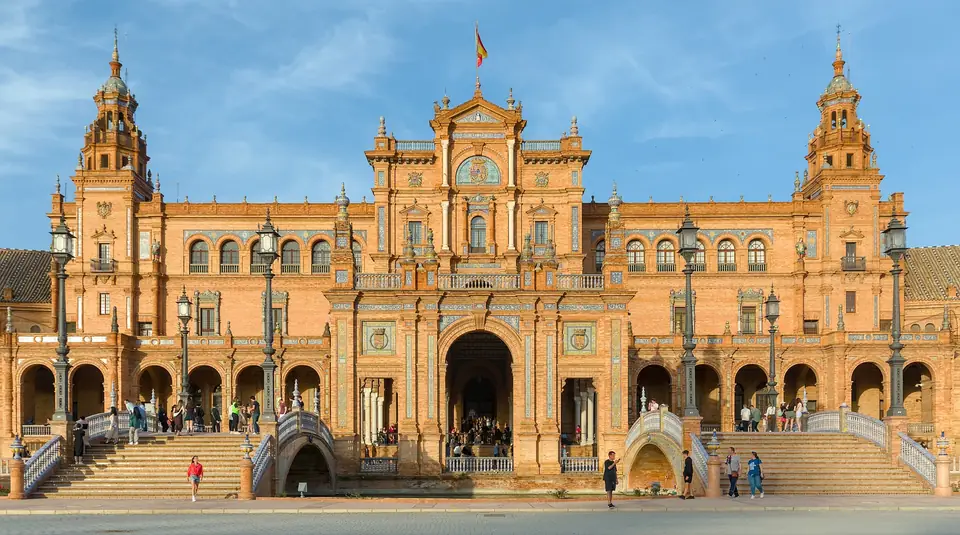
Aníbal González designed Plaza de España as the Palace of Events and Festivities of the Ibero-American Exposition, and built it between 1914 and 1929 on the site where a stadium was to go. It is the largest construction of that fair: a curve of exposed-brick buildings with loggias of round arches, a central building of superimposed arcades and two towers at the ends, all open toward the Guadalquivir, understood as the road to America.
Every afternoon, hundreds of people walk the curve reading province names like someone looking for home: by tradition, visitors sit on the bench of their own province and have their picture taken in front of its historical scene, and in the tile bookcases that flank each one a book left by another traveller often waits for the next. But the ceramic map froze at the moment of its design: the Canary Islands share a single tile, Ceuta and Melilla have no bench, and one breaks the alphabetical order because of a scene nobody ever got to see.
Highlights
- Semicircle — 230 metres in diameter between two towers, Spain's embrace of America
- Provincial benches — 48 tile scenes in alphabetical order, with one bench out of its letter
- Canal and four bridges — Castile, León, Aragon and Navarre, with rowing boats restored in 2010
- North and South towers — Built tall despite the Academy, which feared they would rival the Giralda
- Statue of Aníbal González — The bronze of the architect who died poor three weeks after the opening
Plaza de España in Seville was born of a change of plans. On 16 May 1913 the Executive Committee of the Ibero-American Exposition moved the stadium planned on this site to the Huerta del Carmen and commissioned a Palace of Events and Festivities in its place. Aníbal González presented the first design on 14 July 1914, with a semi-elliptical canal crossed by eight bridges, and closed it in 1918 with four. Work stretched from 1914 to 1929, with decoration still under way in 1928, and the result was the largest construction of the whole fair: a semicircle of exposed brick and tile 230 metres in inner diameter, according to the decree that protects it, although other sources give slightly different measurements.
The history of Plaza de España is also one of a runaway budget and a royal visit. In 1915 Alfonso XIII suggested that the complex be permanent and serve the city once the Exposition closed; the cost estimated in 1914, some 628,500 pesetas, exceeded 17 million in 1929, and Aníbal González resigned in 1926. After came state offices, a Captaincy General, cellars used as a prison during the Civil War, Hollywood shoots, an eight-year restoration that returned water to the canal and a Bien de Interés Cultural declaration that took more than forty years to arrive, until Royal Decree 599/2023.
The architecture of Plaza de España is best read from within: the loggia of round arches, the ceramic medallions of illustrious Spaniards in white on blue, the colonnaded gallery with marble columns and Neo-Mudéjar coffered ceilings, the Aragon and Navarre gates with their monumental staircases and Vicente Traver’s central fountain. What to see at Plaza de España is arranged in five stops, from the architect’s bronze statue to the gallery of the central building, passing the fountain, the south bridge over the canal and the provincial benches, and the full experience, with the episodes the postcards leave out, is best enjoyed walking it with the audio guide.
The visit fits with the Royal Alcázar of Seville, a little over ten minutes on foot toward the centre, and with the Santa Cruz Quarter, less than a kilometre away.
The bronze of an architect who died ruined
Aníbal González Monument
Summary of this stop
Facing the square, on a granite base, a bronze statue placed in 2011 greets visitors: Aníbal González, the architect who designed the semicircle and built it between 1914 and 1929 as the major piece of the Ibero-American Exposition. From this point opens the first full view of the brick curve, the two towers and the central building.
The figure that goes with that view is a budget that multiplied. In 1914 some 628,500 pesetas were estimated; by 1929 spending exceeded 17 million. In 1926 González resigned and Pedro Sánchez Núñez took over the remaining works. Even so, on 9 May 1929 the square hosted the opening ceremony of the Exposition, with Alfonso XIII and Queen Victoria Eugenia presiding.
According to a documented tradition, the architect’s end was very different from that of his work. Aníbal González died in Seville on 31 May 1929, barely three weeks after that ceremony and a few days before turning 53, poor and with unpaid bills. A crowd came to his funeral, with many construction workers among them, and the newspaper El Liberal opened a collection for his family that by 20 October 1929 had reached 150,000 pesetas, with which a house was later built for his widow. What happened between the glory of May and that autumn collection is what the narration unpacks at the foot of the bronze.
A 230-metre curve that embraces America
Plaza de España Fountain
Summary of this stop
From Vicente Traver’s monumental fountain, in the centre of the esplanade, the whole gesture of the square is understood at once. The semicircle measures 230 metres in inner diameter between the two towers and its shape symbolises Spain’s embrace of its former American territories; the opening faces the Guadalquivir, the river by which ships left for America. Around it, the loggia of round arches carries ceramic medallions of illustrious Spaniards in its spandrels, portraits in white on a blue ground of Seneca, Columbus, Cervantes, Velázquez, Goya or Sorolla.
That all of this is still standing is partly due to a visit. On 14 December 1915 Alfonso XIII, passing through Seville, suggested that Plaza de España be a permanent building, usable once the Exposition was over. The North and South towers, which cap the ends and now house the Government Delegation and Sub-delegation, grew in height between 1923 and 1926 despite opposition from the Academy of Fine Arts, which feared they would rival the Giralda. Their exact height varies by source, between 70 and 74 metres.
The anecdote says the king himself, seeing the finished square, said: “Gentlemen, I knew this was beautiful… but not this much”. Whether the phrase is true or not, the reaction repeats daily in anyone entering the semicircle for the first time. What that amazement leaves out, and what the towers really contested with the Giralda, is told beside the fountain.
Four kingdoms over a canal that once ran dry
Bridge over the canal
Summary of this stop
The curved canal around the esplanade is crossed by four bridges dedicated to the kingdoms of Castile, León, Aragon and Navarre. They were not always going to be four: the first design, of July 1914, planned a semi-elliptical canal with eight, and the definitive project of 1918 halved them. From the south bridge, the balustrades and the ceramic lamp posts look like 1929, but to a large extent they are not.
The restoration of 2002 to 2010 replaced almost 25% of the tiles on the provincial benches and 90% of the ceramic bookcases and balustrades with replicas, and recreated 20 vanished lamp posts from photographs and postcards in the municipal newspaper archive. During those years the canal ran dry; a 2009 study by two professors of ground engineering went as far as attributing a slight tilt of the towers to that drying, a matter that is still debated.
Water returned on 17 October 2010, with a reopening that cost about 9 million euros and gave the canal back its rowing boats, absent for twenty years. What happens under the water and why a canal can move a tower is what the narration reveals from the bridge.
The Pamplona bench, out of its letter
Provincial benches
Summary of this stop
Set against the wall of the semicircle, 48 tile benches form an open-air ceramic museum. They are arranged alphabetically in four stretches of twelve; each shows a historical episode of its province, the provincial map on the floor, the coat of arms above and two ceramic bookcases at the sides. Seville, as host, has no bench of its own: it is represented by eight scenes of everyday life at the start and end of each stretch.
And between León and Pontevedra there is a bench that breaks the sequence. According to a documented tradition, its heading does not say Navarra but Pamplona: the planned tile, “The death of García IV”, was withdrawn for being considered too violent and replaced with the “Division of the kingdom of Navarre”, and with the change of scene the label went from Navarra to Pamplona, moving the bench out of its place in the alphabetical order.
In a square ordered letter by letter, a single bench out of place gives away the censored piece of the ensemble. Whose death that tile was going to show and who decided to withdraw it is told in front of the Pamplona label.
From Captaincy and prison to Naboo palace
Central building gallery
Summary of this stop
The colonnaded gallery of the central building offers the coolest shade in the square: a covered walk on marble columns, with Neo-Mudéjar timber coffered ceilings and heraldic shields. The cinema knows it well. It was the British headquarters in Cairo in Lawrence of Arabia (1962) and the royal palace of Naboo in Star Wars: Episode II (2002); in March 2017 the European Film Academy chose it as a Treasure of European Film Culture.
Before the shoots, this building had another life. In 1936 Gonzalo Queipo de Llano assigned the square to state offices; in 1937 the region’s military command moved to the central building, called the Captaincy General ever since, and during the Civil War its cellars were used as a prison. Today it is still a military seat: the Land Force of the Spanish Army was constituted here on 5 May 2005, with its Headquarters in the central building.
Heritage protection came late. The file was opened on 3 November 1981, but the buildings were not declared a Bien de Interés Cultural until Royal Decree 599/2023, of 4 July 2023, and since then there has been debate over how to reconcile events and tourist use with their conservation. What happened in those cellars and why a Hollywood set took forty years to become a monument is revealed under the arcades.