Historic bullring
Maestranza Bullring Audio Guide (Plaza de Toros de la Maestranza)
The Maestranza bullring took 120 years to close, from 1761 to 1881, which is why its sand ring is not round: it is an oval of 30 uneven sides wedged between the Guadalquivir and the Arenal. Its Puerta del Príncipe opens only for those who cut three ears, and in more than a century and a half a handful of matadors on foot have seen a tail awarded in Seville.
- 30 min of audio
- 120 years of construction
On the Baratillo hill, beside the river, the Royal Maestranza of Cavalry of Seville began in 1761 a masonry bullring, to a design by Francisco Sánchez de Aragón, that gradually replaced the earlier wooden rings. The works were not closed until 1881: in between, Vicente de San Martín shifted the centre of the ring, Charles III banned bullfights in 1785 and the work stopped for sixty years, and Juan Talavera covered the sand and closed the upper arcade with the last 40 iron balconies. The result is an irregular polygon of 30 sides, presided over by the Puerta del Príncipe and the box dedicated to Prince Philip.
The bright sand also holds a darker memory. On 5 May 1861 Empress Elisabeth of Austria, Sissi, followed a bullfight from these stands; in 1922 the matador Varelito took a goring here that killed him three weeks later, with no antibiotics to hold back the infection; and in 1992, the black year of the banderilleros, two men in silver died in the same infirmary barely four months apart. In the Bullfighters' Chapel, beside the Patio de Caballos, the votive offerings before the Virgin of the Rosary tell the other side of glory.
Highlights
- Puerta del Príncipe — Opens only for three ears, or two ears and a tail
- Oval sand ring — A polygon of 30 uneven sides, the mark of 120 years of construction
- Prince's Box — A tiled dome and a sculpture group by Cayetano de Acosta, from 1765
- Goya prints — Twelve engravings of the Tauromaquia, the Paris edition of 1876
- Bullfighters' Chapel — An altarpiece of the Virgin of the Rosary with the matadors' votive offerings
In the Arenal district of Seville, between Paseo de Cristóbal Colón and the streets Adriano and Antonia Díaz, the Maestranza Bullring (Plaza de Toros de la Maestranza) occupies an almost triangular block on the old Baratillo hill, a stone’s throw from the Guadalquivir. Its owner is the Royal Maestranza of Cavalry of Seville, which around 1730, after Philip V’s privilege to hold bullfights, built its first wooden ring here. The masonry one, of sand-coloured earth and lime, was begun in 1761 to a design by Francisco Sánchez de Aragón and was not closed until 1881: 120 years of work that explain why the building, inside and out, is an irregular polygon of 30 uneven sides and why its ring traces an oval instead of a circle.
The history of the Maestranza Bullring is a succession of corrections. Between 1761 and 1765 the inner façade was raised and, above it, the Prince’s Box, with the sculpture group by Cayetano de Acosta; between 1781 and 1785 Vicente de San Martín reduced the ring by shifting the centre of the circle; in 1785 Charles III’s ban halted the works for sixty years; in 1876-1877 Juan Talavera lowered the ring and covered it with sand, and in 1880-1881 he closed the upper arcade with the 40 balconies that were missing, the first time iron entered the building. Even in 1914-1915 José Sáez y López and Aníbal González rebuilt the stands in exposed brick. The Maestranza itself has had to fix the chronology against other versions: for a long time the original layout was attributed to San Martín, and some sources push the start back to 1749, a date the institution reserves only for the stonework outbuildings attached to the wooden ring.
Today the ring keeps its season with bullfights at the April Fair and the San Miguel Fair in September, and between the two it can be visited as a museum: the Puerta del Príncipe, the stands over the sand, the two facing boxes, the paintings and prints rooms opened in 2008, with twelve engravings from Goya’s Tauromaquia, and the Bullfighters’ Chapel beside the Patio de Caballos. What to see at the Maestranza Bullring is arranged in five stops, and the architecture of the Maestranza Bullring, with its 120 years of work written in the floor and the brick, is fully understood when walked with the audio guide.
Five minutes along Paseo de Colón, the Torre del Oro watches over the same bank of the Guadalquivir, and inland, half a kilometre away, stands Seville Cathedral.
The Puerta del Príncipe, only for the triumphant
Real Maestranza Bullring of Seville
Summary of this stop
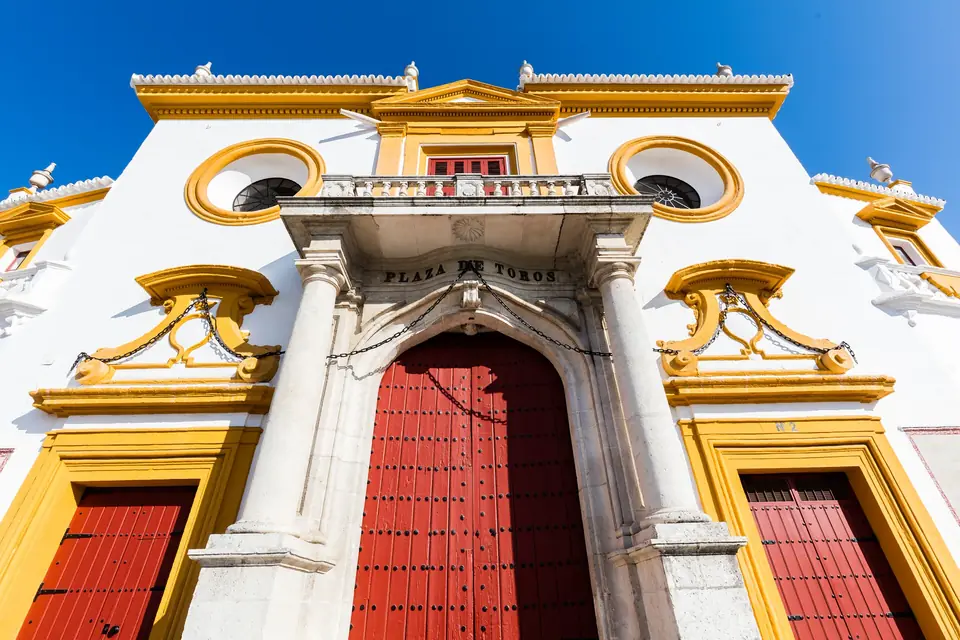
From the pavement of Paseo de Cristóbal Colón, with the river behind, the Maestranza façade opens at the Puerta del Príncipe: a lower body of exposed stone flanked by two turrets with smaller lintelled doors. It is the main gate of the bullring, but not the one used by the public. Triumphant matadors leave through it on shoulders, and for it to open at least three ears must be cut, or two ears and a tail. In a bullring known for how little it grants, that threshold is the measure of success.
It is enough to walk along the façade to notice that the building does not obey a clean geometry. The Maestranza is an irregular polygon of 30 uneven sides, wedged into an almost triangular block on the Baratillo hill, between Paseo de Cristóbal Colón and the streets Adriano and Antonia Díaz. That irregularity is no whim: the masonry ring was begun in 1761 to a design by Francisco Sánchez de Aragón and not closed until 1881, and each stretch of those 120 years left its own shape in the walls.
Beside the bullring, the bronze of Curro Romero, the Pharaoh of Camas, the work of Sebastián Santos Calero unveiled in 2001, looks toward the gate he crossed four times on shoulders between 1966 and 1980; nearby are also the statues of Pepe Luis Vázquez and of his brother Manolo Vázquez. On 19 May 1966 Curro cut eight ears from six bulls, the biggest haul in a single afternoon at the Maestranza. What it took that afternoon to deserve the statue is told in front of it.
A sand ring that is not round
Sand ring
Summary of this stop
From the stands, the yellow ring of the Maestranza looks like a circle until the eye lingers: the plan is slightly oval. The explanation lies in the 18th century. Between 1781 and 1785 Vicente de San Martín reduced the ring by shifting the centre of the circle and drawing another of shorter radius, and from that correction was born the oval that now sets the Seville ring apart from any other.
The sand was not always there either. In 1876-1877 Juan Talavera y de la Vega reduced and lowered the ring again and covered it with that yellow earth that now identifies the bullring. And in 1914-1915 José Sáez y López and Aníbal González replaced the old stands with exposed brick, reduced the ring once more and fitted the railing from the convent of Regina Angelorum. Three successive reductions, each still drawn in the floor and the terracing.
Why each architect shrank the ring again, and what bullfighting gained from it, is revealed by listening to the narration seated in these very stands.
From the Prince’s Box to Franzi’s coat of arms
Prince's Box
Summary of this stop
Facing the stands, the bullring reads as a dialogue between two boxes. Above the inner façade rises the Prince’s Box, built between 1761 and 1765 and dedicated to Prince Philip, first senior brother of the Maestranza: a balcony reserved for the Royal Family, with columns and a dome of blue and white tiles, crowned by the sculpture group of the Portuguese Cayetano de Acosta. It is the oldest piece of the masonry ring, the starting point of the work.
Opposite, above the bull gate, the Diputación Balcony marks the end of that same work. In 1880-1881 Juan Talavera closed the upper arcade with the 40 balconies that were missing, twenty on each side of the bull gate, and for the first time used iron in the construction; the coat of arms of the Royal Maestranza that presides over it was sculpted by Augusto Franzi. Between one box and the other lie 120 years of distance and the whole covered terrace that rings the arena. In those boxes sat Empress Elisabeth of Austria, Sissi, on 5 May 1861 to attend a bullfight.
And on this sand the trophies weigh. On 26 April 2023 Morante de la Puebla cut two ears and the tail from Ligerito, of Domingo Hernández, and the bull was granted a lap of honour: no matador on foot had cut a tail at the Maestranza since Francisco Ruiz Miguel in 1971, and only the mounted bullfighter Pablo Hermoso de Mendoza had managed it, in 1999. Fifty-two years of waiting for a prize this ring almost never grants; what happened in the stands that afternoon is told by the narration facing the boxes.
Before stone, wooden rings
Paintings and prints rooms
Summary of this stop
The paintings and prints rooms, opened on 21 November 2008, bring together bullfighting oils from the 18th to the 20th century and a collection of engravings, among them twelve prints from Goya’s Tauromaquia in its third edition, the Paris one of 1876. Among those paintings, the history of the ring rewinds to before the stone.
Around 1730, with Philip V’s privilege to hold bullfights, the Royal Maestranza raised its first ring in the Arenal: of wood and rectangular, like the one in Plaza de San Francisco. It did not last. In 1733 it was dismantled because fighting in its four corners had proved dangerous, and another was built, also of wood, round and octagonal; to make room for it the Baratillo hill began to be lowered. On that lowered ground the masonry ring would later be set, from 1761.
The next blow came from the court. In 1785 Charles III banned bullfights across the country and the work stood still for sixty years; meanwhile, the unfinished part of the ring remained wooden. How stone and planks lived side by side for decades, and what Goya’s prints show of that 18th-century bullfighting, is revealed in front of the paintings by the narration.
The Virgin of the bullfighters’ votive offerings
Bullfighters' Chapel
Summary of this stop
The visit ends in a small chapel beside the Patio de Caballos, the Bullfighters’ Chapel, presided over by an altarpiece of the Virgin of the Rosary. At her feet, the votive offerings donated by matadors: each one a promise kept or a plea before stepping into the ring. It is the reverse of the Puerta del Príncipe: glory is celebrated outside, in the street; fear is prayed here.
The bullring’s infirmary holds the darkest episode of that memory. In 1992, the black year of the banderilleros, on 1 May, at the April Fair, the bull Cubatisto, of Atanasio Fernández, first of José María Manzanares’s afternoon, gored his banderillero Manolo Montoliu in the chest just after placing a pair; he reached the infirmary practically dead, a bugle call announced his death and the bullfight was suspended in silence, with the news given live by the journalist Fernando Fernández Román. On 13 September of that same year, the bull Avioncito, of the Conde de la Maza, wounded the banderillero Ramón Soto Vargas in the chest, and he died hours later in the same infirmary.
And yet, every April and every September, at the April Fair and the San Miguel Fair, the matadors pass this threshold again before stepping onto the sand. What is asked of the Virgin of the Rosary at that moment, and what votive offerings have been left here by those who left on shoulders, is revealed in the narration of this last stop.