Gothic cathedral
Seville Cathedral Audio Guide (Catedral de Sevilla)
The largest Gothic cathedral was raised from 1401 over the great Almohad mosque, and the mosque is still standing inside it: its minaret is the Giralda, its ablutions courtyard is the Patio de los Naranjos. Beneath a dome that collapsed twice await the largest altarpiece in Christendom and the tomb of Columbus.
- 40 min of audio
- Almohad mosque and Gothic
Seville's great mosque was built between 1172 and 1198 on the orders of Caliph Abu Yaqub Yusuf, measuring 113 by 135 metres, with 17 aisles of horseshoe arches and a minaret crowned with four gilded bronze spheres. Consecrated as the cathedral of Saint Mary after the Christian entry of 23 November 1248, it served as a church for over 150 years, until on 8 July 1401 the chapter agreed to pull it down and build a work “the like of which there is none”. The final stone was laid in October 1506.
The Giralda is three towers stacked together: the base holds seven Roman altars, one dedicated to a 2nd-century olive-oil merchant; the brick shaft is the Almohad minaret of 1184, and the bell chamber was added by Hernán Ruiz II between 1558 and 1568. At the top turns the statue of Faith, the weathervane that was first called “Giralda” and ended up lending its name to the whole tower.
Highlights
- Giralda — An Almohad minaret of 1184 on seven Roman altars, with a Renaissance belfry of 1568
- Main altarpiece — 26 metres of walnut and chestnut with over 200 figures, the largest in Christendom
- Tomb of Columbus — Four bronze heralds carrying the remains that arrived from Havana in 1899
- Crossing dome — The vault that collapsed in 1511 and fell again in 1888
- Patio de los Naranjos — The mosque's ablutions courtyard, with a crocodile hanging over its door
Seville Cathedral, Santa María de la Sede, is the largest Gothic cathedral in existence, although the record is phrased in several ways: the largest Gothic building in Europe, the cathedral with the greatest floor area in the world, certified as such in 1988, or the successor to Hagia Sophia as the largest cathedral in the world when it was finished in the early 16th century. What is beyond dispute is what it was built on. Between 1172 and 1198 Caliph Abu Yaqub Yusuf had the great Almohad mosque built here, directed by Ahmad Ben Baso: 113 by 135 metres, 17 aisles with horseshoe arches, an ablutions courtyard and a minaret. Ferdinand III entered the city on 23 November 1248 and the mosque was consecrated as the cathedral of Saint Mary; it served as a Christian church for over 150 years, with a Royal Chapel for Ferdinand himself, Beatrice of Swabia and Alfonso X.
The history of Seville Cathedral changes course on 8 July 1401. The earthquake of 1356 had damaged the old mosque and the chapter agreed to pull it down and build a new church; the minutes of that day asked for a work “so good and so great that there is none to equal it”. The phrase usually quoted, “let us build a church so beautiful and so grand that those who see it finished will take us for madmen”, comes from Seville oral tradition, not from the document. In October 1506 the final stone was laid at the top of the crossing dome, with no celebrations; five years later, on 28 December 1511, that same vault collapsed. It would do so again in 1888.
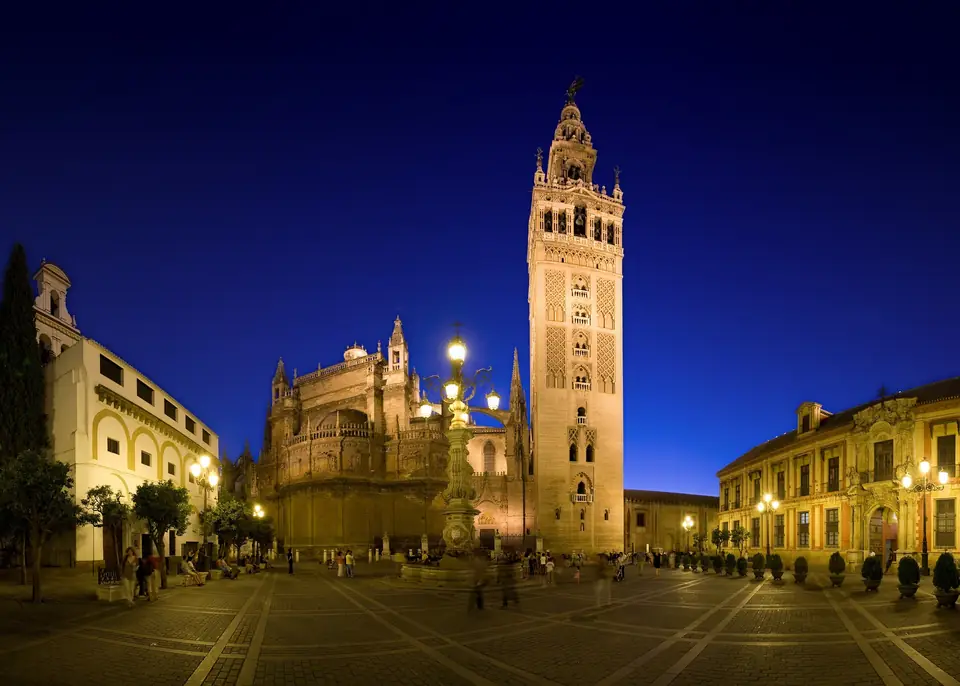
And yet the mosque did not disappear. Its minaret of 1184 still stands as the Giralda, with the Renaissance crown Hernán Ruiz II added between 1558 and 1568; its ablutions courtyard is the Patio de los Naranjos, and the Puerta del Perdón is still the entrance from Calle Alemanes. What to see in Seville Cathedral is arranged in six stops, from Plaza Virgen de los Reyes to the mosque courtyard, passing by the life-size Giraldillo, the tomb of Columbus, the largest altarpiece in Christendom and the 35 ramps of the tower. The architecture of Seville Cathedral, Almohad, Gothic and Renaissance at once, is fully understood when walked with the audio guide, stop by stop.
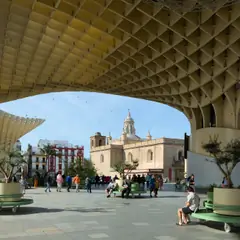
Across Plaza del Triunfo stands the Royal Alcázar of Seville, with which the cathedral shares its World Heritage status, and behind it begins the Santa Cruz Quarter, the old Jewish quarter. About ten minutes on foot to the north, the Metropol Parasol offers a timber counterpoint to the Gothic of 1401.
A tower read from the bottom up
Plaza Virgen de los Reyes
Summary of this stop
From Plaza Virgen de los Reyes the Giralda reads like a book of eras. In the first course of the base, during works in the 1990s, seven Roman altars turned up; one of them is dedicated to Marcus Julius Hermesianus, an olive-oil merchant from Astigi, today’s Écija, in the 2nd century. Above it, the brick shaft of the minaret begun in autumn 1184 with ashlar taken from the palace of Ibn Abbad. And higher still, of another stone and another time, the Renaissance bell chamber of Hernán Ruiz II, built between 1558 and 1568. Its height is given as 94.69 metres to the Giraldillo or as 104 or 105 from the ground to the weathervane, depending on how it is measured.
On 10 March 1198, after the Almohad victory at Alarcos, the minaret was crowned with the yâmûr: four great spheres of gilded bronze, so large that the biggest could not fit through the Almuédanos gate. All four fell in the earthquake of 24 August 1356. In their place, on 13 August 1568, the statue of Faith cast by Bartolomé Morel was hoisted. That weathervane was first called “Giralda”, and the name eventually slid down to the foundations to designate the whole tower.
The belfry also keeps a living ritual. At midnight on 28 June and at 9:30 and 12 on the morning of the 29th, the musicians of the Nuestra Señora del Sol cornet and drum band play the “Lágrimas de San Pedro” (Tears of Saint Peter) from the top, a melody they repeat three times on each of the tower’s four faces, in memory of the apostle’s tears after denying Jesus three times. The custom goes back to 1403 and was interrupted twice, between 1839 and 1865 and between 1961 and 1986. What exactly the Giralda plays that night and why it nearly fell silent for good is told by the narration at the foot of the tower.
Faith, life-size, on the pavement
Puerta del Príncipe
Summary of this stop
In front of the Puerta del Príncipe stands a figure almost no one has seen up close: the Giraldillo. The original weathervane measures 3.5 metres and weighs about 1,300 kilos, and in 1997 it was taken down from the tower for a restoration by the Andalusian Institute of Historical Heritage that lasted until 2003 and cost 720,000 euros. The bronze copy cast in 1998 to replace it in the meantime is the one that now stands at street level, and lets the eye measure what from below looks like an ornament.
That same scale helps to grasp the ambition of the chapter on 8 July 1401, when it decided to pull down the mosque damaged by the earthquake of 1356 and asked for a work “so good and so great that there is none to equal it”. The original minutes were lost and were transcribed by Ceán Bermúdez in 1801; the popular version, with canons who wanted to be taken for madmen, is an addition of tradition. What was lost of the mosque in that decision and what was chosen to be kept, with the 1,300-kilo weathervane as witness, is revealed by the narration at this point.
Four kingdoms carry Columbus
Tomb of Columbus
Summary of this stop
In the south arm of the transept, facing the Puerta del Príncipe, four bronze heralds 260 centimetres tall with alabaster faces carry a coffin on their shoulders. They represent Castile, León, Aragon and Navarre, and inside the coffin are the remains of Christopher Columbus. They arrived from Havana in 1899, after the loss of Cuba, as part of the baggage of an empire in retreat, and on 17 November 1902 were installed in the monument designed by Arturo Mélida.
Whether the bones really are Columbus’s was debated for a century. Santo Domingo maintains they never left its cathedral, and another theory places them in the Cartuja of Seville. In 2006 a mitochondrial DNA study by the University of Granada, which compared them with those of his brother Diego, backed those in Seville, although the debate has not fully closed on the other side of the Atlantic. What journey these remains made before reaching the shoulders of four kingdoms, and what each herald says with his posture, is heard in front of the monument.
A vault that fell twice and a wall of gold
Crossing dome
Summary of this stop
In the centre of the crossing, the eye rises to the vault and falls to the altarpiece. The dome was finished in October 1506 with the laying of the final stone; Archbishop Diego de Deza, too old to climb, followed the ceremony from the chapel of the Virgen de la Antigua, and there were no celebrations because of the recent death of Philip the Handsome. On 28 December 1511 the failure of a pillar brought it down. Juan Gil de Hontañón designed the new one, which collapsed again on 1 August 1888 and dragged Jordi Bosch’s organ down in its fall; Joaquín Fernández rebuilt it in the same form, which is what is seen today.
In front, behind a Renaissance screen of gilded iron, rises the main altarpiece: 26 metres high, 18 wide and 5 deep, more than 200 figures carved in walnut and chestnut with dozens of scenes from the life of Christ. Pedro Dancart began it in 1482 and it was considered finished in 1564, after passing through hands such as those of Jorge Fernández, Roque Balduque and Juan Bautista Vázquez the Elder. It is the largest altarpiece in Christendom, and turns the stone ambition of the 1401 minutes into gilded wood. What scene each street of the altarpiece hides and what was left under the rubble of 1888 is told here, looking up.
Thirty-five ramps and a house inside the tower
The Giralda
Summary of this stop
The Giralda is not climbed by stairs. There are 35 ramps winding around the core of the tower, with windows that gradually open onto the city, and a final stretch of 17 steps up to the bell chamber, where 25 bells hang. The ramps are wide enough for a horse, hence the oft-repeated image of the muezzin who rode up to call to prayer; it should be said that there is no documentary proof of this, and that the rider is an interpretation rather than a fact.
The inner chambers of the tower were dwellings. The warden of the Giralda and the bell-ringers lived in them with their families, and according to a documented tradition the nun Bárbara de Santo Domingo, famous for her mystical visions and therefore known as “the Daughter of the Giralda”, was born in one of them. What life was like behind these brick walls and what is heard from the bell chamber when all 25 ring at once is discovered by climbing with the narration in your ears.
The mosque courtyard, with orange trees and a crocodile
Patio de los Naranjos
Summary of this stop
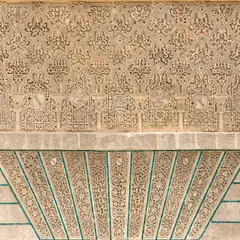
The route ends where it all began, inside the Almohad mosque itself. The Patio de los Naranjos, 43 by 81 metres, was the ablutions courtyard of the mosque that Abu Yaqub Yusuf ordered built between 1172 and 1198, and its fountain is still in the centre, among rows of orange trees. After the Christian entry of 1248 the courtyard served as a cemetery, as the site of the city’s annual fairs and as a place of preaching. It is entered through the Puerta del Perdón, the old mosque gate from Calle Alemanes, with a horseshoe arch, wooden leaves covered in bronze and plasterwork by Bartolomé López of 1522.
Between the courtyard and the cathedral opens the Puerta del Lagarto, and in the covered gallery a crocodile hangs from the ceiling with an elephant tusk, a staff of command and a horse bit. According to legend, they were part of the gifts the sultan of Egypt sent Alfonso X the Wise around 1260 to ask for his daughter’s hand: the king refused the marriage but kept the presents. The crocodile seen today is a 16th-century wooden carving, a replica of the original, and a more prosaic explanation says it was used to scare off birds.
Here the thesis of the route closes: not a cathedral on the ruins of a mosque, but a mosque still standing inside a cathedral, with its minaret, its courtyard and its water still in use. What became of the horse bit said to have belonged to a tame giraffe, and why the courtyard passed from the dead to the fairs, is heard beside the fountain.