Royal palace
Royal Alcázar of Seville Audio Guide (Real Alcázar de Sevilla)
A caliph founded his seat of government here in 913, and a Castilian king, Peter I, built on top of it a palace in the Andalusi manner with Arabic inscriptions calling him “Sultan Don Bidru”. Eleven centuries later, the Royal Alcázar of Seville is still a residence of the royal family: the oldest royal palace in use in Europe.
- 45 min of audio
- Mudéjar architecture
The Royal Alcázar of Seville was born in 913 as Dar al-Imara, the government compound that Abd al-Rahman III ordered built beside the port, on the south flank of the city. The Almohads rebuilt it completely in the 12th century, Alfonso X added a Gothic palace between 1252 and 1260 and Peter I, after the earthquake of 1356, built the Mudéjar palace with craftsmen from Toledo, Granada and Seville. Since 1987 it has formed, with the Cathedral and the Archive of the Indies, a UNESCO World Heritage ensemble.
The most refined beauty lived here alongside blood. In the same palace where Charles V married in 1526 beneath the gilded dome of the Hall of Ambassadors, Peter I had his half-brother Don Fadrique clubbed to death in 1358, and legend insists the stain is still on the marble. Beneath the Patio del Crucero, a vaulted pool survived the Lisbon earthquake of 1755 that devastated the Gothic palace.
Highlights
- Façade of Peter I — Castilian Gothic lettering and tiles with an Arabic inscription, dated 1364
- Patio de las Doncellas — The pool buried under marble in 1580 and recovered in 2002
- Hall of Ambassadors — A gilded dome of 1427 and 56 portraits of kings, from Chindasuinth to Philip III
- Baths of María Padilla — Ten vaulted bays beneath the Patio del Crucero that withstood the 1755 earthquake
- Fountain of Fame — The only fountain of its style in Spain, with a water organ that sounds on the hour
The Royal Alcázar of Seville is a government compound that has been in use for eleven centuries. In 913 the caliph of Córdoba Abd al-Rahman III al-Nasir ordered the Dar al-Imara built on the south flank of the city, beside the port: an almost square compound about 100 metres on each side, built where a Visigothic Christian basilica had once stood. The Almohads rebuilt it entirely in the 12th century and linked it by walls to other fortifications as far as the bed of the Guadalquivir. After the Castilian conquest of 1248, Ferdinand III touched nothing and the court lived for decades in Almohad halls; Alfonso X built the Gothic palace between 1252 and 1260, and Peter I, after the earthquake of 1356, the Mudéjar palace that gives the complex its fame today. In 1987 UNESCO inscribed the Cathedral, the Alcázar and the Archive of the Indies as a World Heritage Site.
The history of the Royal Alcázar of Seville is also that of the Crown. Here the Catholic Monarchs created in 1503 the Casa de Contratación de Indias, which regulated trade and navigation with America until its move to Cádiz in 1717; here, according to a documented tradition, Isabella I gave birth on 30 June 1478 to Prince John, in the chamber that has been called the Prince’s Room ever since; and here Charles V married Isabella of Portugal in 1526. The royal family still stays in the Upper Palace when visiting Seville, which makes the building the oldest royal palace in use in Europe. Film has lived here too: “Lawrence of Arabia” shot here in 1962 and “Game of Thrones” turned it into the kingdom of Dorne in 2015 and 2016.
The architecture of the Royal Alcázar of Seville reads as superimposed layers: each king, Muslim or Christian, built on top of the previous one without erasing it. Almohad horseshoe arches turned into round ones, plasterwork by craftsmen from Toledo, Granada and Seville, a Renaissance floor of Charles V above the Patio de las Doncellas, a Neo-Mudéjar mezzanine of 1847-1855 in the Patio de las Muñecas, where, according to popular belief, finding the nine little faces carved at the springing of an arch brings luck, and a 12th-century wall disguised as a grotto in 1612. What to see in the Royal Alcázar of Seville is arranged in six stops, from the Lion Gate to the Fountain of Fame, passing the façade of Peter I, the Patio de las Doncellas, the dome of the Hall of Ambassadors and the baths of María Padilla; each holds a detail that is only fully understood when walked with the audio guide.
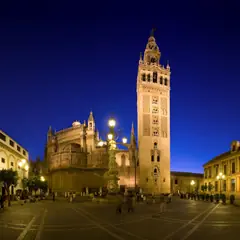
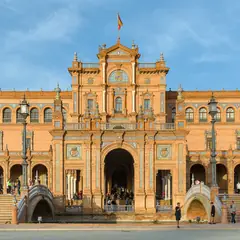
Seville Cathedral is a step away, in the same Plaza del Triunfo. To the south, about ten minutes on foot, opens Plaza de España, and toward the river, at a similar distance, the Maestranza Bullring.
A gate with a lion for a thousand years of power
Lion Gate
Summary of this stop
From Plaza del Triunfo, the Lion Gate opens the outer wall of the compound. The name seems to be from the 19th century: it used to be called the Montería gate, and the reason is disputed. Ortiz de Zúñiga, in the 17th century, explained it by the king’s departure with his hunting huntsmen; José Gestoso, by some hunting reliefs. What is not disputed is what it protects: not just any castle, but the heart of Seville’s government since the caliphate of Córdoba.
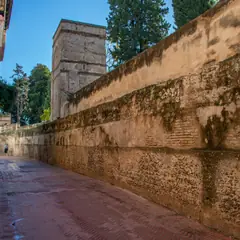
In 913 Abd al-Rahman III al-Nasir ordered the Dar al-Imara built here, an almost square compound about 100 metres on each side, beside the port and on the site of a Visigothic Christian basilica. The Almohads rebuilt it entirely in the 12th century and linked it to a system of walls that reached the Guadalquivir. At the back of the Patio del León stands a stretch of that wall with three porticoes; its arches were born horseshoe-shaped and turned into round arches in Christian times.
That double origin, caliphal and Almohad, is what UNESCO recognised in 1987 when it inscribed the ensemble of the Cathedral, the Alcázar and the Archive of the Indies as a World Heritage Site, testimony of Almohad civilisation and of Christian Seville. What became of the basilica on which the compound was built and what remains of it beneath the courtyard is what the narration reveals in front of the gate.
Gothic and Arabic lettering for a king who signed as a sultan
Patio de la Montería
Summary of this stop
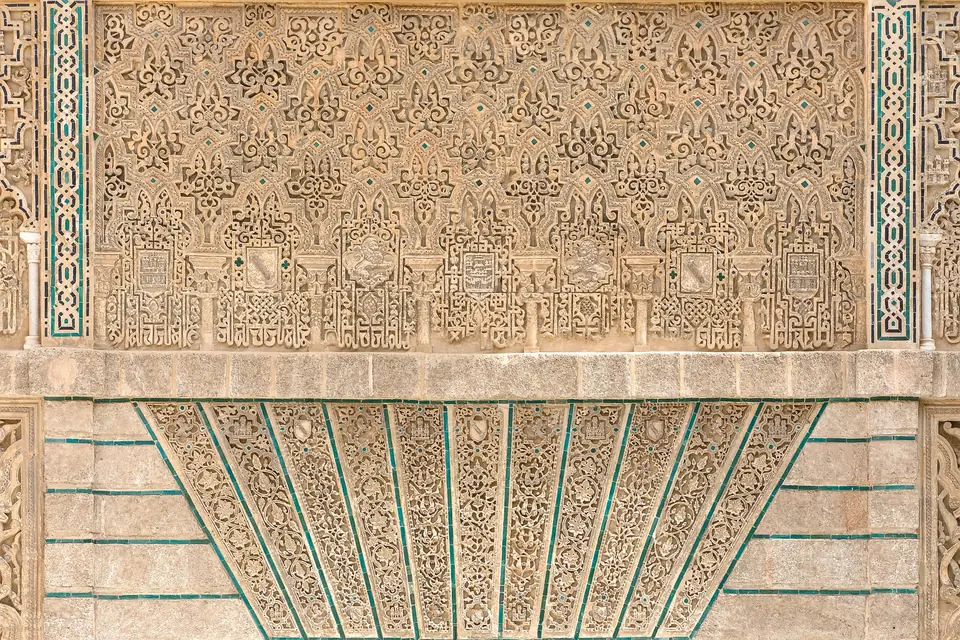
The façade of Peter I’s palace presides over the Patio de la Montería: a great timber eave over gilded muqarnas, a tile mural with an Arabic inscription and, below, a frieze in Castilian Gothic lettering proclaiming that Don Pedro “ordered these alcázares and these palaces and these doorways made”, dated to the year 1402 of the Spanish Era, that is, 1364. Inside, other Arabic inscriptions call the Castilian king “Sultan Don Bidru”. A single doorway sums up the paradox of a Christian monarch who commissioned a palace in the Andalusi manner and had himself named like a sultan.
Popular tradition adds a dark episode to the courtyard. It is said that in 1362 the Nasrid king Muhammad VI of Granada came to Seville to ask Peter I to end the war, that the king had him seized during a banquet along with fifty knights of his retinue and that, a few days later, he killed him personally with a lance thrust at Tablada. On searching the body a great red spinel would have turned up, which passed into the king’s hands and which years later the Black Prince claimed as payment for his help at the battle of Nájera: according to that tradition, it is the so-called Black Prince’s Ruby, which today shines at the front of the Imperial State Crown of Britain.
A century and a half later, this same courtyard controlled the trade of a continent. In 1503 the Catholic Monarchs created the Casa de Contratación de Indias in the Alcázar, which regulated trade and navigation with America and inspected merchandise; it occupied the area from today’s Plaza de la Contratación to the Patio de la Montería, in the rooms on the western side where the Admiral’s Room is visited today, and did not move to Cádiz until 1717. What exactly the Arabic inscriptions inside say and why a Castilian king wanted to read them above his head is heard in front of the façade.
The pool that spent four centuries under marble
Patio de las Doncellas
Summary of this stop
The Patio de las Doncellas, 21 by 15 metres, is the heart of the Mudéjar palace. Peter I had it built after the earthquake of 1356, pulling down three Almohad palace buildings to attach his new palace to Alfonso X’s Gothic one. Work began that year and ended in 1364, although another reading of the inscriptions puts the start in 1364 and the end in 1366; in any case, in 1366 civil war broke out with his half-brother Henry II, ending with Peter’s death in 1369. Craftsmen from Toledo, Granada and Seville took part in the work, and everything suggests that his Nasrid ally, Muhammad V of Granada, sent his own to help with the construction and decoration. The Renaissance upper floor is an addition by Charles V, from between 1540 and 1572.
The courtyard seen today, with its central pool and its flower beds sunk one metre, was hidden for over four centuries. Between 1580 and 1584 everything was buried under a marble floor, and it did not see the light again until the archaeological excavations begun in 2002, directed by Miguel Ángel Tabales. The courtyard’s name, incidentally, is linked to the apocryphal story of an annual tribute of one hundred maidens demanded by Muslim rulers from the Christian kingdoms, a tale with no historical basis.
Among lobed arches and plasterwork, the palace also holds a fratricide. In May 1358 Peter I lured his half-brother Don Fadrique, master of the Order of Santiago, to the Alcázar, and some of the king’s crossbowmen clubbed him to death. From that crime came the legend that the master’s blood remained indelible on the marble floor; popular versions do not agree on the room, which some place in the Hall of Justice and others in the Hall of Tiles, nor on the weapon, which in some turns into a dagger wielded by the king himself. There are still visitors who walk through these rooms looking at the floor. Where each version points and what truth there is in the stain is what the narration tells beneath the gallery.
A sky of gold for an imperial wedding
Hall of Ambassadors dome
Summary of this stop
The Hall of Ambassadors is covered by a gilded hemispherical dome, of the type called “media naranja”, made by Diego Ruiz in 1427. Beneath it runs a frieze of 56 panels painted by Diego de Esquivel between 1599 and 1600 portraying the kings from Chindasuinth to Philip III: a gallery of power that puts Gothic, Castilian and Habsburg monarchs in a single line. The room is completed by 14th-century wooden doors with Arabic inscriptions and 16th-century wooden balconies.
Here power became spectacle. In 1526 Emperor Charles V, Charles I of Spain, married his cousin Isabella of Portugal beneath this dome, and for the occasion the Jardín de las Damas was laid out that same year, which can still be walked among myrtle hedges. What that union celebrated, and why an emperor chose a Mudéjar palace to marry in, is revealed beneath the gold of the dome with the narration in your ears.
What remained of the palace that fell
Baths of María de Padilla
Summary of this stop
After the Castilian conquest of 1248, Ferdinand III did not remodel the Alcázar and the Christian court settled for decades in the Almohad spaces. It was Alfonso X who, between 1252 and 1260, built the Gothic palace using the main building, beside today’s Patio del Crucero. Of that palace much less remains today than once stood.
The Lisbon earthquake of 1755 destroyed a good part of the Gothic palace. After the catastrophe, the lower garden of the Patio del Crucero, 4.7 metres below, was filled with earth, and from today’s courtyard the traces of that level can still be made out. Only the vaulted cellar known as the baths of María Padilla survived, reached from the Jardín de la Danza: a nave of ten bays with rib vaults over a long pool of water.
The name comes from Peter I’s mistress, though the structure has no connection to her: one source dates it to the Almohad 12th century and another links it to Alfonso X’s Gothic palace. Legend says María de Padilla bathed in this pool, malicious tongues add that she did so naked, and that courtiers, to win the king’s favour, went so far as to drink the water in which she had bathed. In the damp half-light of the cistern, the narration separates what the stones say from what legend imagines.
A wall disguised as a grotto and a fountain that sounds like an organ
Fountain of Fame
Summary of this stop
In 1612 the Milanese architect Vermondo Resta transformed a stretch of 12th-century Almohad wall, which also defended against the floods of the Tagarete stream, into the Galería de Grutescos: irregular stones, imitation marble and mythological frescoes by Diego de Esquivel turned the old defence into a garden theatre. Its upper gallery can be visited and opens over the gardens.
Attached to it, in the Jardín de las Damas, the Fountain of Fame is the only fountain of its style left in Spain. Its hydraulic mechanism, restored, makes the pipes of an organ sound on the hour with the passage of water, facing the garden laid out in 1526, divided into compartments of myrtle hedges around a central fountain with a bronze Neptune. Not far away, the Puerta de Marchena, a 15th-century Gothic doorway brought in 1913 from a palace of the Dukes of Arcos, leads to the Jardín de la China.
The Alcázar is still alive. It is the residence of the Spanish royal family when it visits Seville, the oldest royal palace in use in Europe: the Upper Palace, above the Mudéjar palace, is attached to Patrimonio Nacional, and the rest is managed by the Royal Alcázar Board. It has also been a film set, from “Lawrence of Arabia” in 1962 to “Game of Thrones”, which in its fifth and sixth seasons, in 2015 and 2016, turned it into the kingdom of Dorne. How the water organ works and why a wall ended up disguised as a grotto is what is heard in front of the fountain.