Former Jewish quarter
Santa Cruz Quarter Audio Guide (Barrio de Santa Cruz)
Seville's most photographed neighbourhood is its old Jewish quarter: attacked in 1391, emptied after 1492 and rebuilt in the early 20th century as a maze of Andalusian squares designed for visitors. Beneath its orange trees lie a church that was once a synagogue, a painter buried under a square and a street that no longer exists.
- 35 min of audio
- Seville's former Jewish quarter
Seville's Jewish quarter took shape in this part of the old town after Ferdinand III of Castile conquered the city in 1248, closed off by a wall that separated it from the rest of the city as far as today's Puerta de la Carne. On 6 June 1391 a crowd stirred up by the archdeacon of Écija, Ferrand Martínez, attacked it and some 4,000 Jews were killed; the synagogues passed to Christian use and the enclosure was divided into three parishes with their churches: San Bartolomé, Santa María la Blanca and Santa Cruz. After the expulsion of 1492 the quarter entered a long decline.
The “Andalusian” air that defines it today is almost a stage set. Between 1912 and 1920 the Marquis of Vega-Inclán, royal commissioner for tourism, drove a remodelling that created Andalusian-style squares to give visitors local colour, and even the wrought-iron cross in Plaza de Santa Cruz is a newcomer: Sebastián Conde made it in 1692 for the crossing of Sierpes and Rioja streets, and it was not installed here until 1921, on the site of the demolished church that gives the quarter its name.
Highlights
- Santa María la Blanca — A 13th-century synagogue with a Gothic doorway and a Baroque nave of 1662-1665
- Plaza de Santa Cruz — The site of the church demolished in 1814, beneath which Murillo lies
- Callejón del Agua — The passage beside the wall where water ran to the Alcázar
- Calle Susona — The tile skull of the Street of Death and the conspiracy of 1480
- Hospital de los Venerables — A Baroque asylum of 1676 that now holds Velázquez's Saint Rufina
The Santa Cruz Quarter (Barrio de Santa Cruz) is the old Jewish quarter of Seville. After Ferdinand III of Castile conquered the city in 1248, the Jewish community settled in this part of the old town, next to the Alcázar, and a wall separated it from the rest of the city; the enclosure ended at today’s Puerta de la Carne, formerly called Bab Chauar, or Gate of the Pearls, and later the Minjoar Gate. On 6 June 1391 a crowd stirred up by the archdeacon of Écija, Ferrand Martínez, attacked the Jewish quarter and killed some 4,000 Jews, a large part of Seville’s community. The synagogues passed to Christian use and the enclosure was divided into three parishes with their churches: San Bartolomé, Santa María la Blanca and Santa Cruz. The Alhambra Decree of 1492, which expelled the Jews from Spain, closed the cycle with a long decline.
The history of the Santa Cruz Quarter that visitors walk today is, to a large extent, 20th-century. In 1810, during the French occupation, the demolition of the parish church of Santa Cruz was decreed to open up a square; the church fell in 1814 and its site is today’s square. A century later, between 1912 and 1920, the Marquis of Vega-Inclán, royal commissioner for tourism, drove a remodelling that created “Andalusian-style” squares to give “local colour” for tourism. The marquis himself bought houses on Calle Pimienta between 1911 and 1912, the last one number 10 in March 1912; Joaquín Sorolla stayed in that house while painting a panel for the Hispanic Society, and in 1925 another house in the quarter was dedicated to Washington Irving in memory of his stay in Seville. The layers go much further back: according to a documented tradition, six columns of a Roman temple were still standing in this area in the Middle Ages; in the 14th century Peter I wanted to take one to the Alcázar, it broke during the move and its remains lay for a time where Calle Mateos Gago runs today, while three columns of the portico survive on Calle Mármoles.
The architecture of the Santa Cruz Quarter reads in strata: the Gothic doorway added to a synagogue, the Baroque of Canon Justino de Neve at Santa María la Blanca and the Hospital de los Venerables, the Alcázar wall that runs alongside the Callejón del Agua, crooked passages such as the Callejón de la Judería, which links Calle Vida with the Patio de Banderas, and the orange-tree squares of the Vega-Inclán remodelling. On Calle Santa Teresa, the convent of San José del Carmen, the Teresas, which Teresa of Ávila founded in late April 1576 in the former palace of the banker Pedro Morga, keeps in the relic case of its sacristy the autograph manuscript of The Interior Castle, written by the saint in 1577. What to see in the Santa Cruz Quarter is arranged in six stops, from the church that was a synagogue to the Baroque asylum that now guards a Velázquez, and each hides something that is no longer there: a church, a theatre, a whole street. What is missing in each square is easier to grasp when walking them with the audio guide.
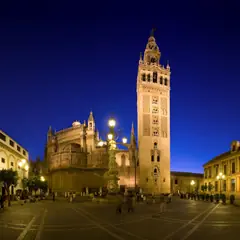
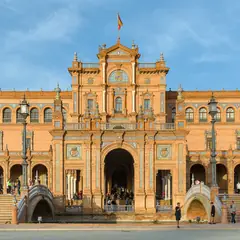
The quarter lies behind Seville Cathedral and borders the Royal Alcázar of Seville, some two hundred metres away. To the south, Plaza de España is less than a kilometre away.
A synagogue read through a church doorway
Santa María la Blanca Church
Summary of this stop
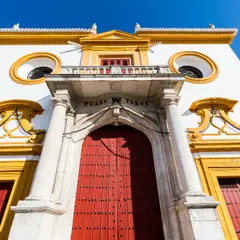
At the edge of the quarter, Santa María la Blanca presents a Gothic façade added at the foot of a building that was not born as a church: it was a 13th-century synagogue, converted to Christian worship after the attack of 1391. Inside, the church changes century: between 1662 and 1665 its nave and vaults were rebuilt in a project promoted by Canon Justino de Neve, and the Baroque nave rests on red marble columns.
Here began the Jewish quarter that Ferdinand III of Castile allowed to organise after taking Seville in 1248. A wall separated it from the rest of the city and its enclosure ended at today’s Puerta de la Carne, formerly called Bab Chauar, or Gate of the Pearls, and later the Minjoar Gate. The quarter that now seems open on every side was for a century and a half a closed enclosure.
What remains of the 13th-century building beneath the Baroque nave, and how a whole community fitted behind that wall, is revealed by listening to the narration in front of the doorway.
Murillo beneath a square with no church
Plaza de Santa Cruz
Summary of this stop
The quarter takes its name from a church that no longer exists. Santa Cruz was one of the three parishes into which the old Jewish quarter was divided after 1391, along with San Bartolomé and Santa María la Blanca. In 1810, during the French occupation, its demolition was decreed to open up a square; the church was pulled down in 1814 and Plaza de Santa Cruz is, literally, its empty site.
Bartolomé Esteban Murillo rests beneath that ground. The painter was buried in 1682 in the church of Santa Cruz and, when the church disappeared, his grave ended up beneath today’s square. A plaque on the west façade commemorates him.
In the centre stands a wrought-iron cross that is not from here either. It was made in 1692 by the ironworker Sebastián Conde, from Almonte, for the crossing of Sierpes and Rioja streets, and reached the square in 1921, as part of the development planned by Juan Talavera y Heredia in 1918. It is popularly known as the Cruz de la Cerrajería, although it is in fact the Cruz de la Sierpes; the Cerrajería cross was another one, of wood, now gone. Why a new square needed an old cross is told by the narration beside the railing.
Water for the king beside the wall
Callejón del Agua
Summary of this stop
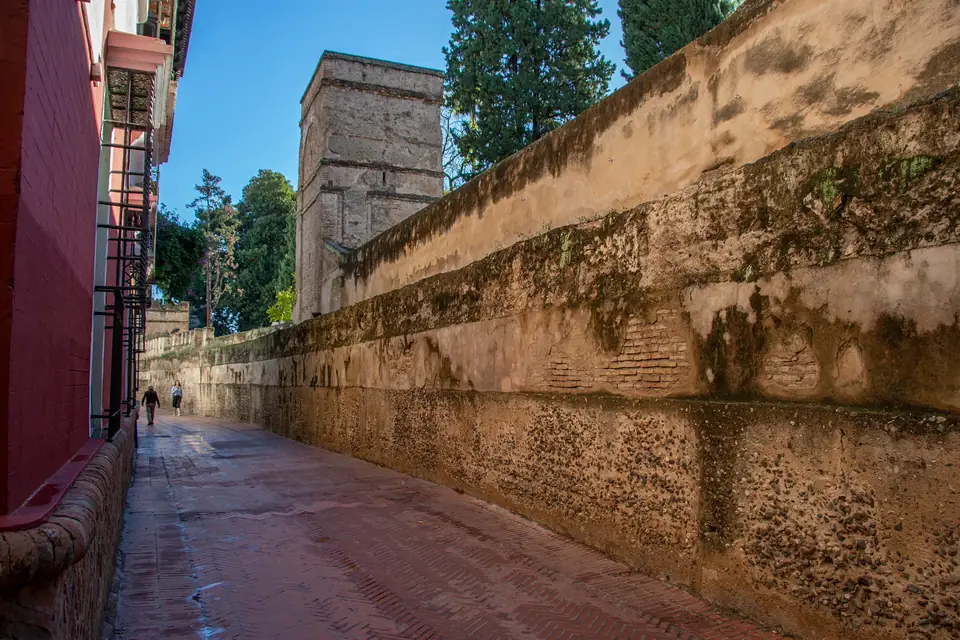
The Callejón del Agua runs against the wall and parallel to the gardens of the Royal Alcázar, at the very edge of the quarter. It is a narrow passage of shade and echo, not built for strolling: its name comes from the channel that carried water from the Caños de Carmona to the Royal Alcázar.
On the street side, the alley is walked like a frontier; on the other side of the wall lie the gardens of the royal palace. Exactly where the water ran and what separates this passage from the Alcázar gardens is told by the narration between its walls.
The skull on the Street of Death
Calle Susona
Summary of this stop
At number 10 Calle Susona, popularly called the Street of Death, two tiles commemorate Susona Ben Susón, daughter of Diego Susón; one of them bears a skull. Diego Susón was one of the ringleaders of a conspiracy of around 1480, an episode recorded as historical fact. What tradition adds about his daughter belongs to legend.
The skull is also the quarter’s deepest wound. On 6 June 1391 the crowd stirred up by the archdeacon of Écija, Ferrand Martínez, attacked the Jewish quarter and some 4,000 Jews died, a large part of Seville’s community. A century later, the Alhambra Decree of 1492 expelled the Jews from Spain and the quarter fell into decline.
What the legend says about Susón’s daughter, and why a skull marks this particular door, is revealed by listening to the narration in front of the tile.
Orange trees over a lost theatre
Plaza de Doña Elvira
Summary of this stop
Plaza de Doña Elvira, small and planted with orange trees, occupies the plot that Henry III granted to Pedro López de Ayala and that Elvira López de Ayala inherited. The Doña Elvira playhouse stood here, one of the theatres of old Seville, until in 1826 the city governor José Manuel de Arjona opened up today’s square.
The orange trees also hide a street that no longer exists. According to a documented tradition, the nobleman Miguel Mañara was walking through the quarter at night with his page Alonso Pérez de Velasco when, near the church of Santa Cruz, he heard funeral chants without seeing anyone. On reaching Calle Ataúd (Coffin Street), a narrow alley that ran into Calle Vida, he received a blow that knocked him to the ground, and both heard a voice: “bring the coffin, he is already dead”. The street disappeared in the 19th century when Plaza de Doña Elvira was enlarged; its street sign is kept in a courtyard of the Hospital de la Caridad, the institution Mañara would later found.
Why that blow, according to the legend, saved Mañara’s life, and what awaited him that night at home, is told by the narration in the middle of the square.
Don Juan and Velázquez in the same square
Hospital de los Venerables
Summary of this stop
Plaza de los Venerables is home to the Hospital de los Venerables, a residence for elderly priests promoted by Canon Justino de Neve. Work began on 13 April 1676 and its church opened in 1699 with mural paintings by Juan de Valdés Leal and his son Lucas Valdés. The Baroque building is organised around a central courtyard with galleries on marble columns.
Since 5 November 1991 the hospital has been the seat of the Focus Foundation, which in 2007 bought Velázquez’s “Saint Rufina” and created the Centro Velázquez here. The priests’ asylum now holds one of Seville’s great painters.
The square boasts another lodger as well. Legend says that the writer José Zorrilla, from Valladolid, stayed at the Hostería del Laurel when he created Don Juan Tenorio, and the quarter believes it enough to have raised a statue to him a few steps away, in Plaza de los Refinadores. It is a fitting close for a quarter that has told its own story since, between 1912 and 1920, the Marquis of Vega-Inclán turned it into an Andalusian stage set for visitors. What is true about Zorrilla’s inn and what remains of the Jewish quarter beneath so many postcards is revealed by listening to the narration in front of the hospital.