Mausoleum and independence square
Ho Chi Minh Mausoleum Audio Guide (Lăng Chủ tịch Hồ Chí Minh)
A block of grey granite rises on the exact spot where Ho Chi Minh proclaimed independence in 1945 and holds his embalmed body, against what he himself left in writing. In front, Ba Dinh Square is still Vietnam's great ceremonial stage.
- 45 min of audio
- 1945 independence square
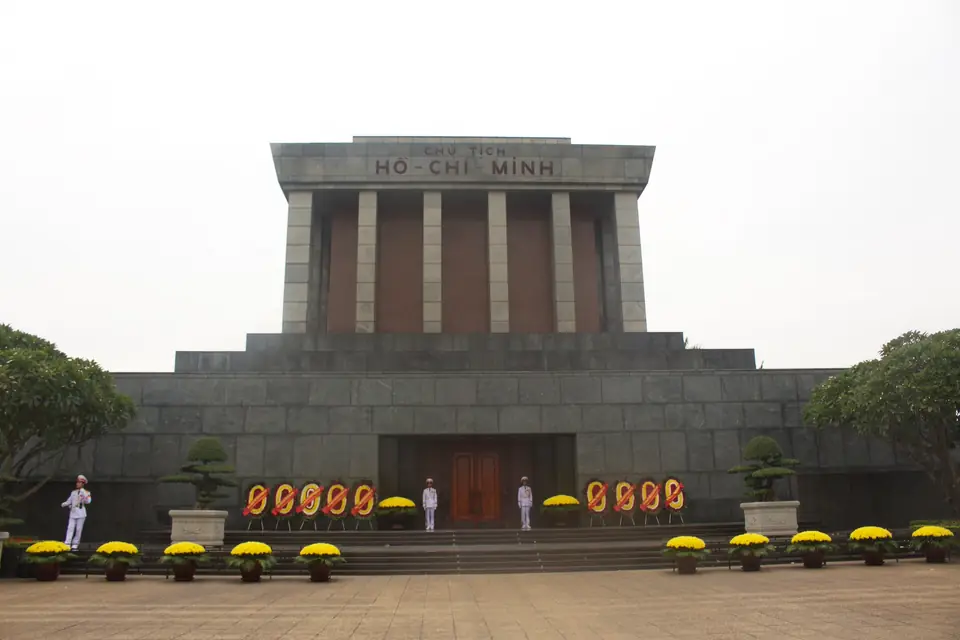
The Ho Chi Minh Mausoleum, which the Vietnamese call Lăng Bác, the Uncle's mausoleum, is the work of the Soviet architect Garol Isakovich and takes the Lenin Mausoleum as its model. Begun on 2 September 1973 and inaugurated on 29 August 1975, it is 21.6 metres high and 41.2 wide, with a square colonnade on all four sides and a stepped roof. In front of it stretches Ba Dinh Square, born in 1894 as a French colonial garden on a levelled hill and the scene, on 2 September 1945, of the Declaration of Independence that founded the Democratic Republic of Vietnam.
The contrast is inside. Ho Chi Minh asked in his will to be cremated and to have his ashes scattered across the country's three regions; the Politburo decided to preserve his body permanently. Today he lies in a glass case in a faded khaki suit and rubber sandals, and between 1969 and 2014 82 Soviet and later Russian specialists travelled to Vietnam to keep him intact.
Highlights
- Ba Dinh Square — Lawn grid where Ho Chi Minh read the Declaration of Independence on 2 September 1945
- Mausoleum facade — Grey granite, a colonnade on four sides and 21.6 m high, modelled on the Lenin Mausoleum
- 79 cycads and two rows of bamboo — One cycad for each year of Ho Chi Minh's life
- The glass case chamber — Khaki suit, rubber sandals and two flags made of 4,000 pieces of Thanh Hóa stone
- 30 m flagpole — Flag raised at dawn and lowered at 21:00, every day
In Hanoi, at the far end of a gridded lawn esplanade, a block of grey granite crowned by the inscription “CHỦ TỊCH HỒ-CHÍ-MINH” holds the embalmed body of the founder of modern Vietnam. It is the Ho Chi Minh Mausoleum, officially Lăng Chủ tịch Hồ Chí Minh, and for the Vietnamese simply Lăng Bác, the Uncle’s mausoleum. In front opens Ba Dinh Square, where on 2 September 1945 Ho Chi Minh read the Declaration of Independence that founded the Democratic Republic of Vietnam, and which has remained the country’s great ceremonial stage ever since.
The history of the Ho Chi Minh Mausoleum and Ba Dinh Square reads in layers: the Núi Khán hill, levelled by the French in 1894 to create the Puginier garden; the renaming of 1945 in memory of an anti-French uprising; the wooden platform raised in 48 hours for the proclamation; Ho Chi Minh’s death in 1969 and the decision to preserve his body, against what his will asked; and the work of 1973 to 1975 that placed the mausoleum right where that platform had stood. According to the account that has come down to us, while construction lasted the body was kept far from the city, in a “glass house” and an underground shelter at the Đá Chông base, in the Ba Vì mountains: a spot that Ho Chi Minh himself had chosen in May 1957 for its landscape of mountain and water.
The architecture of the Ho Chi Minh Mausoleum was also a national consultation. Between May and August 1970, 200 design proposals were received; 24 were exhibited in Hanoi, Hai Phong, Thai Nguyen, Son La and Nghe An before 745,487 visitors, who left 34,022 opinions. The final, Soviet-inspired building was designed to withstand bombing and magnitude 7 earthquakes, with protection against flooding from broken dikes and a special chamber to keep the body in situ in case of war. Such zeal surrounded the preservation technique that, according to Li Zhisui, Mao Zedong’s personal physician, in 1976 Beijing sent two people to Hanoi to learn it and Vietnam did not let them see the body; the episode rests on that testimony and remains disputed.
What to see at the Ho Chi Minh Mausoleum and Ba Dinh Square is arranged in four stops, from the lawn grid to the fence of the Presidential Palace, and the whole makes full sense when walked with the audio guide.
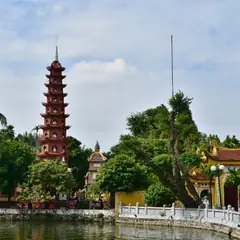
About five hundred metres away, the Imperial Citadel of Thang Long keeps the bunker from which the war was directed; many of the independence leaders had earlier passed through the cells of Hoa Lo Prison, and a little over a kilometre to the north the Tran Quoc Pagoda looks out over West Lake.
A levelled hill and a 48-hour platform
Ba Dinh Square
Summary of this stop
At the east end of Ba Dinh Square, the esplanade presents itself as a geometric void: squares of lawn separated by 1.4-metre paths and crossed by the parade avenue. Even their number is not settled. Some sources speak of 240 and others of 210; the Vietnamese version explains that there were 240 until a transverse row was removed to build the new National Assembly, leaving 7 by 30.
Beneath that geometry there was another landscape. In 1894 the French demolished the Hanoi citadel, levelled the Núi Khán hill and planted in its place a garden christened Vườn hoa Puginier. In 1945 Mayor Trần Văn Lai renamed it Ba Đình garden, in memory of the anti-French Ba Đình uprising in Thanh Hóa, which Đinh Công Tráng led in 1886 and 1887: the settlers’ park came to bear the name of a rebellion against them.
The decisive moment was prepared in two days. Between 30 August and 1 September 1945, the painter Lê Văn Đệ and the architect Ngô Huy Quỳnh raised with wood, nails and cloth the platform from which, on 2 September, Ho Chi Minh read the Declaration of Independence. What became of that ephemeral stage, and why it still marks the square, is revealed by listening to the narration right there.
Soviet granite and sand of the Mường people
Ho Chi Minh Mausoleum
Summary of this stop
In front of the facade appears the grey granite block, with its square colonnade, its stepped roof and, at the top, the inscription in dark red stone from Cao Bằng. In front of the entrance, which faces east, two honour-guard soldiers change shift every hour. The site is no accident: the wooden proclamation platform was dismantled on the very afternoon of 2 September 1945, and the mausoleum was later raised on its old site. The work, by the Soviet architect Garol Isakovich and with the Lenin Mausoleum as its model, began on 2 September 1973 and was inaugurated on 29 August 1975.
The materials gather the whole country: sand from the Kim Bôi streams, in Hòa Bình, brought by the Mường people; 16 kinds of precious wood from the Trường Sơn range; and 20,000 slabs of polished granite and marble from the USSR. In front and behind grow 79 cycads, one for each year of Ho Chi Minh’s life, and on the north and south sides, two rows of bamboo, the symbol of Vietnam.
A living ritual also begins here. The Vietnamese do not go “to the mausoleum”, they go to Lăng Bác, to see the Uncle. The visit is free and strict: no overly short or revealing clothing, no cameras, no phones that record or photograph, no food or drink; phones go off and the queue moves in silence. Every year the building closes for several weeks for maintenance: in 2023, viewing of the body was suspended from 12 June to 14 August.
A khaki suit against Soviet machinery
Glass Case Chamber
Summary of this stop
The central chamber is dimly lit and lined with Ha Tay marble. On a bronze bed with lotus motifs, in a glass case guarded by four soldiers during visiting hours, lies Ho Chi Minh in a faded khaki suit and rubber sandals. Above him, two flags composed of 4,000 pieces of Thanh Hóa stone.
The scene holds a contradiction. His will asked for cremation and for his ashes to be scattered across the country’s three regions; after his death in 1969, the Politburo of the Third Central Committee decided to preserve the body permanently, a decision that clashes with that written last wish. The embalming was done at Military Hospital 108 in Hanoi with the Soviet academician Yuri Lopukhin and experts from the Lenin Mausoleum Institute, and between 1969 and 2014 82 Soviet and later Russian specialists travelled to Vietnam to preserve it.
There was a moment when the body came close to leaving the country. According to an episode of documented tradition, in September 1969 the Soviet delegation that came for the funeral, led by Alexei Kosygin, insisted on taking it to the USSR, and Lê Duẩn refused on behalf of Vietnamese custom. How that refusal took shape in the small hours, and what Ho Chi Minh’s own reaction had been when the idea was raised with him years earlier, is the part of the story the audio guide reserves for this chamber.
A daily flag and a hidden date
Presidential Palace (Phủ Chủ tịch)
Summary of this stop
Before the fence of the Presidential Palace, the square reveals itself as a stage of State. To the north and south of the mausoleum extend two 65-metre grandstands from which the leaders preside over parades, and around them one recognises the Presidential Palace, the National Assembly and the Ministry of Foreign Affairs; at the end of the axis, Bắc Sơn street and the martyrs’ monument.
At the centre, the 30-metre flagpole marks the daily pulse: the flag is raised at 6:00 from 1 April to 31 October, or at 6:30 from 1 November to 31 March, and lowered at 21:00. The square hosted Ho Chi Minh’s funeral on 9 September 1969, the reunification parade on 2 September 1975 and the great parade for the 80th anniversary of independence on 2 September 2025.
The closing carries an uncomfortable date. Some 250,000 people and 5,000 official guests attended the funeral, but the day of death announced then was not the real one. Why the State decided to change it, and for how long it kept the secret, is the last twist the narration reveals in front of the fence.