Heart of Hanoi
Hoan Kiem Lake Audio Guide (Hồ Hoàn Kiếm)
A piece of the old Red River trapped in the middle of Hanoi, with a legendary name: the Lake of the Returned Sword, where tradition says a golden turtle claimed from King Lê Lợi the sword that had carried him to victory. And in a room of the temple on its islet, a very real giant turtle.
- 45 min of audio
- Legend of the returned sword
Hoan Kiem Lake is what remains of a stretch of the old Nhị Hà, the Red River: 115,511 m² of water between Đinh Tiên Hoàng, Hàng Khay and Lê Thái Tổ streets. Its name, Hoàn Kiếm or Hồ Gươm, means “lake of the returned sword” and comes, according to tradition, from an episode in 1428. Its shores gather centuries of architecture: the Ngọc Sơn Temple and the Pen Tower, restored in 1865 by the scholar Nguyễn Văn Siêu; the Turtle Tower, finished in 1886 with pointed arches of French influence and a curved Vietnamese roof; and the Hòa Phong Tower, the only remnant of a pagoda taken down in 1898.
The turtle of the legend had flesh-and-blood relatives. On 2 June 1967 a giant softshell turtle of 200 kg and 1.9 m died in the lake, and its body is still on display in the Ngọc Sơn Temple. The last one, which the people of Hanoi called “Cụ Rùa”, the great-grandmother turtle, was found dead in January 2016, on the eve of the Communist Party congress, and many read its end as a warning about the handover of power.
Highlights
- Lê Thái Tổ Memorial — Bronze statue of the king with the sword in his hand, on the west shore
- Thê Húc Bridge — 45 metres of red-painted lim wood to the Ngọc Sơn islet
- Pen Tower — A stone brush tip and the inscription “write on the blue sky”
- Ngọc Sơn Temple — A 200 kg giant lake turtle, preserved in its back room
- Turtle Tower — 1886, French pointed arches and a Vietnamese roof in the middle of the water
In the very centre of Hanoi, Hoan Kiem Lake (Hồ Hoàn Kiếm), the Lake of the Returned Sword, looks like a still pond ringed by trees and traffic. It is much more than that: it is what remains of a stretch of the old Nhị Hà, the Red River, left trapped inside the city, 115,511 m² of water bounded today by Đinh Tiên Hoàng, Hàng Khay and Lê Thái Tổ streets. The Trịnh lords split it in two, Tả Vọng and Hữu Vọng, and from 1884 the French protectorate filled in the southern half to build up the city. What survived is today’s lake, and with it the legend that gives it its name: according to tradition, in early 1428 a golden turtle rose from its waters to claim from King Lê Lợi the sword that the Dragon King had lent him to drive out the Ming.
The history of Hoan Kiem Lake is made of layers. According to documented traditions, in 1728 Lord Trịnh Giang had an underground palace, the Thưởng Trì Palace, dug on the south shore, and between 1735 and 1739 he built the Khánh Thụy Palace on the east shore, which King Lê Chiêu Thống had burned down in 1787 to take revenge on the fallen Trịnh; the Ngọc Sơn Temple later rose on that razed site. Then came the scholar Nguyễn Văn Siêu, who in 1865 rebuilt the temple islet with its red bridge and its brush-shaped tower, and the colonial era, which left a hybrid tower in the middle of the water and, for a time, a replica of the Statue of Liberty.
Anyone wondering what to see at Hoan Kiem Lake will find a walk of five stops: the memorial to the sword king, the Pen Tower and the stone inkwell, the Ngọc Sơn Temple with its embalmed giant turtle, the Turtle Tower and the Hòa Phong Tower. The architecture of Hoan Kiem Lake mixes pagodas, scholars’ gates and Franco-Vietnamese towers, but the thread running through it all is an animal: of the four known giant turtles of the lake, none is still alive, and one of them, around 1962 or 1963, is said to have ended up in somebody’s cooking pot in the Chí Linh garden, a few steps from the shore. The audio guide goes round all of it, shore by shore, with a narration researched and fact-checked against historical sources.
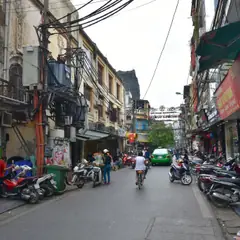
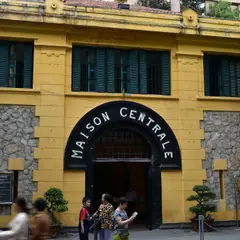
North of the shore begin the trade streets of the Hanoi Old Quarter, and about eight hundred metres away Hoa Lo Prison keeps the gate of the colonial jail.
The king who had to give back the sword
Lê Thái Tổ Memorial
Summary of this stop
On the west shore, under a double-roofed pavilion, a 1.2 m bronze statue shows King Lê Thái Tổ, Lê Lợi, with the sword in his right hand. It is the natural starting point of the walk, because this is where the origin of the lake’s name is told. According to tradition, in early 1428, as the king was sailing with his court on what was then Lake Tả Vọng, a golden turtle, Kim Quy, surfaced and claimed the sword that the Dragon King had lent him to drive out the Ming. Ever since, the lake has been called Hồ Gươm or Hoàn Kiếm, “lake of the returned sword”.
The legend has a prequel. It is said that the blade was pulled from the water in his net by the fisherman Lê Thận, a friend of Lê Lợi, and that when the rust was cleaned off, the characters “Thuận Thiên”, “Will of Heaven”, appeared engraved next to “Lợi”; Thuận Thiên became the name of the reign era. Before this memorial the lake stops being a backdrop and becomes the stage of a pact between a tamed river and a sword that went back into the water, and the narration saves for that moment the detail that closes the circle.
A stone brush that writes on the sky
Pen Tower
Summary of this stop
The entrance to the Ngọc Sơn Temple is designed as a calligraphy lesson. On a 4 m rock, Mount Độc Tôn, rises the five-storey Pen Tower (Tháp Bút), from 1865, topped by a 90 cm brush tip and carved with three characters, “Tả Thanh Thiên”: “write on the blue sky”. Further on, above the Đài Nghiên gate, rests a green stone inkwell in the shape of a split peach, 97 × 80 cm and 30 cm high, held up by three toads and bearing a 64-character Chinese inscription composed by Nguyễn Văn Siêu.
All of it is part of the renovation this scholar (1799-1872) undertook in 1865, although some sources place it in 1864: he enlarged the islet, ringed it with a stone wall, built the Trấn Ba pavilion, “against the waves”, by the water, and laid the Thê Húc Bridge from the east shore. Past the outer gate, two walls show a dragon and a tiger, symbols of the honour rolls where the names of those who passed the imperial examinations were written. They were there so that candidates would apply themselves even harder to study, and the audio guide reveals what it meant to walk past them.
The turtle of the legend was real
Ngọc Sơn Temple
Summary of this stop
Thê Húc Bridge, “where the morning light rests”, is today 45 m long and 2.6 m wide, with 15 spans of 3 m in red-painted lim wood. The original collapsed during the war against France and the current one was built by Trương Văn Đa. On the other side waits the Ngọc Sơn Temple, on Jade Islet, dedicated to Văn Xương and Trần Hưng Đạo, with its incense courtyard and its pavilion beside the water.
In a back room waits the strongest contrast of the walk: the preserved body of a giant softshell turtle from the lake, of 200 kg and 1.9 m, which died on 2 June 1967 after being beaten with crowbars by the fisherman in charge of catching it. The lake’s last turtle, “Cụ Rùa”, was caught in nets on 3 April 2011 to treat its wounds and was found dead in January 2016; sources hesitate between the 19th and the 26th of that month. Even its species is disputed: most herpetologists consider it Rafetus swinhoei, while some Vietnamese biologists argue for a species of its own, Rafetus leloii.
Seeing the turtle surface, which it did very rarely, was held to be a sign of good fortune. That is why, according to popular belief, its death landed as a bad omen, on the eve of the Communist Party’s five-yearly congress that was to renew the country’s leadership. The narration tells how an entire capital read in that animal a message about power.
The collaborator’s tower and its Statue of Liberty
Turtle Tower
Summary of this stop
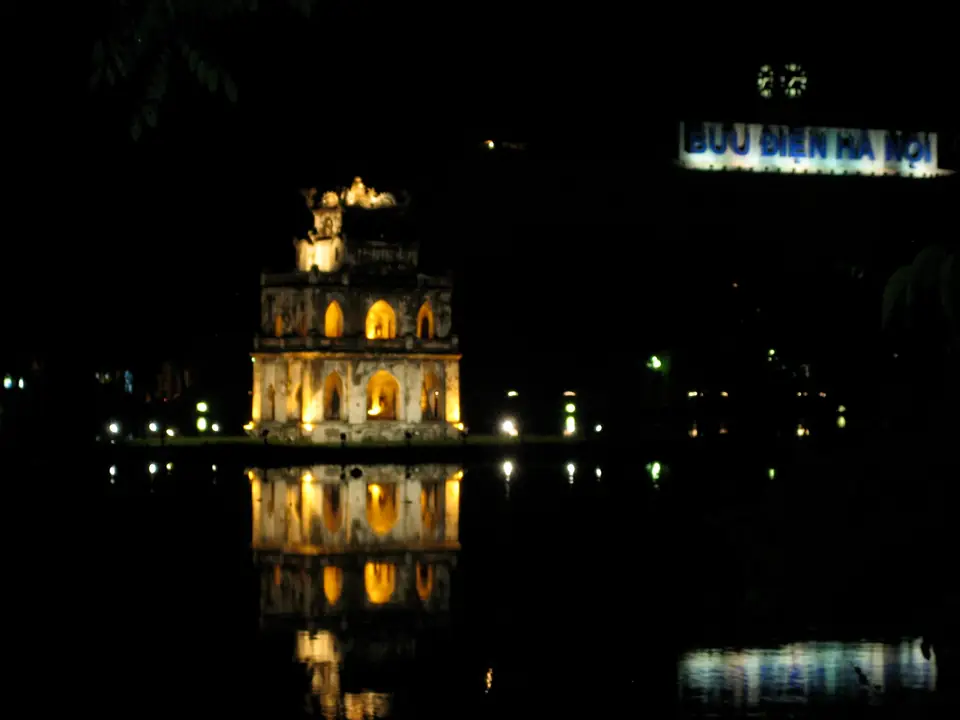
From the east shore one sees the emblem-image of Hanoi: the Turtle Tower (Tháp Rùa), on the islet in the south of the lake, which can only be seen from land. It was built between mid-1884 and April 1886 on the Gò Rùa mound: brick in four diminishing storeys, pointed arches of French influence on the two lower floors, a curved Vietnamese roof, 8.8 m high from the islet floor and the inscription “Quy Sơn Tháp” above the round window of the third floor.
It was raised by Nguyễn Hữu Kim, an intermediary between the French and the Vietnamese after the taking of the Hanoi citadel in 1883, who grew rich and was nicknamed Bá hộ Kim; that is why it was at first called “Bá hộ Kim’s Tower”. A tradition without convincing proof, which his descendants dispute, holds that he secretly buried his parents there. In 1890 the French placed a miniature replica of the Statue of Liberty on top, which the people of Hanoi mockingly nicknamed “tượng Đầm Xòe”, the lady in the flared skirt; when it was removed is another disputed matter.
This same mound is also contested, along with two other spots on the lake, as the platform from which King Lê Thánh Tông fished in the 15th century, according to a story the sources never quite close. The audio guide explains why the most photographed tower in the city hides such an uncomfortable tale.
The last tower of an erased pagoda
Hòa Phong Tower
Summary of this stop
On the east shore stands the Hòa Phong Tower, of brick and three storeys, with four gates named Báo Đức, Báo Ân, Hòa Phong and Báo Thiên. It is the only remnant of the Báo Ân Pagoda, taken down in 1898: an entire pagoda reduced to a single standing tower.
It is not the only absence. South and southeast of the lake, the streets and blocks of the French era occupy the old Hữu Vọng Lake, called Thủy Quân in the days of Tự Đức, where the war fleet was reviewed and which the French protectorate began to fill in in 1884. Against that loss, the shore regains its life every week: on Friday, Saturday and Sunday evenings, Đinh Tiên Hoàng, Lê Thái Tổ, Hàng Khay, Tràng Tiền and the other streets around the lake close to traffic and form a pedestrian zone that around 2018 drew 15,000 to 20,000 people a night, with dragon dances, traditional music and calligraphy. The narration ends the walk here and ties together all the threads of the lake.