Historic quarter
Hanoi Old Quarter Audio Guide (Phố cổ Hà Nội)
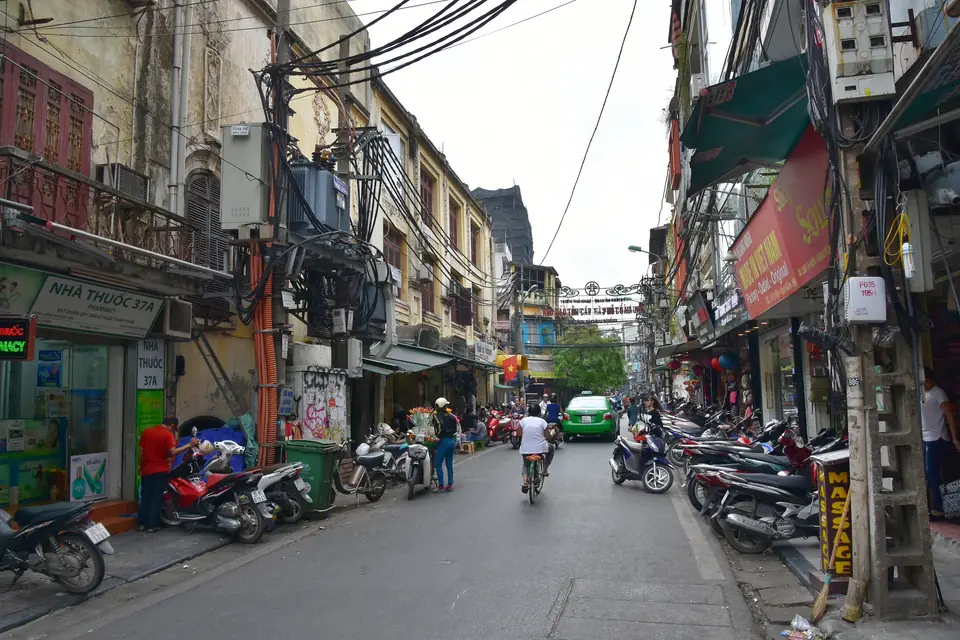
Hanoi's “36 streets” are a map of trades almost a thousand years old: each street still bears the name of the goods that settled it, from the silver of Hàng Bạc to the votive paper of Hàng Mã. Among motorbikes and shopfronts stands the last gate of the old city wall, and in a neighbourhood temple, a white horse that legend credits with laying out the city.
- 90 min of audio
- Streets named after trades
The Hanoi Old Quarter took shape between the 11th and 14th centuries, under the Lý and Trần dynasties, between the imperial citadel of Thăng Long and the bank of the Red River. Craftsmen from the trade villages grouped into guilds to sell to merchants, which is why most of its streets are called “Hàng”, goods, followed by the product: Hàng Tre, the bamboo street; Hàng Đồng, the copper street. Its tube houses, narrow and with the shop on the front, were built mostly in the 18th and 19th centuries.
The “36 streets” were never 36. The phrase is a traditional formula, not a count: the official Old Quarter, delimited in 1995 by the Ministry of Construction, covers some 100 hectares and 76 streets. And beneath that bustle of shops hide episodes bigger than the quarter itself, such as the dining room on Hàng Ngang where in 1945 the draft of Vietnam's Declaration of Independence was written.
Highlights
- Ô Quan Chưởng Gate — The last gate of the 1749 wall, saved from demolition in 1906
- Đồng Xuân Market — Five 52-metre halls built by the French in 1890 over a filled-in river
- Hàng Mã — From paper gold for the dead to Mid-Autumn lanterns
- Bạch Mã Temple — The white horse that, according to legend, traced the wall of Thăng Long
- Hàng Bạc and Kim Ngân Communal House — The silver street and its silversmiths' guildhall, five centuries old
In Hanoi, the Old Quarter (Phố cổ Hà Nội), known as the “36 streets” (36 phố phường), is the old merchant district that grew up east of the imperial citadel of Thăng Long, down to the bank of the Red River. Its roots go back to the Lý and Trần dynasties, between the 11th and 14th centuries, and at the start of the Lê dynasty the scholar Nguyễn Trãi already named several of its trade guilds in his Dư địa chí. That order is still written on the street signs: almost every street begins with “Hàng”, goods, followed by what was sold there. The figure of 36, mind you, is a formula and not a count: the official Old Quarter, delimited by the Ministry of Construction on 30 March 1995, covers some 100 hectares and 76 streets.
The history of the Hanoi Old Quarter does not fit in its shop windows. In March 1907, on the upper floor of number 4 Hàng Đào, the silk street, Phan Chu Trinh, Lương Văn Can, Phan Bội Châu and Tăng Bạt Hổ opened a free school, the Đông Kinh Nghĩa Thục, where they taught the country’s history and geography, mathematics, classical Chinese, French and the quốc ngữ alphabet, with a girls’ class included; in November that year the French forced it to close. Very close by, at number 48 Hàng Ngang, the home of the businessman Trịnh Văn Bô’s family hosted Hồ Chí Minh in August 1945: on a small table covered in green leather in its dining room the draft of the Declaration of Independence that he would read on 2 September in Ba Đình was written. That same street was in the 19th century the street of the Cantonese merchants, and it is said that its name, Hàng Ngang, recalls the crosswise gates that closed it at night, though the origin is disputed.
The architecture of the Hanoi Old Quarter is that of the tube house (nhà ống): narrow fronts, a sloping tiled roof and the shop open to the street, built in the 18th and 19th centuries, when almost the whole quarter was thatched except for the rich houses and those of the Chinese merchants. The one at number 87 Mã Mây, a 19th-century merchant’s house open to the public, preserves its succession of rooms and courtyards and its dark carved wood. Many others have disappeared since the late 20th century, and the repainting of facades in yellow for the 2010 Millennium drew criticism for its sloppy execution. What to see in the Hanoi Old Quarter is arranged in five stops, from the last gate of the wall to the silver street, passing through Đồng Xuân Market, the lanterns of Hàng Mã and the White Horse Temple, and it makes full sense when walked with the audio guide.
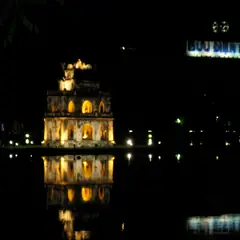
To the south, the quarter flows out into Hoan Kiem Lake, and to the west, a little over a kilometre away, the Imperial Citadel of Thang Long keeps the seat of power beside which the quarter grew.
A 1749 gate that was saved by a hair
Ô Quan Chưởng
Summary of this stop
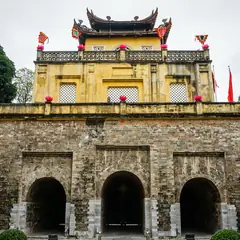
On the Red River side stands Ô Quan Chưởng, a two-storey gate in the vọng lâu style: below, three vaulted openings, the central one about three metres high and wide, with its great wooden leaf; above, a four-sided pavilion with a balustrade. It was built in 1749 under the Chinese-character name of Đông Hà Môn, after the old Đông Hà district, within the 16-kilometre earthen wall that Lord Trịnh Doanh rebuilt that year to protect the capital on the Red River side. How many gates that wall had is a matter of debate: the geographic texts of the Minh Mạng era speak of 21 and André Masson, working from archives, counted 16.
Its present name remembers a man. The Chưởng Cơ, a minor Nguyễn officer from Bắc Ninh, stood up with about a hundred soldiers to the first French assault on the Hanoi citadel, in 1873, which entered precisely through this gate. Eight years later, Governor Hoàng Diệu had a stele carved, still set in the left wall of the central opening, forbidding guards to extort those who pass: the “Thân cấm khử tệ”, dated to the 34th year of the reign of Tự Đức, 1881.
When the French rebuilt the city in the European manner, the wall’s gates fell one after another. Ô Quan Chưởng came close to being demolished in 1906, and today it is the only one preserved almost intact. Who stepped in to save it and what that tablet says about life on the city’s frontier is revealed by the narration beneath the arch.
Two markets fused over a vanished river
Đồng Xuân Market
Summary of this stop
At the northern end of the quarter, Đồng Xuân Market occupies a landscape that no longer exists. In 1889, when the last remains of the Tô Lịch River and Thái Cực Lake were filled in, the French abolished the two markets beside the Cầu Đông Pagoda and the Bạch Mã Temple and brought them together here. In 1890 they began a large building with five entrance arches and five halls 52 metres long and 19 high, of which the present market is the heir.
The wounds came later. When the Resistance against France broke out, in December 1946, residents and fighters of the Vệ quốc quân broke through the party walls from house to house to travel a street end to end without stepping on it, and in February 1947 the market was the scene of fierce fighting. By around 1990 the building had been rebuilt with three halls of three storeys; on the night of 14 July 1994 a fire razed almost all its stalls and was not fully put out until 19 July, the largest market fire in Hanoi.
Today the ground floor sells clothes and electronics, and the interior works mostly as a wholesale market. What remains beneath its halls of the river and of the markets the colonial city erased is revealed by the narration in front of its facade.
The street that sold gold for the afterlife
Hàng Mã
Summary of this stop
On Hàng Mã, the street’s name is true to the letter. Votive paper objects used to be sold here to be burned as offerings to the dead: banknotes and “afterlife” gold, figures of mandarins, entire houses of paper. Today its shop windows hang with lanterns, đèn ông sao stars, papier-mâché masks and tò he figurines, and overflow in the weeks before Tết Trung Thu, the Mid-Autumn Festival, and the lunar New Year.
The street is also the best place to understand how the whole quarter worked. Craftsmen from the trade villages around the city grouped into guilds to sell to merchants, and each street took the name of its goods: “Hàng” plus the product. Its tube houses, with the shop on the front and the dwelling behind, mix tiled-roof fronts with new multi-storey buildings that betray the absence of many old houses.
How a street devoted to the dead ended up filled with children’s toys is told by the narration at the mouth of Hàng Mã.
A white horse at the origin of the city
Bạch Mã Temple
Summary of this stop
On Hàng Buồm hides the Bạch Mã Temple, the White Horse temple: three parallel halls with crab-shell roofs, stone steles, an old well at the back and, inside, a large white wooden horse. It is the shrine of Long Đỗ, the old protector god of the citadel, and its story is that of the whole quarter, which was born almost a thousand years ago in the shadow of Thăng Long.
According to a documented tradition, when Lý Thái Tổ moved the capital to Thăng Long in 1010, the walls he ordered built kept collapsing. The king had prayers said at the shrine of Long Đỗ, and a white horse came out of it; the wall was laid out following the prints of its hooves and never fell again. Long Đỗ was named tutelary god of the capital. The legend even has a precedent centuries older, starring a Tang governor and some bronze talismans.
The temple was also the first stop of a spring rite, the Tiến xuân ngưu: mandarins and residents carried a clay buffalo statue here, amid firecrackers and the odd blow with mulberry branches, before parading it to the royal palace; the rite has been partly revived. What happened on that stormy night with the governor’s talismans is revealed by listening to the narration in front of the temple.
Village silversmiths and a patron for all
Kim Ngân Communal House
Summary of this stop
Hàng Bạc, “the silver one”, is an unbroken row of gold and silver jewellers. Its origin lies in the 15th century, when, under King Lê Thánh Tông, the mandarin Lưu Xuân Tín, Minister of Personnel, brought the goldsmiths of Châu Khê village, in Hải Dương, to Thăng Long to smelt silver ingots for the court’s trade. In the early 19th century the Nguyễn dynasty took the royal foundry to its new capital, Huế, but most of the goldsmiths stayed; silversmiths from Định Công and Đồng Xâm joined them later.
Wedged between the shop windows, at numbers 42 and 44, the Kim Ngân communal house offers a solemn half-light against the bustle of the street. This communal house, built between the late 15th and early 16th centuries, does not venerate Lưu Xuân Tín, founder of the trade for the Châu Khê people, but Hiên Viên, patron of the hundred trades: silversmiths from several villages worked on the street and a common patron was needed. Even so, the people of Châu Khê still come every year to the anniversary of the trade’s patron, and on the 1st and 15th of each lunar month residents come to burn incense.
Almost all jewellery is now machine-made, but at number 83 the craftsman Nguyễn Chí Thành, fifth generation of a family from Định Công that had been on the street for 117 years in 2019, still chisels silver by hand. What other lives the communal house had, and who came to live inside its hall of worship, is revealed by the narration in front of its door.