Buddhist temple
Tran Quoc Pagoda Audio Guide (Chùa Trấn Quốc)
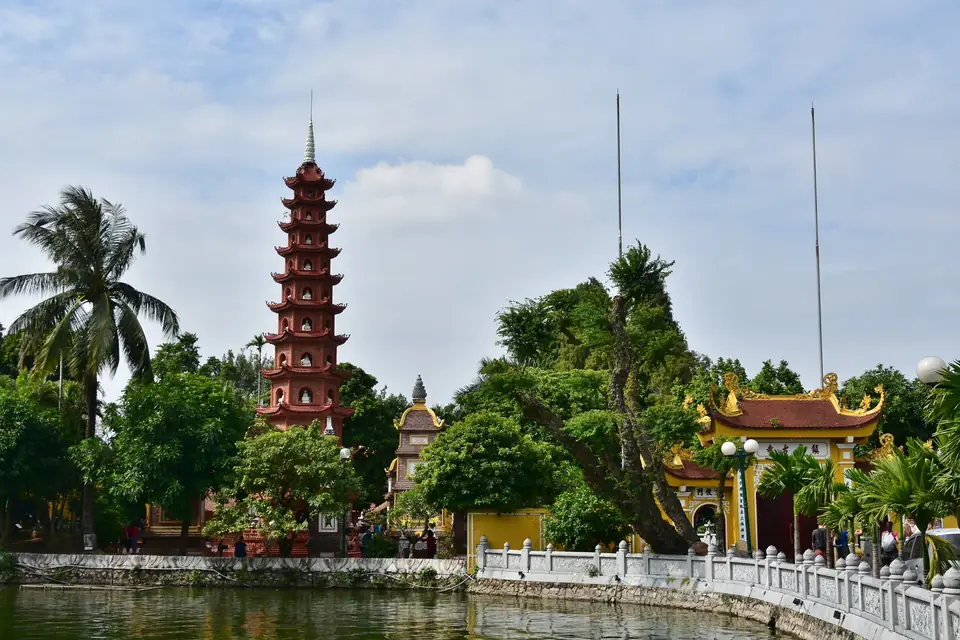
Hanoi's oldest Buddhist pagoda was born on the bank of the Red River and, in 1615, moved lock, stock and barrel to an islet in West Lake so as not to drown. Today a red eleven-storey stupa and a bodhi tree from India await there.
- 30 min of audio
- 6th-century Buddhist temple
Founded in the middle of the 6th century under the reign of Lý Nam Đế with the name Khai Quốc, “Foundation of the Kingdom”, the Tran Quoc Pagoda was the Buddhist centre of the capital Thăng Long during the Lý and Trần dynasties. In 1615, harassed by the floods of the Red River, it moved to Kim Ngư islet, the “Golden Fish”, and was built on the foundations of old royal palaces. It received its present name, Trấn Quốc, “Protection of the Kingdom”, under Lê Hy Tông.
Few temples condense so many layers in so little ground: beneath the courtyard paving rest the foundations of a Lý palace and a Trần hall; above, a stupa of 1998 stands in mirror image to a bodhi grown from a cutting of the Bodh Gaya tree, the same one under which the Buddha attained enlightenment. And the road that leads here began as a fishermen's embankment.
Highlights
- Lục Độ Đài Sen Stupa — 11 storeys, 15 metres and 6 niches per storey with Amitabha Buddhas
- 1959 bodhi tree — cutting of the Bodh Gaya tree, a gift from Indian President Rajendra Prasad
- The 1615 move — from the Red River to an islet in West Lake, over Lý and Trần palace foundations
- Shakyamuni Buddha entering nirvana — gilded wooden statue in the main hall
- 14 stone steles — the written memory of ruins, restorations and Trịnh lords
The history of the Tran Quoc Pagoda begins far from where it stands today. In the middle of the 6th century, during the reign of Lý Nam Đế, it was founded in the village of Y Hoa, beside the Red River and outside the Yên Phụ dike, under the name Khai Quốc. The dates of that reign vary by source, so the pagoda’s famous “1,500 years” is an approximate figure, and even so it is considered the oldest Buddhist temple in Hanoi. Under the Lý and Trần dynasties it was the Buddhist heart of the capital Thăng Long, and in 1615, when the river began to eat away the bank, the whole pagoda moved to Kim Ngư islet in West Lake, where it is still joined to the shore by a causeway.
Since then it has changed names with the rhythm of the kingdom’s history: An Quốc in 1440, Trấn Quốc under Lê Hy Tông and Trấn Bắc, “Guardian of the North”, in the 19th century, after the visit of a Nguyễn emperor whose identity and donations do not match in all sources. The people, however, never stopped calling it Trấn Quốc. The history of the Tran Quoc Pagoda, its architecture and its living customs are best understood on the islet itself, with the audio guide’s narration accompanying every step of the walk.
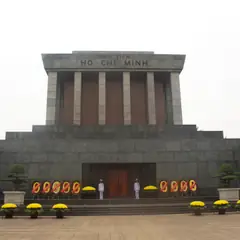
Back on the mainland, a little over a kilometre to the south, the Ho Chi Minh Mausoleum presides over Ba Dinh Square, and the Temple of Literature, from 1070, completes the map of Hanoi’s ancient temples.
A fishermen’s causeway to the Gate of Skilful Means
Tran Quoc Pagoda
Summary of this stop
The approach to the pagoda already tells a story. The causeway starts from Thanh Niên dike avenue, which separates West Lake from Trúc Bạch Lake, and leads to the islet to which the temple moved in 1615 fleeing the Red River. According to a documented tradition, that path was born around 1620 as a small embankment that the villagers of Yên Hoa and Yên Quang raised to close off a corner of the lake and fish more easily.
A Trịnh lord had it widened and christened it Cố Ngự, “hold firm”; a mispronunciation eventually turned it into Cổ Ngư, “ancient fish”. In 1958-1959, young people and students of Hanoi worked on it to raise and widen it, and the city renamed it Thanh Niên road, “Youth”, at the suggestion of Hồ Chí Minh.
At the end of the path waits the gateway with three characters above the opening: “Phương Tiện môn”, the Gate of Skilful Means. On both sides, a couplet in nôm script contrasts the clatter of carts and horses of the world with the Zen door open to rivers and mountains. The full meaning of that threshold is revealed by listening to the narration in front of the gate itself.
The red tower, the Indian bodhi and the buried palaces
Lục Độ Đài Sen Stupa
Summary of this stop
The courtyard is the place where the layers of the Tran Quoc Pagoda read best. On moving in 1615, now inside the Yên Phụ dike, the temple was built over the foundations of the Thúy Hoa palace of the Lý dynasty and the Hàn Nguyên hall of the Trần dynasty: beneath the visitor’s feet rest remains of the court of two dynasties.
On top rises the Lục Độ Đài Sen stupa, a red tower of 1998 with 11 storeys and 15 metres in height. Each storey opens 6 arched niches with a statue of Amitabha Buddha in precious stone, and a nine-level lotus crowns it.
Facing it, in a deliberate symmetry, grows the bodhi tree that Indian President Rajendra Prasad gave on his visit of 24 March 1959, grown from a cutting of the Bodh Gaya tree. The sources do not fully agree on whether it was a personal gift, a present from the Indian government or a tribute to Hồ Chí Minh, and that ambiguity is part of its story.
The golden Buddha and the incense never burned in fours
Tam Bảo Main Hall
Summary of this stop
The main hall, the Tam Bảo, joins front pavilion, incense hall and upper sanctuary in a plan shaped like the character 工. It was a court temple: during the reign of Lý Nhân Tông, the queen mother Ỷ Lan came here several times to converse with eminent monks.
Among the treasures inside stands out a statue of Shakyamuni Buddha entering nirvana, in gilded wood, accompanied by stone steles, 3 bronze bells and almost a hundred couplets and horizontal tablets. The names of the pagoda, from An Quốc to Trấn Quốc, followed the fate of the kingdom, and these walls keep a good part of that memory.
Before the altars, the custom is still alive: according to popular belief, incense is always burned in odd numbers, because even numbers bring bad luck and four sounds in Sino-Vietnamese like the word “death”. Offerings are left meat-free, out of respect for the vegetarian monks who live in the pagoda. The why of many of these gestures makes sense with the narration before the altar.
Fourteen steles and a bell tower to awaken
Funerary Stupa Garden
Summary of this stop
The rear part of the compound gathers the pagoda’s written memory. In 1639 Lord Trịnh Tráng ordered it repaired, lotuses planted around it and turned into a pleasure residence for his house; that year the laureate Nguyễn Xuân Chính wrote the stele that records it. In the late 18th century the temple fell into ruin, and the stele of 1815, with text by Dr Phạm Quý Thích, records the restoration of 1813 to 1815. In all, the compound preserves 14 steles.
Behind the pagoda also rise several funerary stupas of monks of the Vĩnh Hựu and Cảnh Hưng eras, from the 18th century, beside the three-bay bell tower with double eaves. A stele of that same century describes the lightness of one who gazes at the lake and the bell that calls awake those still trapped in the dream of the world. What that phrase means beside the water is better understood by hearing it there, with the bell a few steps away.