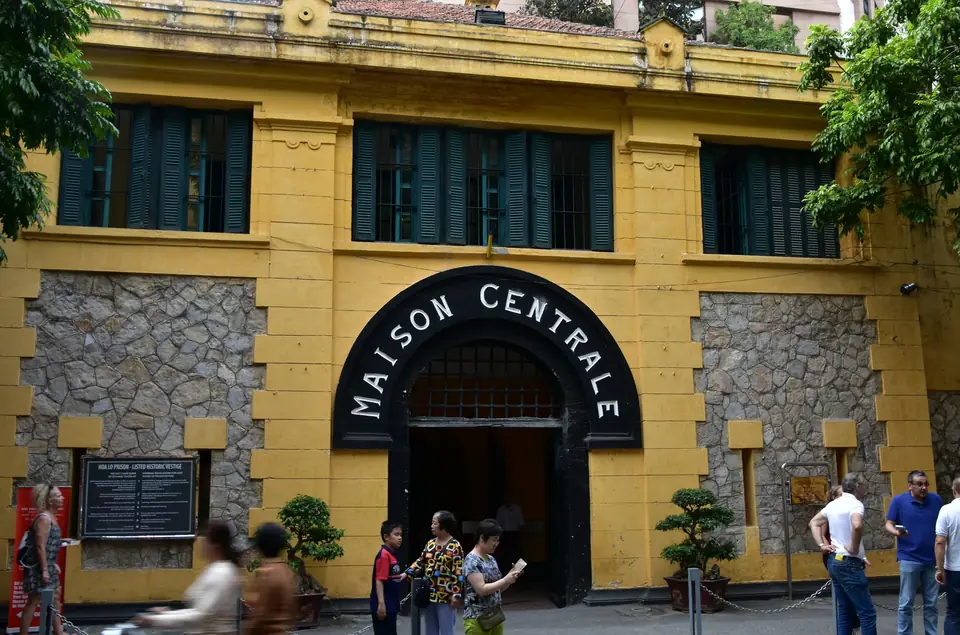
Colonial prison museum
Hoa Lo Prison Audio Guide (Nhà tù Hỏa Lò)
The French Maison Centrale jailed the future leaders of Vietnam and, decades later, the American pilots who ironically nicknamed it the “Hanoi Hilton”. Today only a corner of wall and some cells remain, at the foot of a skyscraper.
- 60 min of audio
- Colonial and war memory
Hoa Lo prison began to be built in 1896 over the village of Phụ Khánh, known for its clay stoves, after evicting its residents and demolishing three pagodas. Surrounded by a 4-metre stone wall topped with broken glass, the colonial jail went from a planned capacity of a few hundred prisoners to more than 2,000 in 1954, and through its cells passed many of the revolutionaries who would go on to govern the north of the country.
The nickname “Hanoi Hilton” was born engraved on the handle of a bucket: an American pilot wrote it to welcome a newly captured comrade. Between 1964 and 1973 the jail held airmen such as Everett Alvarez and John McCain, whose flight suit and parachute are on show in the museum. Since 1993, the Hanoi Towers have occupied most of the site.
Highlights
- “Maison Centrale” gateway — the original arch with the jail's French name
- Guillotine room — the original equipment used by the colonial administration
- The 1951 Christmas Eve escape — the sewer opening through which 17 condemned men fled
- Pilots' room — John McCain's flight suit and parachute
- Memorial to the fallen — a courtyard still alive with incense offerings
The history of Hoa Lo prison is that of a city that locked up its future rulers. In 1896 the French colonial administration approved a 41-clause building specification to raise in Hanoi a court and a jail, the Maison Centrale, and demanded that all the metal and glass come from France. Sources disagree on when it was finished (some say 1901, others 1904), but they agree on the start: 1896, over a village of potters and three demolished pagodas. The name, Hỏa Lò, means “stove”, and is attributed to the village that made them or to the street that sold them.
For almost a century, its walls saw revolutionaries, Vietnamese condemned to death who escaped through the sewers, American pilots captured during the war and, in the 1980s, a dissident poet. In 1993 demolition began and today a little over 2,000 m² survive beside Hỏa Lò street, in the shadow of two towers. The audio guide goes through that preserved corner in five stops and explains what each wall tells, often two stories at once: that of confinement and that of those who defied it.
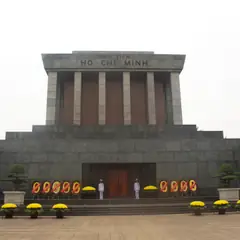
About eight hundred metres away, Hoan Kiem Lake marks the heart of the city, and on Ba Dinh Square the Ho Chi Minh Mausoleum rises where in 1945 the independence was proclaimed for which many prisoners of this jail had been locked up.
The “Maison Centrale” gateway and the wall of the stove village
Hoa Lo Prison
Summary of this stop
The visit starts in front of the entrance arch on Hỏa Lò street, which still shows the French sign MAISON CENTRALE over the door. To make room for the jail, the French evicted the residents of Phụ Khánh and demolished the Lưu Ly, Bích Thư and Bích Hoạ pagodas. Beside the gateway a stretch of the original wall still stands: stone 4 metres high and half a metre thick, which was once topped with broken glass and high-voltage wire, with four watchtowers at the corners. In 1945 it was raised by 1.5 metres on the street side.
That wall was never entirely watertight. Between the 1910s and the 1930s, Hanoi street vendors made a living passing messages through the windows and throwing tobacco and opium over the glass, while letters and parcels flew out toward the street. The narration, heard before the stone, turns this boundary into what it really was: a line that the city crossed every day.
Shackled bunks that were also a classroom
Wards with prisoner figures
Summary of this stop
In the communal cell ward, figures of political prisoners chained to concrete bunks reproduce the overcrowding of the French period. The numbers explain it: a 1913 renovation raised capacity from 460 to 600 places, but in 1916 there were about 730 inmates, 895 in 1922, 1,430 in 1933 and more than 2,000 in 1954.
Even so, in the 1930s and 1940s these cells worked as a political school for many future leaders of North Vietnam and the Việt Minh. According to documented tradition, prisoners studied in groups of ten to fifteen with pens made from bàng tree twigs and chalk of soft brick, under a simple rule: whoever can read teaches whoever cannot. Very close, the women political prisoners’ area recalls women such as Nguyễn Thị Quang Thái. The smallest detail of this ward, and perhaps the one that best explains why people spoke of a “school”, is left to the narration.
The guillotine and the escape through the sewer
Guillotine Room
Summary of this stop
In its own room is displayed the guillotine that the French administration used to execute patriots and revolutionaries, with the original equipment. Facing the edge of the sentence, Hoa Lo also keeps the memory of those who managed to get out. After the Japanese coup of March 1945, at 19:30 on the 12th, Trần Tử Bình ordered a manhole cover opened in front of compound J: 29 political prisoners crawled through a conduit of just over 20 centimetres in diameter to the street, and in the following days those who escaped that way exceeded a hundred.
The most cinematic escape came on Christmas Eve 1951, when seventeen condemned men lowered themselves through the sewer of their ward’s courtyard. The account that has come down to us includes a ping-pong game with a guard, keys copied in ten days and condensed-milk cans scraped against the cement to cover the noise of the saws. Only five managed to get away. The mouth of that sewer is displayed in the museum, and the audio guide reconstructs the plan step by step beside it.
McCain’s suit in the “Hanoi Hilton”
American Pilots Room
Summary of this stop
The room devoted to the years 1964–1973 gathers objects of the American prisoners. The first was naval pilot Everett Alvarez, shot down on 5 August 1964, who spent more than eight years there. The nickname “Hanoi Hilton” was first written when Bob Shumaker engraved “Welcome to the Hanoi Hilton” on the handle of a bucket to greet Lieutenant Robert Peel. In the most visited display case are the flight suit and parachute of John McCain, who spent part of his five and a half years of captivity in Hỏa Lò before becoming a senator for Arizona and a presidential candidate in 2008.
It is also the room with the most debate. Testimonies of former prisoners and reports of the US Senate document beatings, isolation and the torment of the ropes, and treatment did not begin to improve until the abuses became public in 1969; the Vietnamese government and the jail’s last commander deny it, and some veterans criticise the exhibition for playing it down. Within those walls the “tap code” was also born, a grid alphabet passed blow by blow against the brick with which prisoners said goodnight to each other. How it worked and what it meant to them is told in the narration.
Incense in the shadow of the Hanoi Towers
Hỏa Lò Memorial to the Fallen
Summary of this stop
The jail stayed in use after the war: the dissident poet Nguyễn Chí Thiện, arrested in 1979 while trying to hand his poems in at the British embassy, spent six years in it. In 1993 demolition came and over most of the site today rise the Hanoi Towers, a 27-storey apartment tower and a 14-storey office building, which mark from above everything that no longer exists. Part of what was demolished travelled far: the materials of several whole cells, with their shackled bunks and an original door, were rebuilt in 2023 at the American Heritage Museum in Hudson, Massachusetts.
The tour ends before the Memorial to the Fallen, dedicated to the Vietnamese patriots and revolutionaries who died in the prison. Far from being an inert piece, the courtyard is still in use: schools, companies and public bodies come to offer incense, to report their achievements before the memory of the ancestors and to solemnly induct new members of the Party and the Communist Youth. The audio guide closes the circle of Hoa Lo here, in the jail where revolutionaries were locked up and where new militants now take their oath.