Vietnam's first university
Temple of Literature Audio Guide (Văn Miếu - Quốc Tử Giám)
Five walled courtyards in a row separate the noise of the motorbikes from a square well guarded by 82 steles of doctors on stone turtles. Since 1070, Vietnam has honoured learning here with stone, incense and memory.
- 60 min of audio
- Confucian temple of 1070
Built in 1070 by Emperor Lý Thánh Tông as a temple to Confucius, south of the imperial citadel of Thăng Long, the Văn Miếu took in the Quốc Tử Giám in 1076, the school of the nation's sons and Vietnam's first university. Its architecture is a journey in a straight line: five walled courtyards, three parallel paths and a succession of gates that lead from the street to the altar of Confucius and the academy.
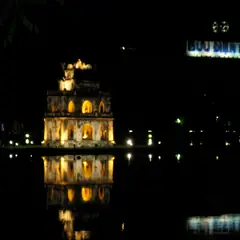
The pavilion that is today the emblem of Hanoi, the Khuê Văn Các, was built in 1805, just when the academy had already lost its role: three years earlier, Emperor Gia Long had taken it to the new capital, Huế. The symbol of the city was thus born as the university was leaving, and even so it ended up on the back of the 100,000 đồng banknote.
Highlights
- Khuê Văn Các Pavilion — emblem of Hanoi since 1805
- 82 steles of doctors on stone turtles, erected between 1484 and 1780
- Thiên Quang Well — the square of the earth beneath the round windows of heaven
- Hạ mã steles — where dukes and generals had to dismount
- Thái Học courtyard — statue of the master Chu Văn An and a bronze bell
The history of the Temple of Literature begins in 1070, when Emperor Lý Thánh Tông ordered a temple dedicated to Confucius built south of the citadel of Thăng Long, the old Hanoi. Six years later, in 1076, his son Lý Nhân Tông founded beside it the Quốc Tử Giám, at first reserved for the sons of the king and of great dignitaries; in 1253 it opened its doors also to sons of commoner families of outstanding scholarship. From the examination of 1442, the names of the doctors who passed were carved in stone, and in 1484 the steles that still flank the central well began to be raised.
Then came the moves and the wars: the academy left for Huế in 1802, the French army used the compound as barracks between 1900 and 1903, in 1906 it was listed as a historic monument of Indochina and, when the Indochina war broke out, artillery brought down the fifth courtyard. The doctors’ steles are on UNESCO’s Memory of the World register, first the Asia-Pacific regional one (2010) and then the international one (2011).
What to see at the Temple of Literature comes down to five gates inward, from the bustle of Hanoi to the silence of the doctors, in about three hundred metres. The audio guide goes along that axis stop by stop, with a narration researched and fact-checked against historical sources, and reserves for each courtyard the story that the stone does not tell at first sight.
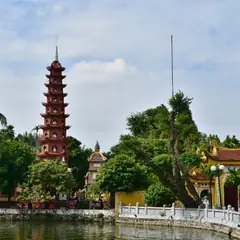
A kilometre away, the Imperial Citadel of Thang Long keeps the buried palaces of the old capital, and the Tran Quoc Pagoda, born in the 6th century on the bank of the Red River, is older still than the temple.
Hạ mã steles: humility begins at the gate
Văn Miếu - Quốc Tử Giám
Summary of this stop
Before the Văn Miếu Môn gate stand two small steles with an engraved order: Hạ mã, “dismount”. Dukes, generals and ministers, whether they arrived on horseback, by cart or by palanquin, had to get down and walk the stretch between the two stones before mounting again. The temple of 1070 of Lý Thánh Tông thus begins with a gesture of compulsory humility before learning.
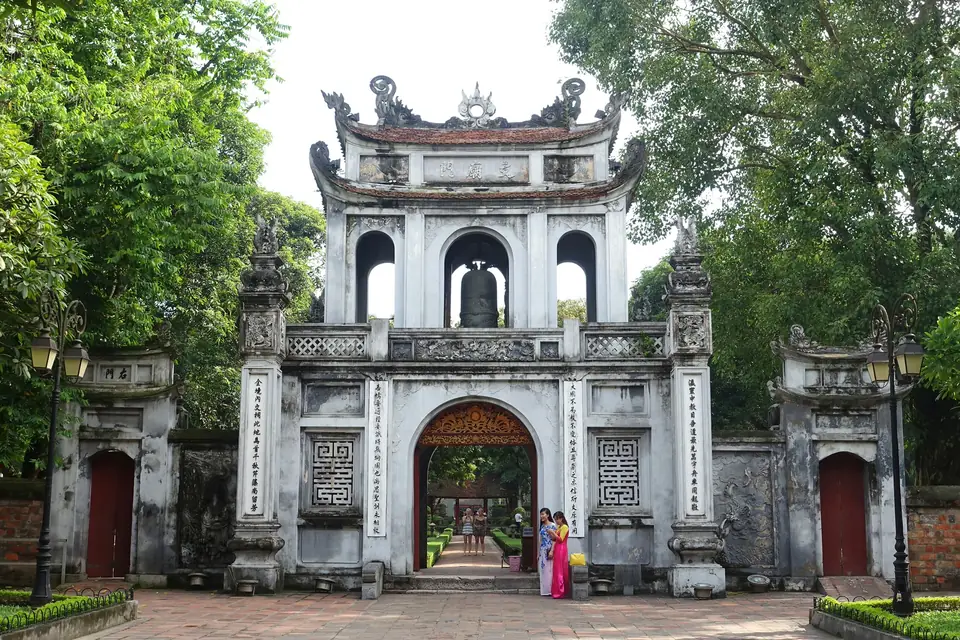
Behind rises a gateway of four brick pillars. The two central ones carry on top a pair of figures of nghê, the guardian animal of Vietnamese tradition, turned toward each other. According to popular belief, they are sacred beings able to tell the wicked from the just man about to cross. At the back, the triple gate, with its two-storey central opening and the characters 文廟門, opens the three parallel paths that run through the whole compound.
What it truly meant to cross this threshold in the days of the royal examinations is the first story heard in the audio guide, right there, under the gaze of the two stone beasts.
Khuê Văn Các, the emblem of Hanoi
Khuê Văn Các
Summary of this stop
In the second courtyard appears the city’s most recognisable image: the Khuê Văn Các, the “pavilion of the splendour of the Khuê star”. It is a square tower of red wood with eight roofs, resting on four white brick pillars on a platform 6.8 metres on a side. On each face opens a round window symbolising heaven, in dialogue with the square Thiên Quang well, the earth.
The architecture of the Temple of Literature holds a paradox here. The pavilion was ordered built in 1805 by the governor-general of Bắc Thành, Nguyễn Văn Thành, just when the academy was leaving: in 1802 Emperor Gia Long had moved the Quốc Tử Giám to Huế, and in 1805 the old school of Thăng Long was reduced to a prefectural school. Even so, the tower became the emblem of Hanoi and the temple appears on the back of the 100,000 đồng banknote.
Every year, just before Tết, the Vietnamese New Year, calligraphers set up beside the temple to write wishes in Chinese characters that families take home as a gift or decoration. Why a late pavilion ended up representing the whole city is one of the keys that the narration reveals in front of its windows.
The 82 steles of doctors on turtles
Thiên Quang Well
Summary of this stop
Around the Thiên Quang well are arranged two gardens with 82 steles, 41 on each side, in two rows and facing the water. Lê Thánh Tông ordered them erected from 1484: one stele for each doctoral examination since that of 1442, placed on the back of a stone turtle, symbol of longevity. Those preserved were raised between 1484 and 1780 and commemorate the royal examinations of the Lê and Mạc dynasties between 1442 and 1779. Their design, motifs, type of characters and the shape of the turtle change with the period, so that over almost three hundred years the turtles varied in shape and size.
There were meant to be 117 steles, but wars and mishaps left 82, a figure that varies slightly by source. Many tablets ended up fitted onto turtles that were not theirs and others, broken, were pieced together. In April 1976 the Vietnam Institute of Archaeology took from the pond beside the Khuê Văn Các a sunken turtle pedestal, without its tablet.
The turtles’ heads shine, polished by touch: before the exams, thousands of students rub them, as they do the steles, and then touch their foreheads to attract luck. In 2014 the red silk cord that surrounded the steles was replaced with a stainless steel fence to curb the wear. Among visitors are also families who read the stone character by character looking for a doctor ancestor. What it means to them to find that name is told in the audio guide, beside the water.
Đại Bái Đường: the first student was five years old
Đại Bái Đường Hall
Summary of this stop
The Đại Thành gate, with three openings and the plaque 大成門, leads into the ceremonial compound: the Đại Bái Đường hall and, behind it, the sanctuary of Confucius and his four disciples, wrapped in incense smoke. It is the religious heart of the complex, the place that gives meaning to everything else.
Here the history of the Temple of Literature as a school takes shape. Its first student was Crown Prince Lý Càn Đức, son of Lý Thánh Tông and the consort Ỷ Lan, who was then five years old and in 1072 would ascend the throne as Lý Nhân Tông. That same child, already king, founded in 1076 the Quốc Tử Giám, the “school of the nation’s sons”, at first reserved for princes and sons of great dignitaries.
In 1253 Trần Thái Tông expanded it as the Quốc Học viện and admitted also sons of commoner families of outstanding scholarship. How the academy went from court privilege to a path of advancement by merit is the thread the narration follows before the altar.
Thái Học: the master who asked for seven heads
Thái Học Building
Summary of this stop
The fifth courtyard, the Thái Học, is a rebuilt scar. Between 1900 and 1903 the French army occupied it as barracks and epidemic quarantine site, and when the Indochina war broke out French artillery brought the building down (sources place the shelling in 1946 or early 1947). Only the base, two stone columns and four inkstones remained. On the site of the old academy there rose, in 1999-2000, a 1,530 m² complex with a pavilion for a 700 kg drum and another for a bronze bell cast in 2000.
On the ground floor of the rear building presides the statue of Chu Văn An, the scholar who headed the Quốc Tử Giám under Trần Minh Tông and was tutor to princes; after his death in 1370, King Trần Nghệ Tông ordered him venerated in the Văn Miếu beside Confucius. On the upper floor are the altars of Lý Thánh Tông, Lý Nhân Tông and Lê Thánh Tông.
According to documented tradition, Chu Văn An presented to King Trần Dụ Tông, his former pupil, the “petition of the seven beheadings” against seven corrupt courtiers; when not heeded, he returned his seal of office and retired to Mount Phượng Hoàng to keep teaching. The end of that story, and what it says about the idea of learning honoured in this temple, closes the audio guide’s tour.