Colonial heritage
Saigon Central Post Office Audio Guide (Bưu điện Trung tâm Sài Gòn)
A secular temple to the telegraph built between 1886 and 1891, with Greek gods and European physicists on the façade, a Khmer naga on the roof and counters that still sell stamps under the portrait of Ho Chi Minh.
- 30 min of audio
- French colonial architecture
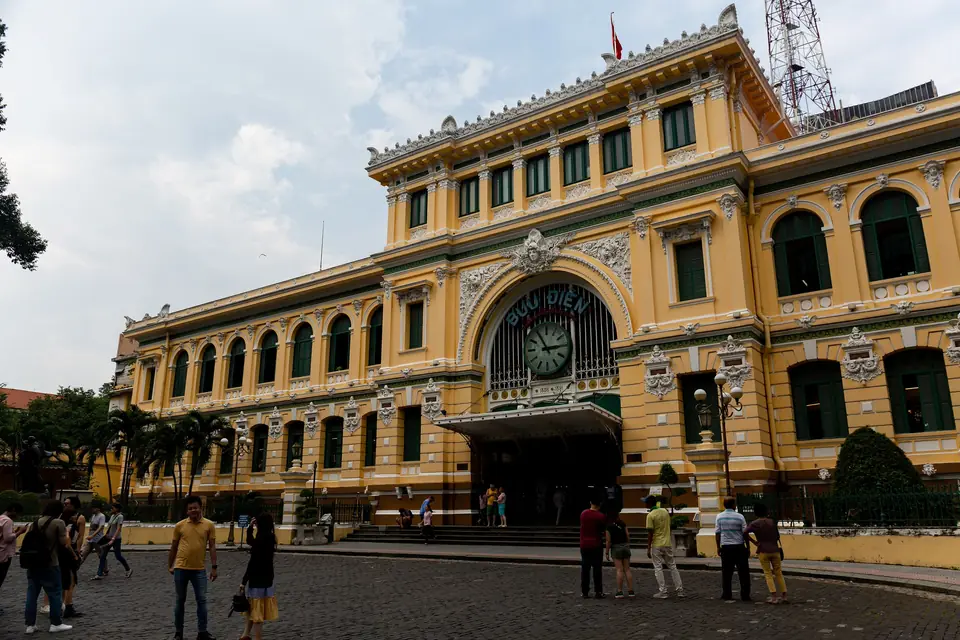
The Saigon Central Post Office is much more than a stop for sending postcards. Its history begins in 1860, when the French set up the “Wire Office”, and the current building, inaugurated on 14 July 1891 to a design by Marie-Alfred Foulhoux, became the hub of the cable with which the colony wove the Indochina telegraph network. Its architecture combines a yellow façade of classical columns and reliefs with a great iron hall that still works as a post office.
On the façade are engraved Morse, Ampère, Volta, Ohm, Faraday and Franklin, but not a single Vietnamese name. And yet, high on the roof, a naga serpent inspired by Khmer temples peeks out, while at the far end of the colonial hall the portrait of the leader of independent Vietnam now presides.
Highlights
- Iron vault — 4 pillars at the corners, each with 4 trusses opening in four directions
- Yellow façade — Hermes in the centre, Poseidon and Nike above a system of 20 columns and pilasters
- Façade plaques — Morse, Ampère, Volta, Ohm, Faraday and Franklin, engraved between the floors
- Painted maps — colonial Saigon in 1892 and the telegraph lines of southern Vietnam and Cambodia
- Roof finial — a naga inspired by the art of Khmer temples
Opposite the cathedral of Saigon stands a yellow palace that, at first glance, nobody would take for a post office. The history of the Saigon Central Post Office begins on 11 November 1860, when the French administration set up the Sở Dây thép Sài Gòn, the “Wire Office”. Inaugurated on 13 January 1863 with Admiral Bonard, during its first year it served only the administration, and it did not open to the public until 1 January 1864. The current building came later: it was raised between 1886 and 1891 on the site of the old seat of the Commandant des troupes and inaugurated on 14 July 1891.
What to see at the Saigon Central Post Office fits in a deceptively simple sentence: a façade, a hall and some counters. But each holds its own story, from the engraved names of the pioneers of electricity to the painted maps of the telegraph network or the last public letter-writer in Vietnam. The audio guide, researched and fact-checked against historical sources, walks through the building in five stops, from the clock door to the counter where stamps are bought today.
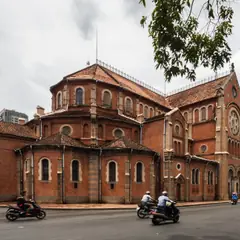
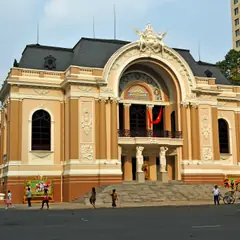
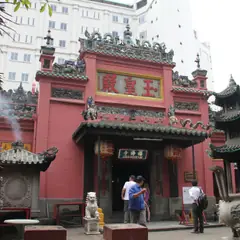
Opposite stands Saigon Notre-Dame Cathedral, built with materials shipped from France, and half a kilometre away the Saigon Opera House completes the French centre; a little further north, the Jade Emperor Pagoda shows the Cantonese Saigon.
A clock, two dates and Foulhoux’s last work
Saigon Central Post Office
Summary of this stop
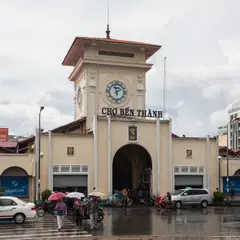
The route starts at the main door: a great arch with a clock in the centre, relief figures crowned with laurel, the sign “Bưu điện TP HCM” and, below, the inscription that sums up the work in two figures, “1886-1891”. It is the calling card of a building conceived as a monument, not as a simple office.
The design is attributed to Marie-Alfred Foulhoux, chief architect of the colony, although the authorship is still disputed: part of the Vietnamese press attributes it to Villedieu, with Foulhoux as assistant, while other sources and an architecture journal of 1891 name Foulhoux as the main author. The inauguration was postponed until the governor-general returned and ended up being held on a 14 July. For Foulhoux it was also an ending: he died in Saigon on 20 January 1892, aged 52, about six months after the opening.
Facing the clock arch, the history of the architecture of the Saigon Central Post Office starts to make sense, and the narration saves for that spot the detail that turns the façade into more than a postcard.
Greek gods, European scholars and a Khmer serpent
Monument in the side garden
Summary of this stop
The façade reads like a manifesto. In the centre appears Hermes, the messenger god, surrounded by white reliefs on the yellow background. A system of 20 columns and square pilasters orders the front, and at the top of the columns, between the arches, appear Poseidon and Nike. Between the ground floor and the first floor, plaques framed in reliefs bear the engraved names of Morse, Ampère, Volta, Ohm, Faraday, Laplace, Galvani or Benjamin Franklin. Some describe them as almost all French, although the list includes Americans, an Italian, an Englishman and a German; what the sources agree on is that no Vietnamese appears.
And yet, high on the roof there is a motif that breaks the Greco-Roman rhetoric: a naga serpent inspired by the art of Khmer temples. In 2025, the deputy director of Culture of Ho Chi Minh City, Nguyễn Minh Nhựt, presented it as a typical example of the cultural blending of East and West.
In the gardens flanking the building, the reply comes from another era: a monument to the telecommunications fighters and the couriers who carried messages during the resistance war, and another dedicated to the modern postal sector. The building raised to dominate the telegraph now has at its sides a tribute to those who carried the messages of the resistance.
The maps of the wire empire
Painted maps in the hall
Summary of this stop
Inside, high on the side walls of the hall, two large painted maps explain the nickname “Wire Office”. One, “Saigon et ses environs 1892”, shows colonial Saigon between the river and the canals. The other, “Lignes télégraphiques du Sud Vietnam et du Cambodge”, draws the network of telegraph lines of southern Vietnam and Cambodia; its date is not agreed, and some sources place it in 1892 and others in 1936.
What they show is the web that began here. On 22 March 1888 the Saigon–Quy Nhơn–Đà Nẵng–Huế–Vinh–Hanoi line, 2,000 kilometres long, was completed; in 1889 the Saigon–Bangkok telegraph line opened, and on 1 July 1894 the city began to use the telephone. For decades this hall was the nervous system of the colony.
The benches of the last public letter-writer
Wooden benches in the hall
Summary of this stop
The central hall is a lesson in iron engineering: a great vaulted lobby held up by four pillars at the corners, each with four trusses opening in four directions, and a long nave on two rows of pillars with joints worked in ornamental motifs. Under that structure, long varnished benches line up and, on both sides, wooden telephone booths.
In this hall worked Dương Văn Ngộ (1930-2023), the last public letter-writer in Vietnam. He had entered the trade at 16 in the small office of Thị Nghè and came here in 1952. On retiring in 1990 he asked permission to keep coming, and he went on writing letters for neighbours who could not write and translating them into English or French. In 2009 he entered the Vietnam Record Book as the letter-writer with the most years of service, and he died in 2023 at the age of 94. He himself reckoned he had written and translated millions of letters and postcards, and his story has a place of its own in the audio guide.
Stamps under the portrait of Ho Chi Minh
Portrait of Ho Chi Minh
Summary of this stop
At the far end of the hall, centred on the end wall, hangs a large portrait of Ho Chi Minh: the leader of independent Vietnam presides over the hall built by the French colonial administration. Beneath him, the stamp and international mail counters are still active. In 2025 the office served between 700 and 800 customers a day, mostly foreign tourists writing and sending postcards home.
The yellow of the walls has a history too. In late August 2014 the first major repainting since 1975 began, at a cost of almost 5,000 million dong, with yellow chosen as the original colour of the building and of the Vietnamese post. The result was criticised by some experts as too garish, and in early 2015 lighter shades were tried.
Buying a stamp here also connects with a very old custom. In 1864, just after the post opened to the public, the first stamp came out in Saigon, and the Saigon people of the day gave it a bird’s nickname. What it was and why, the narration reveals beside the counters, where sending a postcard becomes a small ritual.