Special National Monument
Independence Palace Audio Guide (Dinh Độc Lập)
A presidential palace drawn with characters of good fortune, raised on the ruins of another one that was bombed, which saw fall every president it was built for and stayed tied to a single morning: 30 April 1975.
- 90 min of audio
- Vietnamese modernist architecture
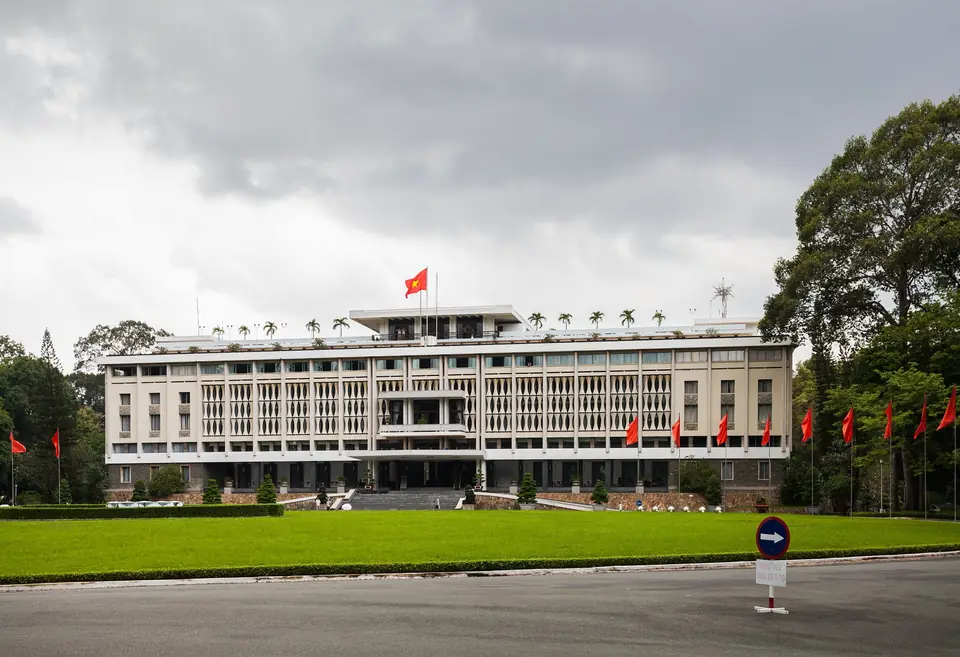
On Saigon's “Dragon's Head” site first stood Norodom Palace, seat of the French governors of Indochina. After the bombing of 1962, the architect Ngô Viết Thụ, the first Vietnamese to win the Grand Prix de Rome, built in its place a modernist building inaugurated in 1966: 26 metres high, more than 100 rooms, a helicopter pad on the roof and an underground bunker.
Seen from the air, the palace draws the Chinese character for good fortune; on its façade, prosperity and sovereignty can be read. It was the residence of a president who fled the country and the stage of an unconditional surrender. Today, also known as Reunification Palace, it still hosts state events.
Highlights
- The gate of 30 April 1975 — through here came tanks 390 and 843, which closed the Vietnam War
- A written façade — a floor plan in the shape of 吉 (good fortune) and the character 主 (sovereignty) completed by the flagpole
- Stone lattices shaped like bamboo canes, inherited from the palaces of Huế
- Rooftop with a helicopter pad and the marks of the April 1975 bombs
- Basement bunker with command rooms, built to withstand heavy bombing
The history of Independence Palace begins with a first stone laid on 23 February 1868 and ends, for many, at 11:30 on 30 April 1975. Between those dates, this site in the centre of Ho Chi Minh City was a palace of French governors, a building taken in the Japanese coup of 1945, the seat of the State of Vietnam from 1954, the target of two bombings by its own air force and, finally, the stage of the surrender that closed the Vietnam War. Its official name is Dinh Độc Lập; many also know it as Reunification Palace, after the Hội trường Thống Nhất, the body that manages it and whose name dates from November 1975.
The current building, inaugurated on 31 October 1966, is a modernist work by Ngô Viết Thụ: 20,000 m² of usable space spread over three main floors, two mezzanines, two basements and a roof with a helipad. Since 2009 it has been a Special National Monument, among the first ten in the country. The complete route, from the gate to the bunker, is truly understood by listening to the audio guide on site, room by room.
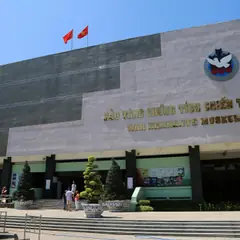
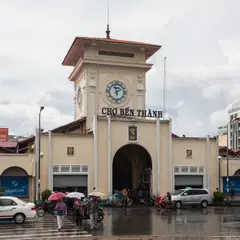
The memory of that war continues some four hundred metres away, at the War Remnants Museum; the parliament of South Vietnam met at the Saigon Opera House, and six hundred metres away Ben Thanh Market returns to everyday Saigon.
The gate that closed a war
Tanks 390 and 843 in the garden
Summary of this stop
The route starts at the end. In the entrance garden wait several combat tanks, among them a replica of tank 843; the original is kept at the Vietnam Military History Museum. Behind them, the iron gate marks the exact spot where it all ended: at 10:45 on 30 April 1975 tank 843 of the 203rd Brigade rammed the side gate, and shortly afterwards tank 390 knocked down the main gate.
At 11:30, Lieutenant Bùi Quang Thận raised the flag of the National Liberation Front on the roof and the last president, Dương Văn Minh, surrendered unconditionally. But the scene has an open debate: for twenty years tank 843 was taken to be first, because its commander was the one who raised the flag; in 1995, photographs by Françoise Demulder suggested that tank 390 of Vũ Đăng Toàn was the first to cross the main gate, while 843 was stuck at the auxiliary one.
Which of the two came in first is the key to reading everything that follows, and the narration at this point raises it in front of the gate itself.
Before the palace, another palace
Fountain on the front lawn
Summary of this stop
Beside the fountain on the front lawn appears a story older than the current building. Here, in 1868, Governor La Grandière laid the first stone of Norodom Palace, designed by the architect Hermite with materials mostly shipped from France, in a compound of some 12 hectares. On 7 September 1954 General Paul Ely handed it over to the State of Vietnam, represented by Ngô Đình Diệm, and the next day it was renamed Independence Palace. Because of its position according to feng shui it was also called Phủ Đầu Rồng, the Dragon’s Head Mansion.
On 27 February 1962, two South Vietnamese pilots, Nguyễn Văn Cử and Phạm Phú Quốc, bombed the palace with two A-1 Skyraiders in an attempted coup against Diệm. Almost the whole left wing was destroyed and the old French palace was demolished in May that year. The documented tradition preserves almost cinematic scenes: deer fleeing across the lawn, a president reading a biography of George Washington and a bomb that went through the room without exploding.
What happened to each of the two pilots after the attack is one of the twists the audio guide keeps for this point.
A façade written in Chinese characters
Dinh Độc Lập
Summary of this stop
At the foot of the main staircase, flanked by crescent-shaped lotus ponds, the palace stops being a building and becomes a text. Ngô Viết Thụ, the first Vietnamese to win the Grand Prix de Rome (1955), began the work on 1 July 1962 on the same site as Norodom Palace and traced it with auspicious Chinese characters: seen from the air, the floor plan draws 吉, good fortune.
On the façade can be read 興 (prosperity), 中, 三 in the lines of balconies and eaves, 口 in the box of the upper floor, and a 王 that the flagpole turns into 主, sovereignty. Wrapping the second floor run the rèm hoa đá, stone lattices shaped like bamboo canes that let light and air through and derive from the wooden barred doors of the palaces of Huế, the old capital.
The architecture of Independence Palace holds more readings than can be seen at a glance, and learning to decipher them from the lawn is part of the charm of this stop.
Rooms of a president who never arrived
Cabinet Room and state rooms
Summary of this stop
The Cabinet Room, the presidential office, the credentials room and the banquet hall keep the furniture of the 1960s and 1970s. In the banquet hall hangs an oil painted by Ngô Viết Thụ himself for the 1966 inauguration. They are rooms of power that changed hands with the blows of history: Diệm, who commissioned the building, never saw it finished, because he was overthrown and murdered in the coup of 2 November 1963.
The one who did live in them was General Nguyễn Văn Thiệu, who inaugurated the palace and lived and worked in it from October 1967 until 21 April 1975, when he left power and fled the country. Nine days later, according to the documented tradition, in one of these rooms a president of barely two days offered to hand over the government and received a curt reply that left his cabinet with nothing to hand over.
Recognised as a National Historical and Cultural Relic in 1976, the palace still hosts state events and official receptions. The exact reply of that morning, and who gave it, is heard in the room itself.
The rooftop of the bomb and the flag
Rooftop helicopter pad
Summary of this stop
From the rooftop the scale of the building can be measured: 26 metres high, 4,500 m² of floor area and more than 100 rooms. There wait the helicopter pad, a UH-1 of President Thiệu and some marks showing where the bombs of 8 April 1975 exploded. That day Lieutenant Nguyễn Thành Trung, a South Vietnamese pilot and infiltrated communist agent, broke away from his squadron at Biên Hòa and bombed the palace with his F-5E: the first bombs fell in the garden and the next on this helipad.
Three weeks later, this was the destination of Lieutenant Bùi Quang Thận and the flag that would become the image of the end of the war. Behind that solemn image, according to an account told with nuances, there is a bumpy climb through corridors and lifts and an enemy flag tied on too tightly.
How he finally managed to untie it and what he wrote in a corner of the cloth is one of the details the narration keeps for the top of the palace.
A bunker born of the fear of 1962
Basement bunker
Summary of this stop
The circle opened on the lawn closes underground. After the attacks of 1962, Diệm demanded a network of anti-bomb tunnels, and beneath the new palace a fortified bunker was built to withstand heavy bombing, with air conditioning and communication systems. Its corridors and command rooms keep the equipment of the time.
What can be walked today is only the upper level of that network. It is said that the rest of the maze allowed movement through the building unseen and that some exit led much further away; since it is not open to the public, the full layout still cannot be checked on foot.
How far those hidden passages reached, according to the evidence, is the last layer of a building designed to resist, and the audio guide reveals it in the basement itself.