Historic market
Ben Thanh Market Audio Guide (Chợ Bến Thành)
It bears the name of a wharf that no longer exists, rises over a marsh that can no longer be seen and faces a square that people named after a fifteen-year-old schoolgirl. Under its clock tower, Saigon's great market keeps more than a century of festivals, fires and protests.
- 45 min of audio
- Colonial market from 1914
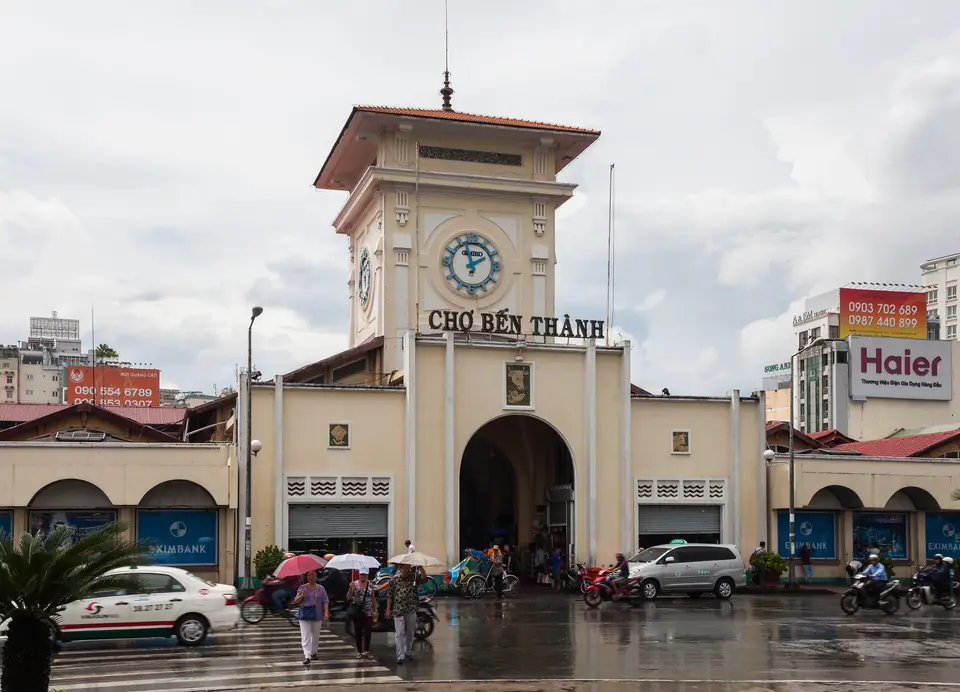
Ben Thanh Market is the great covered market of Ho Chi Minh City: a steel-framed building that the French firm Brossard et Maupin raised between 1912 and 1914 over the muddy Bồ Rệt pond, filled in for the occasion. Its clock tower, above the south gate, has become the unofficial emblem of the city, and the whole covers 13,056 m² with nearly 1,500 stalls and more than 6,000 small businesses among textiles, coffee, spices, fish sauce and phở kitchens.
Behind its bustle lies a history of losses and returns. The first Bến Thành market burned in 1859, when Vietnamese soldiers set fire to the city after the French capture of the citadel; the rebuilt one lost a hall in another fire in 1870. The current one opened with three days and three nights of festivities and, tradition says, with a young woman fighting a tiger with a spear. Half a century later, police fired in front of its main gate on a student march, and the square still bears the victim's name.
Highlights
- South gate clock tower — The unofficial emblem of Ho Chi Minh City, facing Quách Thị Trang Square
- Biên Hòa ceramic reliefs — 12 glazed plaques from 1952 over the four gates, with oxen, ducks, carp and bananas
- Inauguration of 1914 — Three days and three nights of festivities with more than 100,000 people
- Four gates as a directory — Textiles to the south, food to the north, coffee and spices to the east, art and ceramics to the west
- Night market — From 6 pm, lit stalls on Phan Bội Châu and Phan Chu Trinh until 10 pm
In the centre of Ho Chi Minh City, Ben Thanh Market (Chợ Bến Thành) is recognisable from afar by the clock tower that crowns its south gate, facing the roundabout of Quách Thị Trang Square and Lê Lợi Boulevard. Under a roof of stepped eaves, with overhangs that extend to give shade and let the air circulate, nearly 1,500 stalls are crowded together: fabrics, footwear and jewellery, fruit and fish, coffee, tea and spices, ceramics and counters with stools where phở, broken rice and bún bò Huế are served. It opens around 6:00 and, as evening falls, trade spills out into the side streets.
The history of Ben Thanh Market begins far from here, by the water. Its name recalls a landing stage on the Bến Nghé river, at the foot of the Gia Định citadel: “bến” is wharf and “thành” is citadel. That first market burned in 1859, the one rebuilt by the French lost a hall in 1870 and, around 1911, it was threatening to collapse. The current building, finished in March 1914, was planted beside the Mỹ Tho railway station, over a muddy pond that had been filled in. Until 1975 Saigon people called it the “New market”, in 1985 its image was even printed on the 30 đồng note and in 2022 the city approved a restoration project that keeps the clock tower and the four gates.
The architecture of Ben Thanh Market is best read by walking it in parts: the square, the clock gate, the central hall and the east gate, each with its own chapter. The audio guide follows that itinerary in four stops, with narration researched and fact-checked against historical sources, and leaves for the place itself the episodes that do not fit on a postcard.
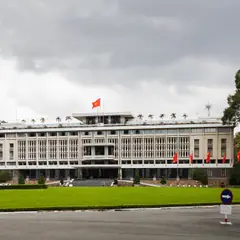
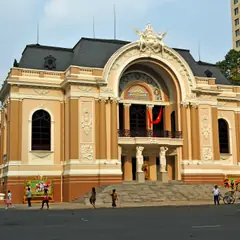
From the same colonial Saigon is the Saigon Opera House, from 1900, and six hundred metres away Independence Palace tells how the war ended.
A wharf without a river and a marsh underfoot
Quách Thị Trang Square
Summary of this stop
The visit starts in Quách Thị Trang Square, with the clock straight ahead. From here the first paradox of the place is understood: a market called “citadel wharf” with no river or citadel in sight. The name travelled with the market from its first site, the Bến Nghé landing where travellers and soldiers disembarked to enter the Gia Định fortress. The ground is not what it seems either: when the old market was pulled down, in 1911, the new one was raised over the Bồ Rệt pond, the French Marais Boresse, and the square in front was named after Saigon’s mayor, Cuniac.
Today the clock tower works as the unofficial emblem of the city, and at its feet open the entrances of the underground Bến Thành station, terminus of Metro Line 1, the first in Ho Chi Minh City, inaugurated on 22 December 2024. Those works also took away a singular neighbour of the roundabout: the statue of General Trần Nguyên Hãn, a fifteenth-century warrior releasing a bird from his horse. Who commissioned it, why that general and where it ended up is one of the stories the narration saves for this spot.
Under the clock: a festival, a tiger and a gunshot
South gate clock tower
Summary of this stop
The main gate is the stage of the two most opposed moments in the market’s history. From 28 to 30 March 1914, the inauguration, named “Tân Vương Hội”, brought together more than 100,000 people from Saigon and the provinces: lion dance, martial arts, a French military band, floats and fireworks. According to tradition, at that opening Võ Thị Vuông, daughter of the martial arts master Hai Ất, faced a tiger captured north of Thủ Dầu Một with a spear, from dawn until noon. The account comes from an English text translated in 1970 and from the memory of a local martial arts school, with no contemporary testimony to confirm it.
Half a century later, the same threshold saw another scene. On 25 August 1963, during a student march against the martial law of the Saigon government, police opened fire in front of this gate and killed Quách Thị Trang, a 15-year-old schoolgirl. What happened afterwards with her body, her funeral and the roundabout crossed to photograph the clock explains why the square bears her name, and the narration tells it right there, under the tower.
The third life of a burned market
Metal roof of the central hall
Summary of this stop
In the middle of the central hall, amid the humid heat, the haggling and the smell of coffee and fish sauce, the building reveals that it is the third version of itself. The old Bến Thành market burned in February 1859, two days after French troops took the citadel, when Vietnamese soldiers set the city on fire. The one the French rebuilt in 1860 lost a hall in July 1870 and was remade with brick pillars, an iron frame and tiles, in five halls: food, fish, meat, hot meals and bazaar.
Some summaries merge both fires into a single one in 1870; Vietnamese sources separate them. That division by goods survives today in the four gates, which serve as a directory for whoever enters, and in the memory of names: until 1975, Saigon people called this building “chợ Mới”, the New market, as opposed to the “chợ Cũ”, the Old market, of which only the meat hall was left standing.
Ox, duck and coaches to the delta
Bến Thành night market
Summary of this stop
At the east gate, on Phan Bội Châu Street, three glazed plaques show an ox and a duck. They are part of the 12 ceramic reliefs that the Biên Hòa art workshops made in 1952 for the four gates, designed by the artist Lê Văn Mậu and fired with local glazes in a wood kiln: a large plaque above, 2.2 × 1.5 m, and two small ones below. Each gate displays what is sold inside, from the ray and the bananas of the west to the ox head with carp of the south.
The street keeps its own layer of history. Until 1940, this street and the parallel Phan Chu Trinh were the terminals of the “xe đò”, the coaches that took travellers to the eastern provinces and the Mekong Delta. Today, from 18:00, the same space fills with lit stalls and food tables until 22:00: the night market that extends Ben Thanh’s life outside its walls every evening.