National monument
Jade Emperor Pagoda Audio Guide (Chùa Ngọc Hoàng)
Behind a gate of dragons, a Cantonese sanctuary in half-light where Saigon still comes to ask for a child, amid oil smoke, hanging threads and turtles that carry a plea.
- 40 min of audio
- Cantonese Taoist temple
Raised in the early twentieth century by the Cantonese Lưu Minh, the Jade Emperor Pagoda was born with two uses at once: the worship of Ngọc Hoàng and the meetings of a secret society determined to overthrow the Qing dynasty. A national monument of architecture and art since 1994, it preserves its space and architecture almost as in the beginning, with some 300 worship images in wood, ceramic and papier-mâché.
The supreme god of the pantheon does not show his face: a curtain of pearls hides it while the faithful, one by one, pour oil into his lamps and say his name and age in a low voice. A few steps away, in the chapel of the twelve celestial midwives, threads are hung to ask for a boy or a girl, the same request that in 2016 drew from Barack Obama an “I like daughters”.
Highlights
- Some 300 worship images, about a hundred of them in papier-mâché
- Ngọc Hoàng enthroned, his face veiled by a curtain of pearls
- Chapel of Kim Hoa Thánh Mẫu and the 12 celestial midwives
- Turtle pond, turtles released to ask for offspring
- Barack Obama's first stop in Ho Chi Minh City in 2016
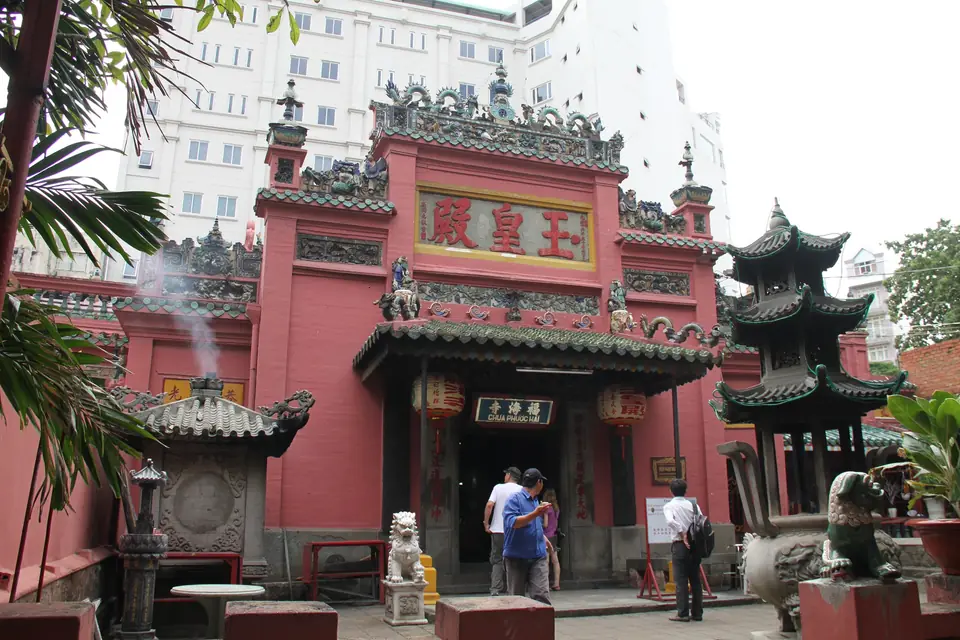
On Mai Thị Lựu Street, the noise of the motorbikes is cut off abruptly before a triple gate guarded by two dragons. On the other side waits the Jade Emperor Pagoda, Chùa Ngọc Hoàng to the city, a small Cantonese sanctuary of the early twentieth century that is still in full swing. The history of the Jade Emperor Pagoda begins with Lưu Minh, a Cantonese with the religious name Lưu Đạo Nguyên who raised it in honour of Ngọc Hoàng; the exact date is disputed and sources place it between 1900 and 1909. In 1982 it passed into the hands of the monk Thích Vĩnh Khương and the Buddhist Church of Vietnam, in 1984 it received the Buddhist name Phước Hải Tự, “temple of the sea of fortune”, and on 15 October 1994 it was declared a national monument of architecture and art.
What to see at the Jade Emperor Pagoda fits in a few metres, but each one is loaded with other people’s wishes: a courtyard of turtles and pigeons, a hall in half-light with some 300 worship images and a chapel visited by couples who want a child. The audio guide walks through the temple in four stops, with documented narration heard right there, amid the oil smoke and the murmur of the faithful.
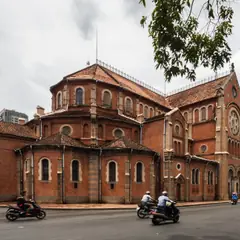
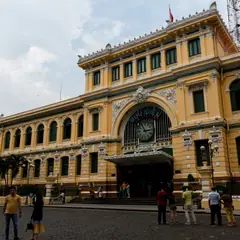
Catholic Saigon has its main church in Saigon Notre-Dame Cathedral, a little over a kilometre to the south, opposite the Saigon Central Post Office.
Two dragons and a founder with a double life
Chùa Ngọc Hoàng
Summary of this stop
The entrance gate, the tam quan, greets with two dragons of lines undulating like waves, facing each other as they contend for a pearl. Above, the brick building shows the architecture of the Jade Emperor Pagoda in its most recognisable form: yin-yang tiles and ridges and corners covered in coloured ceramic figurines. Although since 1984 the official name has been Phước Hải Tự, in the city it is still called Ngọc Hoàng.
Behind that façade is a founder about whom two incompatible stories are told. The sources document Lưu Minh as a strict vegetarian and follower of the Minh Sư cult, who paid for the temple for worship and, at the same time, for the meetings of a secret society bent on overthrowing the Manchu Qing dynasty. Another, more disputed version presents him as a businessman seeking the favour of the gods for his commercial affairs. Which of the two portraits fits better with what can be seen in the halls is a question the narration leaves open at the threshold.
Turtles that carry a plea
Turtle pond
Summary of this stop
The tiled front courtyard revolves around a great incense burner, with trees, pigeons and motorbikes parked in a corner. Beside it, a pond crowded with turtles, some very large, and another of whitish fish, always with someone leaning over to look at them.
Those turtles are not there for decoration. Whoever asks for a child buys a pair and releases it in the pond; if the turtle becomes pregnant, the plea is taken as granted, and some engrave the names of husband and wife on the shell. That tiled floor is, moreover, the only fundamental change the complex has undergone in more than a hundred years: the rest of the space and the architecture has come down almost intact, and the national monument certificate of 1994 hangs inside the temple.
An emperor who listens behind a curtain of pearls
Statue of the Jade Emperor
Summary of this stop
In the main hall stands the temple’s largest statue: Ngọc Hoàng enthroned, with a sceptre held in both hands and a headdress from which hangs a curtain of pearls that hides his face. He is flanked by Huyền Thiên Bắc Đế and a court of celestial generals and soldiers carved in wood. All around, the temple gathers some 300 worship images, and about a hundred of them are made entirely of papier-mâché, the giấy bồi, alongside others of wood and ceramic.
Before this emperor, lighting incense is not enough. According to a documented tradition, the worshipper buys oil at the entrance of the hall, pours it into the altar lamps and, while it burns, says in a low voice his name, his age and those of his family to ask for peace or harmony at home. A wooden staircase on the right climbs to an altar on the upper floor, entered barefoot, and to a small terrace over the courtyard. Every year, on the 9th day of the 1st lunar month, the date taken as the Jade Emperor’s birthday, the Vía Ngọc Hoàng festival fills the temple with pilgrims; what that curtain of pearls truly hides is left for the narration in front of the altar.
Twelve midwives and a thread to ask for a child
Chapel of Kim Hoa Thánh Mẫu and the 12 bà mụ
Summary of this stop
To the left of the main hall opens the chapel of Kim Hoa Thánh Mẫu and the 12 bà mụ, celestial midwives who each shape a part of the child’s body. It is the corner visited by couples asking for offspring, and the gesture is ruled: whoever wants a boy hangs a thread on the image on the right, whoever wants a girl, on the one on the left, and then rubs the midwife’s belly three times and their own three times. Very close, the altar of Ông Tơ and Bà Nguyệt, the deities who bind marriages, receives singles and young couples, and another hall, that of the judge of hell, displays plaques with the ten tortures of hell.
In this chapel the different stages of one same story meet: women who are still waiting, pregnant women who return to ask for an uncomplicated birth and families who bring the child already born to give thanks. Barack Obama also came here on 24 May 2016, on his first stop in Ho Chi Minh City, with the street closed and the mobile signal blocked; when it was explained to him that people pray at the temple to have sons, the father of Malia and Sasha answered, laughing: “I like daughters”.