Romanesque Revival cathedral
Saigon Notre-Dame Cathedral Audio Guide (Nhà thờ Chính tòa Đức Bà Sài Gòn)
A cathedral of red brick shipped from France, paid for by the colonial government to impress Saigon, with six bells named after musical notes and an 8-tonne Virgin who, in 2005, was rumoured to be weeping.
- 30 min of audio
- French brick from 1880
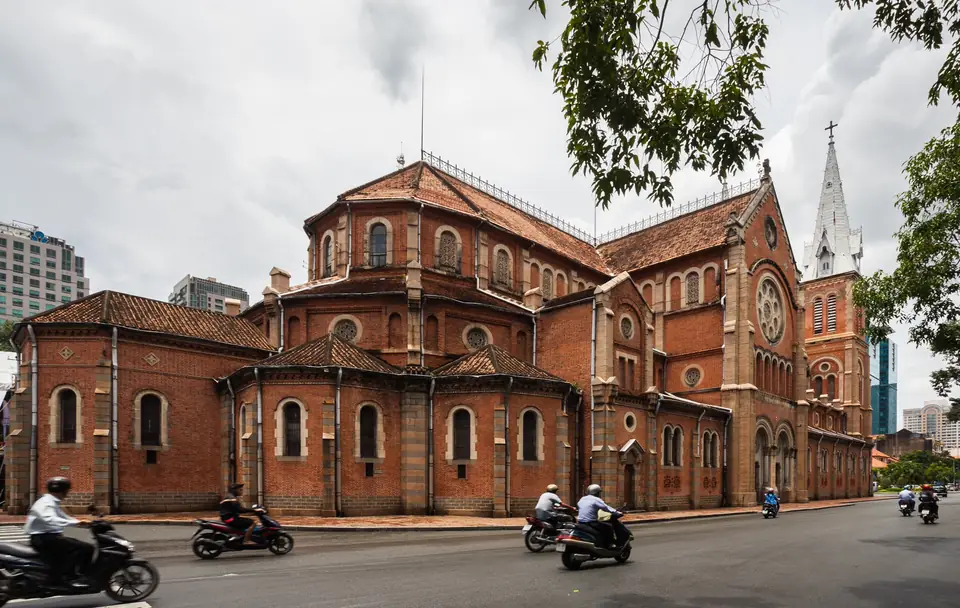
Raised between 1877 and 1880 to a design by Jules Bourard, winner of a competition among 18 proposals, Saigon Notre-Dame Cathedral was paid for with colonial administration money and built with materials from France, from the cement and steel to the screws. Its walls of bare red brick, left unplastered, and its two towers of about 57 metres rise at the end of Đồng Khởi Street, over a square open to four streets and with no fence. Since 1960 it has been the cathedral of the Archbishop of Saigon, and today it is also a minor basilica.
The church France built to show off its power has ended up belonging to Saigon. Above the right-hand door there are Chinese characters with the year 1880; among the roof tiles, almost all stamped by a Marseille workshop, a few marked “Wang-Tai Saigon” slip in, replacement pieces made in the city, probably to patch war damage; and at the feet of its Virgin, according to a documented tradition, lies a silver box full of prayers for peace.
Highlights
- Virgin of Peace — 4.6 metres and 8 tonnes, deliberately left unpolished so it can be seen from afar, on a pedestal that stood empty for fourteen years
- Bare red-brick façade — Brick ordered from France that, more than 140 years later, is still pink and free of moss
- Right-hand door — Inscriptions in Chinese characters with the name of the church and the year 1880
- Swiss clock of 1887 — Over a tonne, some 15 metres above the ground between the two towers
- Six bronze bells — About 27 tonnes, each named after a musical note
In the heart of Ho Chi Minh City, where Đồng Khởi Street begins, Saigon Notre-Dame Cathedral (Nhà thờ Chính tòa Đức Bà Sài Gòn) raises two towers of bare red brick over a cross-shaped square formed by four streets. Unlike the other churches in the area, it has no fence or perimeter wall: the building opens directly onto the square. It was built between 1877 and 1880 with materials shipped from France, from the cement and steel to the screws, and today it is the cathedral of the Archbishop of Saigon, a minor basilica and the heart of the city’s Catholicism.
The history of Saigon Notre-Dame Cathedral begins before the first stone, with a pagoda occupied during the war of conquest and a wooden church devoured by termites, and it goes on long after the last: a bronze bishop pulled down, a Virgin brought by ship from Italy, a news story that in 2005 forced traffic to be stopped. Its Romanesque Revival architecture, with mouldings inspired by Romanesque and Gothic models, holds inside a nave 93 metres long and 35 wide, with a 21-metre vault and two rows of six pillars symbolising the twelve apostles; the altar is a block of marble with six carved angels holding up the table, and it seats about 1,200 people. It is lit by 56 stained-glass windows with biblical scenes, 31 rose windows and 25 coloured-glass oculi, although only four windows are the originals from the Lorin workshop of Chartres: the rest were remade around 1949, after almost all of them were broken in the Second World War.
A good part of what to see at Saigon Notre-Dame Cathedral, however, is settled from the outside. The 30-minute audio guide circles the exterior from the square: the Virgin of Peace and her pedestal, the façade with its Chinese characters, the Swiss clock and the bell towers, with narration researched and fact-checked against historical sources, to be heard in front of each detail. Since 2017 the church has been going through its first major restoration in 137 years, planned to run until 2027, and scaffolding and tarpaulins currently alter the silhouette of towers and roofs.
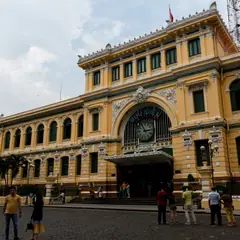
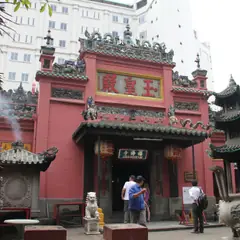
Across the square, the Saigon Central Post Office completes the colonial backdrop; another face of the city’s faith is found at the Jade Emperor Pagoda, the Cantonese sanctuary where people come to ask for a child, and some eight hundred metres away the War Remnants Museum tells of the human cost of the war.
A competition-winning church to impress Saigon
Paris Commune Square
Summary of this stop
The route starts at the end of Đồng Khởi Street, with the cathedral straight ahead. Before this building, the Catholic mission of French Saigon lived on borrowed premises: its first church occupied a pagoda abandoned during the war of conquest, on Street 5, today Ngô Đức Kế. In 1863 a wooden church was raised beside the Charner canal (Kinh Lớn), finished in 1865, which termites left in ruins, to the point that Mass ended up being held in the governor’s palace hall.
In August 1876 the governor of Cochinchina called a design competition. Among 18 proposals the one by Jules Bourard won, and the commission had a double purpose: to give the mission a church and to show the population the strength of French civilisation through architecture. Bishop Isidore Colombert laid the first stone on 7 October 1877, and the cathedral was blessed and inaugurated on Easter Sunday, 11 April 1880, before Governor Charles Le Myre de Vilers.
The bill, 2,500,000 francs, was paid by the colonial administration, which is why at first it was known as the State Cathedral. How it went from that name to Notre-Dame is a story told a few steps away, in the middle of the square.
From the bronze bishop to the Virgin of Peace
Statue of Our Lady of Peace
Summary of this stop
In the middle of the front garden, on a cylindrical base of red granite with a Latin bronze plaque, stands the Virgin of Peace. That pedestal has more history than the statue: in the early twentieth century it held a bronze of Bishop Pigneau de Behaine leading Prince Nguyễn Phúc Cảnh, son of Emperor Gia Long, by the hand. Ordinary Saigon people called it the statue of the “two figures”, to tell it apart from the “one figure” one, that of Admiral Rigault de Genouilly, which stood near the river. In 1945 the government of Trần Trọng Kim pulled it down, and the stone stood empty for fourteen years.
In February 1959 the Virgin of Peace (Regina Pacis) arrived by ship, the work of the sculptor G. Ciocchetti, carved in Pietrasanta. She measures 4.6 metres, weighs 8 tonnes and was deliberately left unpolished so that she could be seen from afar; the most detailed account speaks of white marble, although other sources describe her as granite ordered in Rome. Cardinal Agagianian blessed her on 17 February 1959, and since then the church has been called Notre-Dame. The Virgin holds a globe with a cross, looks to the sky and treads on the head of a serpent, today missing its upper jaw; the sculptor’s name is on the edge of the cloak. In October 2005 news spread that she was weeping from her right cheek: thousands of people came and the authorities had to close the traffic around the cathedral, although the Vietnamese Catholic hierarchy did not confirm the phenomenon.
The best-kept secret of this stop is out of sight. According to a documented tradition, right where the stone meets the statue’s feet a hollow was dug that holds a silver box with prayers for peace, sent from many regions of Vietnam. What they were written on and who read the first one before the invited guests is the subject of the narration in front of the pedestal.
Chinese characters above a French door
Right-hand door of the façade
Summary of this stop
In front of the right-hand door, the façade can be read up close. The exterior walls are of brick ordered from France (some versions say Toulouse and others Marseille) and were left bare, unplastered: more than 140 years later they keep their pinkish red tone and have no moss. All the building material, from the cement and steel to the screws, crossed the sea from France.
That is why what lies above this door is surprising: lines of Chinese characters that name the church and the Immaculate Conception and record the year of inauguration, 1880. Higher up, between the two towers and some 15 metres above the ground, appears the face of a clock made in Switzerland in 1887, weighing over a tonne, which had to be wound once a week with a crank.
The cathedral is also a pantheon. Inside are buried three bishops of the Cochinchina mission: Jean-Marie Dépierre (1855-1898), Isidore Dumortier (1869-1940) and Isidore Colombert (1838-1894), the same man who laid the first stone in 1877. The bishop who inaugurated the church never left it, and the narration at this point finishes telling why this so very French building belongs to Saigon today.
Six bells that start swinging with a kick
Cathedral bell towers
Summary of this stop
From the pavement by the Post Office, the two bell towers can be seen in full. For years they stood at 36.6 metres without a roof; in 1895 the architect Gardes added two 21-metre spires, and today each reaches about 57 metres. With the crosses at the top, 600 kilos each, the whole reaches 60.5 metres. Inside hang six bronze bells cast in France and brought to Saigon in 1879, four in the right-hand tower and two in the left, seen from outside. Each is named after a note (sol, do, re, mi, la, si) and together they weigh about 27 tonnes, almost 29 with the counterweights. The three largest are so heavy that they have to be set swinging with kicks before the electric mechanism is switched on.
Their ringing follows a fixed calendar that lets you guess the day by ear: on a weekday, only the mi bell at five in the morning and the re at 4:15 pm; on Sundays and feast days, three. The three largest are reserved for occasions such as New Year’s Eve, Christmas or Lunar New Year, and their sound carries up to 10 kilometres in a straight line.
The towers also tell the recent history of the church. In 1960 John XXIII created the Vietnamese Catholic hierarchy, with archdioceses in Hanoi, Huế and Saigon, and the building became the cathedral of the Archbishop of Saigon, a role it still holds. On 29 June 2017 its first major restoration in 137 years began, and on 6 March 2023 the two crosses, almost 4 metres tall and rusted after 127 years at the top, were taken down to be restored in Ingelmunster (Belgium) along with eight smaller ones. On which single night of the year all six bells ring at once is the closing of the route.