Memory of the war
War Remnants Museum Audio Guide (Bảo tàng Chứng tích Chiến tranh)
Aircraft in the yard, a guillotine by the entrance and the photos of Agent Orange: the museum Saigon opened in 1975 stands on a plot that was once an imperial pagoda, a French fort, a clinic and an American office.
- 90 min of audio
- Vietnam War
Inaugurated on 4 September 1975, barely four months after the end of the war, the War Remnants Museum shows the human cost of the Vietnam conflict with a bluntness few museums allow themselves. It holds more than 20,000 documents, objects and films, of which more than 1,500 are spread across 9 permanent exhibitions, and since 1998 it has been part of the International Network of Museums for Peace.
Beneath the tanks of the yard lies a much longer history: on this very plot the future Emperor Minh Mạng was born in 1791, a French captain turned the pagoda into a fort, Vietnam's first woman doctor opened a clinic and the Americans set up their offices. Even the name of the museum has changed twice with the rhythm of the country's history.
Highlights
- Machinery yard — Huey, F-5A, Skyraider, M48 tank and the 6,800 kg Daisy Cutter bomb
- Tiger cages — reproduction of the Côn Đảo cells with original iron doors
- The guillotine — original, last used in 1960
- Agent Orange room — photographs of victims and three jars with preserved foetuses
- War photography — some 250 images donated by Bun'yō Ishikawa
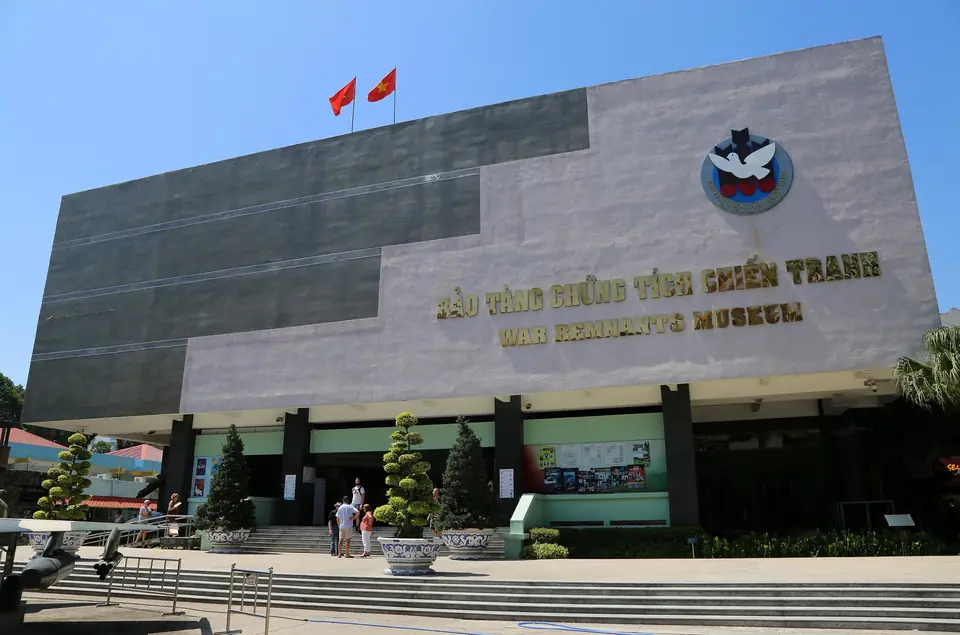
On 4 September 1975, four months after the fall of Saigon, the city’s Party committee opened at number 28 of the old Trần Quý Cáp Street, today Võ Văn Tần, an exhibition with a name that left no room for doubt: the House of Exhibition of US and Puppet Crimes. Half a century later, the War Remnants Museum (Bảo tàng Chứng tích Chiến tranh) is one of the most direct and most debated museums in Ho Chi Minh City: aircraft and armoured vehicles in the open air, isolation cells, a genuine guillotine and photography rooms that soften nothing.
The history of the War Remnants Museum begins long before 1975. The plot has been a royal pagoda, a colonial fort, a villa with an obstetrics clinic and an American office, and the museum itself has changed name and tone to the rhythm of relations between Vietnam and the United States. That thread, documented and checked against historical sources, runs through each of the stops of the audio guide, which turns the visit into more than a stroll between display cases.
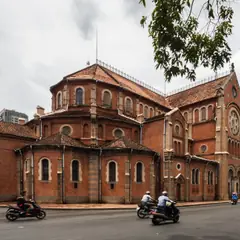
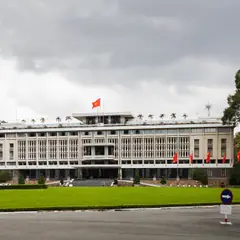
Some four hundred metres away, Independence Palace preserves the gate through which the tanks entered on 30 April 1975, and Saigon Notre-Dame Cathedral is a short walk away.
An imperial pagoda under the yard
War Remnants Museum
Summary of this stop
At the Võ Văn Tần gate nothing recalls that a temple once stood here. Yet in 1791, at the back of the Khải Tường pagoda that occupied this land, the concubine Trần Thị Đang gave birth to Prince Nguyễn Phúc Đảm, the future Emperor Minh Mạng. Once on the throne, the monarch paid for the pagoda’s restoration with 300 lạng of silver from the royal treasury and renamed it Quốc Ân Khải Tường tự. According to tradition, it all began in 1744 with two monks who were brothers in religion, who cleared the jungle and raised two leaf huts a few steps from each other, the origin of the sister pagodas Từ Ân and Khải Tường.
The temple did not survive the arrival of the French. After the capture of the Gia Định citadel by the Franco-Spanish expedition in December 1859, the pagoda became a fort under Captain Nicolas Barbé, who moved the Buddha statue out into the yard; the place came to be known as Fort Barbé until, on the night of 7 December 1860, the insurgents of Trương Định killed the captain outside its walls. In 1880 the colonial administration pulled the pagoda down. The gilded Buddha was saved, and how an emperor came to locate the exact corner of his birth is one of the stories the narration keeps for this point.
A Huey in the garden of Vietnam’s first woman doctor
Aircraft and helicopter in the yard
Summary of this stop
The walled yard is the first thing that holds the eye: a Bell UH-1 “Huey” helicopter, a Northrop F-5A fighter, a Douglas A-1 Skyraider, a Cessna A-37 Dragonfly, an M48 Patton tank and artillery pieces in the open. Among them stands out the casing of a BLU-82 “Daisy Cutter”, a conventional bomb of 15,000 pounds (6,800 kg) dropped from C-130 aircraft and conceived in Vietnam to flatten a patch of jungle and instantly open a landing zone for helicopters; 225 were made. In one corner are gathered bombs and shells that did not explode, now defused.
The irony of the place lies in what stood here before. In the mid-twentieth century the politician Bùi Quang Chiêu built a European villa here, and in 1940 his daughter, Dr Henriette Bùi, the first woman doctor in Vietnam, opened an obstetrics and gynaecology clinic in it. In 1961 the building passed to the American military advisers; the Vietnamese version and the museum itself speak afterwards of a civilian personnel office, one for USAID and, from 1973, the embassy security service, while other sources describe it as an information and intelligence headquarters. Some of the aircraft in the yard, moreover, are not what their labels say, a detail the audio guide reveals in front of the fuselages.
Tiger cages and a guillotine from 1960
Reproduction of the tiger cages
Summary of this stop
A low building in the compound reproduces the “tiger cages” of the Côn Đảo prison, built by the French in 1940: 120 isolation cells covered by iron bars. The recreation incorporates an original set of iron doors from that prison, cast in France and moved to Ho Chi Minh City with the support of the Côn Đảo Party committee. The cages came to light in July 1970, when two US congressmen, Augustus Hawkins and William Anderson, strayed from the official visit; Tom Harkin’s photos were published in Life magazine on 17 July that year.
In the open air, before the main entrance, stands the original guillotine the museum tracked down after a long search, used by the French authorities and by the South Vietnamese regime to execute prisoners, for the last time in 1960. Next to the Côn Đảo cells another version of the cage is also displayed, made only of barbed wire, that of the Phú Quốc prison camp. What being locked in it meant, according to the surviving accounts, is one of the hardest stories of the route.
Photos that accuse, photographers who fell
“Hồi Niệm” photo exhibition
Summary of this stop
The war photography room, with the exhibition “Hồi Niệm”, recalls the origin of the museum: a show born in 1975 from a war-crimes investigation commission, created on 13 August that year, in order to accuse. Here is shown part of the some 250 photographs that the Japanese Bun’yō Ishikawa, who covered the war from Saigon between 1964 and 1968, donated to the museum in 1998 for a permanent exhibition.
The museum has also hosted “Requiem”, the tribute to the photographers killed on both sides in the wars of Vietnam and Indochina, born of the book by Horst Faas and Tim Page that won the Robert Capa Gold Medal and the George Polk Award in 1997. Behind those images lies a personal obsession tied to Sean Flynn, son of the actor Errol Flynn, who disappeared on a road in Cambodia in April 1970. How that absence marked the life of his friend Tim Page is the story the narration tells in front of the photos.
Three jars and a softer name
Agent Orange room
Summary of this stop
The Agent Orange room gathers photographs of dioxin victims and three jars with preserved human foetuses, deformed by exposure to the defoliant. It is the most intimate blow of the visit. In 2014 and 2015, the temporary show “Agent Orange: Messages from the Heart” changed the focus and showed survivors who got ahead, in a turn towards a more reconciliatory tone.
That turn has precedents in the museum’s own name. On 10 November 1990 it lost the words “US” and “puppet”, and on 4 July 1995, a year after the end of the embargo and the normalisation of relations with Washington, it adopted the name War Remnants Museum. Some still see in the presentation a partial and deliberate gaze, and the debate continues in the visitors’ books. The current exhibition building, whose works began in 2002, was inaugurated on 28 April 2010 on the same plot. How a museum conceived to accuse ended up in a network of museums for peace is the closing the audio guide keeps for the end.