French colonial architecture
Saigon Opera House Audio Guide (Nhà hát Thành phố Hồ Chí Minh)
A postcard-white façade that was stage, refuge, parliament and target: the theatre of 1900 took a century to stop being the French one and become the city's own.
- 30 min of audio
- Opera, parliament and war
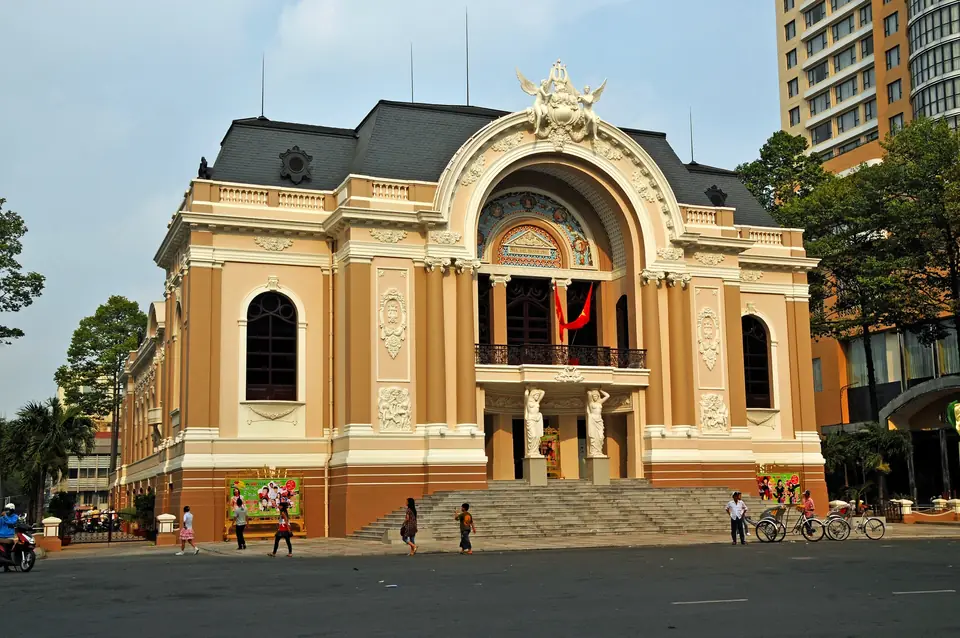
Finished on 1 January 1900 to a design by Félix Olivier, the Saigon municipal theatre copied for its façade the model of the Petit Palais in Paris, built that same year. Decorations, inscriptions and furniture were drawn in France and shipped from there. From Lam Sơn Square, between the Continental Hotel and the Caravelle, it presides over the colonial centre of Ho Chi Minh City.
For two decades the curtain was raised not for operas but for deputies: from 1956 to 1967 it housed the National Assembly of South Vietnam and from 1967 its Lower House. In front, a nine-metre monument to the Marines had its soldiers facing the parliament, and the Saigon of the day read it as a bad omen.
Highlights
- Façade of 1900 — inspired by the Petit Palais in Paris
- Parliament of South Vietnam — National Assembly and Lower House for two decades
- Lam Sơn garden — where the 9-metre Marines monument stood
- Muses of the arts — removed in 1943 and returned in 1998
- Continental Hotel — where Graham Greene conceived The Quiet American
The history of the Saigon Opera House begins before the building itself. In 1863, with Cochinchina freshly conquered, the French colonial administration brought in a theatre company to entertain the troops. Work on the definitive theatre began in 1898 and on 1 January 1900 the building was ready: a design by Félix Olivier, construction supervised by Ernest Guichard and Eugène Ferret and an architecture usually described as “flamboyant”, of the French Third Republic, although other readings speak of Gothic reminiscences or of an Empire style with Beaux-Arts additions.
What came after does not fit in any programme. Allied bombing in 1944, French refugees in 1954, a parliament installed in the hall for two decades and a façade stripped of its statues and then put back together. Saigon people called it “Nhà hát Tây”, the theatre of the Westerners; today it is, for short, “Nhà hát Thành phố”, the City Theatre. What to see at the Saigon Opera House and how to read its history in Lam Sơn Square is exactly what the audio guide route arranges: four stops around the exterior, between the Continental Hotel and the Caravelle, researched and fact-checked against historical sources.
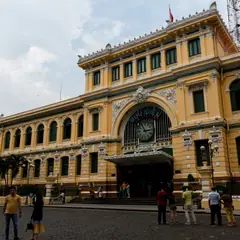
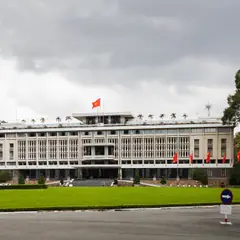
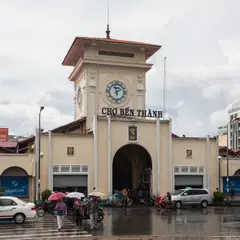
The other seat of South Vietnamese power was Independence Palace; from the same French city are Ben Thanh Market, with its clock tower, and the Saigon Central Post Office, half a kilometre away.
The private box of French Saigon
Hotel Continental Saigon
Summary of this stop
The route starts at the corner of Đồng Khởi with the square, beside the Continental Hotel, built by Pierre Cazeau between 1878 and 1880. That is, the hotel was already there when the theatre’s walls began to rise. During the First Indochina War it was nicknamed “Radio Catinat”, after the correspondents and politicians who gathered in it, and Graham Greene, a long-time guest in room 214, conceived The Quiet American within its walls.
From this corner the urban stagecraft the French sought can be understood. After the theatre opened in 1900, the esplanade in front of the façade was renamed place du Théâtre, and the group of hotel, theatre and square became the showcase of the colonial city. The stop places the visitor in that privileged box, with Olivier’s façade ahead and the Continental behind, and saves for the narration the connection between Greene’s novel and what could be seen from this corner.
Nine metres of soldiers facing the Lower House
Lam Sơn Park
Summary of this stop
Lam Sơn garden, in front of the entrance, looks today like a green breather in the middle of the centre. But its history is one of absence. In 1955 the theatre was remodelled as a legislative seat and the square, until then place Augustin Foray, took the name Lam Sơn. From 1956 to 1967 the building housed the unicameral National Assembly of South Vietnam, and on 31 October 1967 the Lower House, with 137 deputies, was inaugurated there.
That same year, the government of the Second Republic raised in the garden a nine-metre monument to the Marines, with the soldiers in an assault pose and facing the parliament. Opinion at the time saw in it a bad omen: the army pointing at the deputies. On 25 July 1970, two anti-war Frenchmen, André Menras and Jean-Pierre Debris, climbed the statue, unfurled the flag of the National Liberation Front and threw leaflets. They were sentenced to three and four years in prison, passed through Chí Hòa and Côn Đảo and were expelled to France at the turn of the year from 1972 to 1973. After the fall of Saigon in 1975, the monument was pulled down.
The episode has an epilogue that the audio guide tells on the very spot where the statue stood: the Vietnamese name that cellmates gave to one of the two Frenchmen, and what happened to that name almost forty years later.
The façade that lost its muses
Saigon Opera House
Summary of this stop
At the foot of the steps, the white façade seems intact since 1900. It is not. Its model was the Petit Palais in Paris, and the decorations, inscriptions and furniture were drawn in France and shipped from there. Sources credit the original building with stalls and two balconies for some 1,800 people, a figure hard to square with the 559 seats there were before the last major renovation.
Between the two world wars, the city council paid for the journeys of companies brought from France, but the public preferred nightclubs and dance halls, and the theatre was left with occasional concerts and performances of cải lương, the traditional opera of southern Vietnam. In 1943, after years of criticism of a façade considered overloaded, the statues of the muses of the arts, the garlands and two lamp posts were removed to rejuvenate its style.
It took until 1998, for Saigon’s 300th anniversary, for the city to restore the façade and put back part of what had been removed, including two muses, the garlands and the lamp posts, at a cost of some 25,000 million dong. The stop teaches how to look at that façade in a different way, and explains why the passage from “theatre of the Westerners” to “theatre of the city” sums up the whole journey.
Bombs, refugees and bamboo circus
Caravelle Saigon
Summary of this stop
The last stop is at the corner of the theatre facing the Caravelle Hotel. That plot holds the origin of it all: there, after the first performances in the admiral’s villa on the old Clock Square, the provisional theatre was raised, although the sources do not agree on whether the building of 1898 was built on top of the old one or right beside it.
From here the building’s hardest years are reviewed. In 1944 Allied air raids against the Imperial Japanese army damaged it and it stopped working; in 1954, after Dien Bien Phu and the Geneva Accords, it served as provisional lodging for French civilians arriving from northern Vietnam. After 1975 it hosted the People’s Assembly of the Provisional Revolutionary Government and in 1976, with reunification, it recovered its function as a theatre. The renovation of 2007 to 2009 rebuilt the roof with tiles made to the 1900 model, restored reliefs and statues and cut the capacity from 559 to 500 upholstered seats.
Today its stage programmes A O Show, by the company Lune Production, presented as Vietnamese bamboo circus. In the same hall where French companies sang and deputies debated, acrobats now leap with bamboo canes, and the narration closes the circle with what that change of scene means for a building that was anything but a simple theatre.