Khmer Rouge memorial
Wat Thmei Audio Guide
An active Buddhist pagoda, about 2 km from Siem Reap along the Angkor road, built beside the wells where the Khmer Rouge executed prisoners between 1975 and 1979.
- 30 min of audio
- Khmer Rouge memorial
Wat Thmei, also known as the Siem Reap Killing Fields memorial, occupies land that in the 1960s was the “Chinese House Village”, with two concrete buildings for the Chinese workers at the airport. Between 1975 and 1979, under the Khmer Rouge regime, the compound served as an execution site, and murdered prisoners ended up in mass graves and in wells. Today it holds an active monastery, a glass-sided stupa with some 800 skulls and a collection of photographs, paintings and torture instruments from the period.
The contrast defines the visit: a few metres from the skulls rises the temple with its Buddhist murals, where monks and neighbours pray daily. Some Cambodian visitors slip money through the slots in the stupa’s glass, and in the exhibition hall a survivor usually signs his book beneath five paintings that tell his life. Here the memory of the genocide is not kept in a closed museum, but remains alive among offerings, chants and testimonies.
Highlights
- Glass-sided memorial stupa — some 800 skulls visible on its four sides
- Excavated pits under cover, with bones and clothing in view
- Rooms with Khmer Rouge photographs, paintings and torture instruments
- A survivor who signs his book beside the paintings of his life
- An active pagoda where every 20 May the monks chant for the victims
What to see at Wat Thmei: a pagoda with a popular name and several official ones (Wat Athikaram, Wat Tepothivong), located in the village of Tropeang She, in the Kuk Cho sub-district. The history of Wat Thmei begins in the 1960s with the Chinese workers at the airport, passes through the years 1975 to 1979, when the Khmer Rouge used the site to execute prisoners, and reaches the renovation of the pagoda in 1995, when the victims’ bones and skulls were placed in a memorial stupa. Between June 2014 and February 2015 the compound also hosted the DC-Cam exhibition on the forced evacuation of the population, the most visited venue in the country thanks to Siem Reap’s tourist circuits. The full experience is completed with the audio guide, which gives voice to each point of the compound. In the same city, Psar Chas shows the urban core of Siem Reap, Angkor Wat lies on the road to the temples and Kampong Phluk, some 22 km away, completes the context with the life of the lake.
The gate beside the Angkor road
Wat Thmei
Summary of this stop
The entrance opens directly onto the road along which visitors to the Angkor temples pass every day, about 2 kilometres from the centre of Siem Reap. The break between that route and the compound is abrupt: the land was the “Chinese House Village”, with two concrete buildings that lodged the Chinese airport workers in the 1960s, and between 1975 and 1979 it served as a prison and execution site of the Khmer Rouge regime.
The murdered prisoners ended up in mass graves and in water wells. The discussion about what exactly existed here in those years remains open: tourist sources present the pagoda itself as the prison, while the 1995 field report describes it as a new construction on the old village, with the wells as the execution site. The details that sort out those versions are saved for the narration on the ground.
Photographs, paintings and a survivor who signs
Khmer Rouge museum rooms
Summary of this stop
Wat Tepothivong works today as an active Buddhist monastery and at the same time houses a collection of photographs, paintings and torture instruments from Pol Pot’s regime, which contrasts with the architecture and murals of the pagoda. The museum rooms arrange the period chronologically. In 2008, by contrast, the memorial amounted to a collection of bones and a few grainy photos and drawings, worn by the weather and pinned to panels; between 2014 and 2015 it became the most visited venue of a national exhibition.
Here the history is not only in the display cases. Sum Rithy, a survivor of the regime, spends much of his time beside a stall where he signs his book “Surviving the Genocide in the Land of Angkor”, beneath five paintings that tell his life. According to his account, militiamen took him one night from his hut and drove him by truck to a detention centre in Siem Reap; he said he repaired motorbikes, and that trade kept him alive. After almost two years he was released along with 28 other prisoners. The rest of that episode is left for the audio guide.
Eight hundred skulls behind the glass
Glass-sided memorial stupa
Summary of this stop
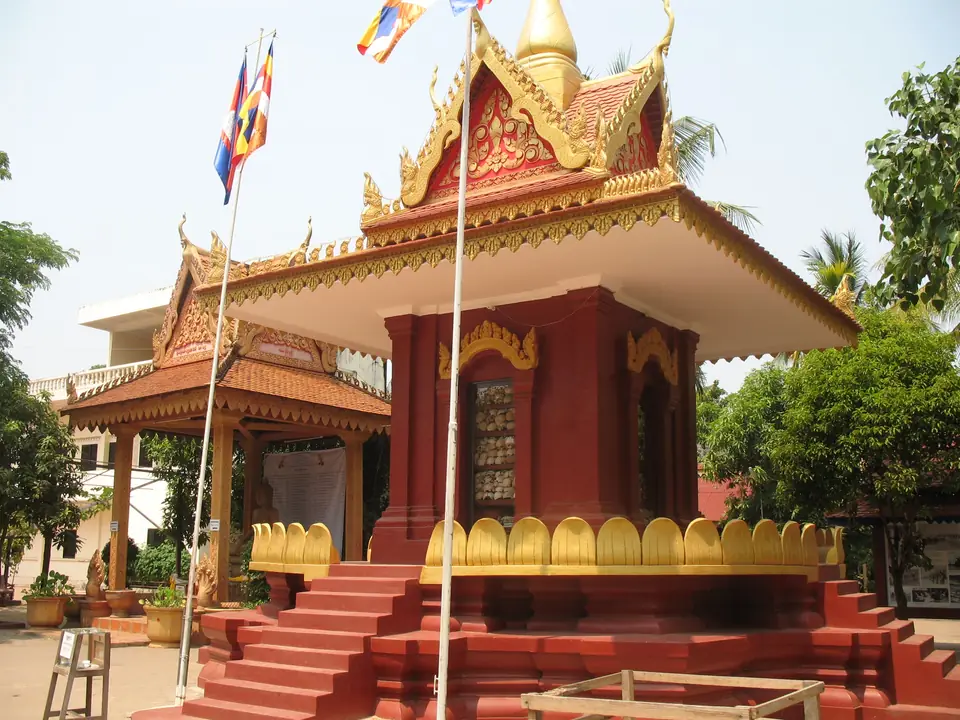
The memorial stupa has glass windows on its four sides, and through them one sees some 800 skulls from the Khmer Rouge period, with bones piled inside. With the renovation of the pagoda in 1995, a large quantity of remains was placed here, exposed to the view of locals and tourists. The count varies according to the sources between “some 800”, “more than 800” and “hundreds”.
Beside the stupa, a sign addressed to “Dear Tourists” explains that the bones were collected from the nearby field and belong to victims of Pol Pot’s regime between 1975 and 1979, among them local residents and people forcibly evacuated from Phnom Penh. Some Cambodian visitors leave money offerings by slipping them through the slots in the glass, so that what is a display case of remains for the tourist is an altar for many.
The well Prum Moy climbed out of
Excavated pits under cover
Summary of this stop
Outside, the excavated pits remain partly in view under a protective cover, with bones and clothing and signs identifying the age and sex of the remains. The 1995 report placed near the monks’ barrack two large pits and numerous wells with bodies, and some 250 metres to the south, around a roofless two-storey concrete house, at least six wells used as graves. The current stupa, with hundreds of skulls recovered on the site itself, replaced an earlier memorial structure that had become too small.
Within this setting falls the testimony of Prum Moy, one of 37 detainees who four days after the Khmer Rouge takeover, in 1975, were brought by truck at around 11 in the morning to the wells of a former village. He was shot five times and fell into the well with the others; he crawled out at around one in the afternoon and spent three months hidden in the jungle. In 1995 another witness, Heung Deum, put the dead at this site at 8,000, a single estimate that was later repeated as established fact.
The new pagoda that prays for the dead
Pagoda vihara
Summary of this stop
The pagoda’s vihara, with its Buddhist murals, is an active temple where monks and neighbours pray a few metres from the memorial. In October 1995 the pagoda was of recent construction: its Preah Vihear, the ordination hall, was still under construction, the monks lived in a three-storey barrack-style building and a stupa with skulls and bones in honour of the dead had already been raised. Wat Thmei is the popular name of a pagoda also known as Wat Athikaram and as Wat Tepothivong.
The compound has also hosted Siem Reap’s ceremony on 20 May, the Day of Remembrance of Pol Pot’s victims. On the morning of 20 May 2015 it was presided over by Governor Khim Bunsong before monks, officials, soldiers, neighbours and the faithful: candles and incense were lit, wreaths of flowers were laid and 65 monks recited chants, performed the bangskol, the Buddhist rite for the souls of the deceased, and received the offering of food in their bowls to dedicate the merit to the dead of the regime.