Historic market
Psar Chas Audio Guide
The oldest market in central Siem Reap gathers on the riverbank a ring of silks and Buddhas and, inside, the aisles of prahok and dried fish where the locals shop.
- 45 min of audio
- Khmer market and colonial legacy
Psar Chas literally means “Old Market” and occupies the south of central Siem Reap, between Pub Street and the river, at the junction of Street 9 with Hospital Road. It is the reference point for addresses in the city: many businesses give theirs in relation to it. The history of Psar Chas is tied to that of the town itself, which grew after the Franco-Siamese treaty of 1907.
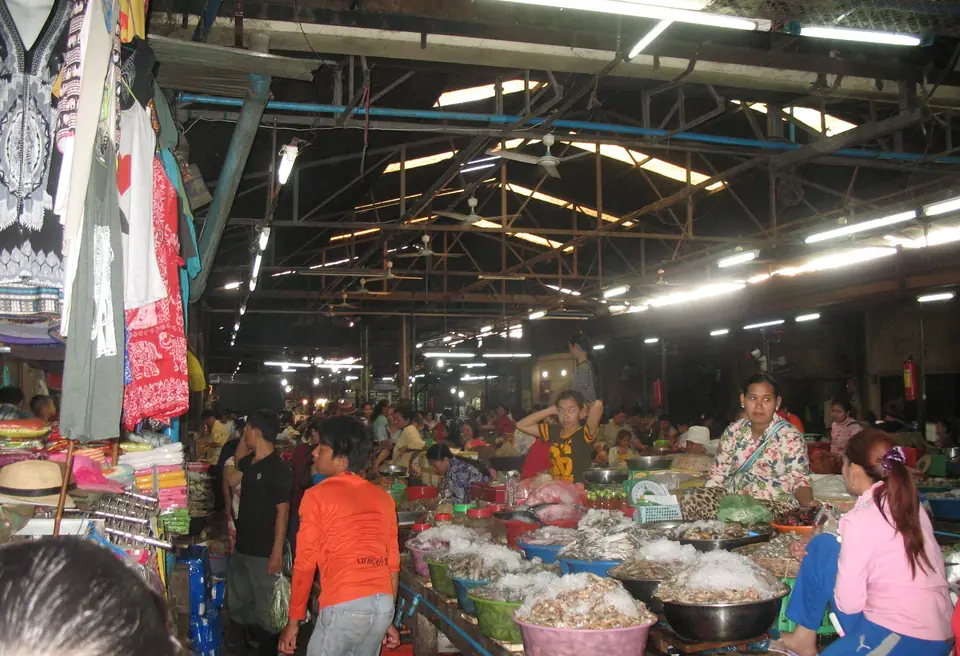
The contrast is the key to the place. Outside, a ring of stalls with silk, silverware, wood and stone carvings and Buddha figures for the visitor. Inside, the Khmer pantry: sacks of rice, dried fish, pork sausages and glass jars of prahok, the fermented fish paste. Even the word “psar” has a journey: it goes back, via Malay or Cham, to the Persian “bazaar”.
Highlights
- A semi-covered Khmer market beside the Siem Reap River, in the city centre
- An outer ring of silk, silverware, carvings and Buddhas facing aisles of prahok and dried fish
- Shophouses with a French colonial and Chinese air around the market
- Food stalls with Khmer soups, baguettes and grilled frogs
- Wat Preah Prom Rath, a riverside pagoda with a foundation attributed to tradition
What to see at Psar Chas, the Old Market of Siem Reap, starts with understanding where the city around it comes from. Siem Reap was under Siamese rule from 1795 to 1907; with the Franco-Siamese treaty of that year it passed to French Indochina and began to grow. The creation of the Conservation des monuments d’Angkor turned the small riverside town into an urban core around the Conservation, the administrative quarter, the market and the roads to the Tonlé Sap, and it stayed that way, small, until the mid-20th century. The history of Psar Chas is, to a large extent, that of this core. Its name, ផ្សារចាស់ in Khmer, is also written Psah Chas, Phsar Chas or Psar Chaa, and does not correspond to the market of the same name in Phnom Penh. The full experience, with the anecdotes that do not fit on a page, is best enjoyed walking it with the audio guide. The city around it has its memorial at Wat Thmei, and the everyday life of the Tonlé Sap continues at Kampong Phluk.
A bridge over the river that founded the city
Old Market Bridge
Summary of this stop
The tour starts on the Old Market Bridge, from which one sees the course of the Siem Reap River and the opposite bank. From there the geography makes sense: the market occupies the south of the centre, between Pub Street and the river, and the water explains why the town was born right here, with roads towards the Tonlé Sap.
After the treaty of 1907 and the creation of the Conservation des monuments d’Angkor, the market became part of the skeleton of the colonial city, alongside the administrative quarter. The visitor thus finds a point where the river, the market and the city explain one another.
On the other bank, the pagoda of Wat Bo holds an unexpected window onto that bustle. Its walls tell the Reamker, the Cambodian version of the Ramayana, in panels arranged like a patchwork, and among the epic heroes scenes of the market of colonial Siem Reap slip in: a Chinese merchant smoking opium, a French officer and French soldiers before a traditional dance. It is disputed history, and the most surprising detail is revealed when listening to the narration right there.
Silks and Buddhas at kilometre zero
Outer ring of souvenir stalls
Summary of this stop
The south side, under the awnings, opens the outer ring of stalls: silk, silverware, T-shirts, wood and stone carvings and Buddha figures. It is the face of the market designed for the visitor, although Psar Chas serves locals and tourists alike.
That ring is also a compass. Psar Chas is the reference point for addresses in central Siem Reap, and many businesses give theirs in relation to it, so the “kilometre zero” of the tourist city coincides with a neighbourhood market.
It is also worth fixing the name. Psar Chas literally means “Old Market”, and should not be confused with its namesake in the capital, Phnom Penh.
Prahok and a word that came from Persia
Prahok and dried fish aisles
Summary of this stop
The inner aisles of the food market are the Psar Chas of the locals: sacks of rice, dried fish, pork sausages, vegetables, fruit and glass jars of prahok, the fermented fish paste. Beyond them line up the kitchens and tables with soups, baguettes and stuffed frogs on the grill to eat right there.
According to tradition, the baguettes and spiced frogs of some stalls are a legacy of the French colonial era, while others cook Khmer soups with red chilli and peanut. In a single aisle one thus reads a history of absorbed colonial cuisine.
The very word of the place holds another story: “psar” or “psah”, market in Khmer, comes from “pasar”, taken from Malay or Cham, and both forms go back to the Persian “bazaar”. An entire trade route fits in a single word, whose full journey is left for the audio guide.
Surviving shophouses and the loudspeaker war
Street 9 shophouses
Summary of this stop
On Street 9, around the market, two- and three-storey shophouses survive, with the shop at the front, storeroom or living space behind and homes on the upper floors. Their architecture blends French colonial and Chinese styles, and several of them surround the market square.
These buildings are also survivors. In 1975, the Khmer Rouge takeover interrupted the restorations of Angkor, closed the local centre of the École française d’Extrême-Orient and left the urban and social fabric of Siem Reap badly damaged.
One block away, Pub Street tells another story. Since the 2000s, the inflow of foreign capital filled the surroundings of the market with small hotels, and the street became the city’s nightlife strip of lights and music. According to the documented tradition, it all began in the late nineties with a single venue, the Angkor What? Bar, which the Temple Club confronted with a musical war of full-volume pop. Street 8 ended up christened Pub Street, and Angkor What? closed in late 2025.
The oldest pagoda, a hundred metres from the bustle
Wat Preah Prom Rath
Summary of this stop
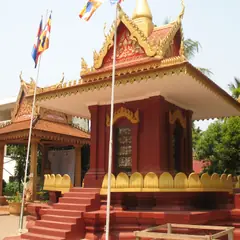
Following the riverbank, the gate of Wat Preah Prom Rath gives way to a sudden silence after the noise of the market. The pagoda’s foundations are dated, according to tradition, to 1915, and its main vihear was built in 1945.
But the memory of the place is much older. It is said that the pagoda is the oldest in Siem Reap: according to tradition it was already a monastery in the 13th or 14th century, and it was consolidated in the early 16th century, when the family of Ta Pum and Yeah Rath donated the land on which it stands.
It is a foundation legend that turns the temple’s ground into the gift of a family with a name, centuries before the market that now surrounds it existed. The rest of the story is better heard at the gate itself, with the audio guide.