Stilt village
Kampong Phluk Audio Guide
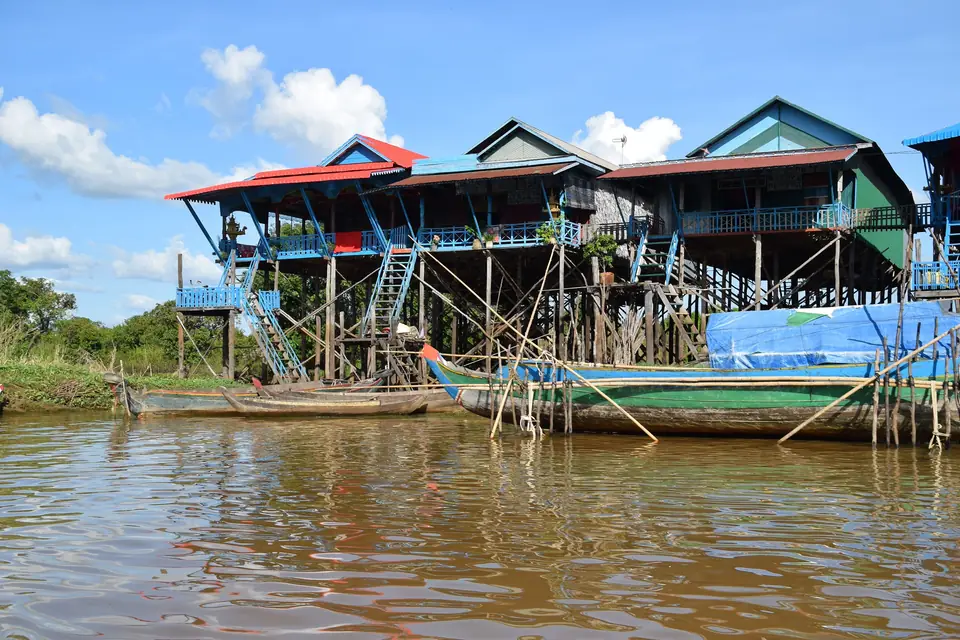
A whole fishing village raised on 6 to 9 metre stilts on the shore of the Tonlé Sap, whose landscape changes completely every year: in the rains the water reaches beneath the floors and the forest is submerged; in the dry season, the stilts stand above the mud.
- 120 min of audio
- Stilt village
Kampong Phluk, in Khmer “Harbour of the Tusks”, is a commune in Prasat Bakong district, about 30 km southeast of the city of Siem Reap. It rises among mangroves, where the Tahas River flows into the Tonlé Sap lake. Many of its houses rest on stilts of between 6 and 9 metres to absorb the difference in water level between the wet and dry seasons. In 2019 the commune had 911 families and 3,707 inhabitants spread over three villages: Tnaot Kambot, Dey Krahom and Kok Kdol.
The boat trip links the landing stage, the central canal between tall houses, a painted pagoda on the only island without stilts, a flooded forest explored in rowing boats and a floating restaurant facing the lake. What some offers advertise as a floating village is in fact a stilt village, different from the houseboats of other settlements on the lake. That rhythm of the water is the same one that sustained Angkor and that today feeds a good part of Cambodia.
Highlights
- Houses on 6 to 9 metre stilts
- Wat Kampong Phluk, a pagoda with painted walls and ceiling
- Flooded forest explored in rowing boats
- The Tonlé Sap, a lake that multiplies its surface every year
- The legend of the Naga serpent and the water festival
What to see at Kampong Phluk starts with understanding the water. This fishing village on the Tonlé Sap, about 30 km southeast of Siem Reap, lives to the beat of a lake that in the dry season covers some 2,500–3,000 km² with a typical depth of 1 metre and that with the rains reaches 9–14 metres and up to 16,000 km². The history of Kampong Phluk is that of a community that adapted to that pulse: tall houses on stilts, shrimp fishing in the wet season and farming in the dry. The full experience is best enjoyed by exploring it with the audio guide, which gathers in five stops what the landscape lets one see and what it keeps behind. In contrast to the urban life of Psar Chas, this village shows the Tonlé Sap, the lake that fed Angkor Wat.
A river that reverses its flow
Kampong Phluk Ticket Office
Summary of this stop
The starting point is the boarding pontoon for the motor boats. From there the canal narrows between banks of vegetation before opening onto the first houses. The village’s very name, “Harbour of the Tusks”, announces a place made for life on the water.
The Tonlé Sap River, 115 km long, flows for six months of the year from the Mekong towards the lake and for the other six in the opposite direction: the lake fills with the Mekong’s flood and then returns the water to it. That back-and-forth already amazed Henri Mouhot, the French naturalist who in his 1864 travel account described the great lake of Cambodia, which he called Touli-Sap, and observed that its flood came mainly from the current of the Mekong.
How that reversal looks from the water, and which detail of the flood tends to go unnoticed, is saved for the narration at the landing stage itself.
Houses at the height of a third floor
Kampong Phluk
Summary of this stop
Along the central canal line up wooden and sheet-metal houses perched on stilts of between 6 and 9 metres, although other versions speak of 5 to 6 metres. In the dry season they are seen in full, with ladders descending to the mud; in the rains the water comes close to the floors.
The village is often advertised as floating, but it is a village of houses on stilts, unlike the houseboats of other settlements on the lake. Its calendar is set by the water level: the community lives mainly from fishing, chiefly shrimp, during the wet season, from May to October. From November to April, when the river falls, many residents farm the land to supplement their income.
In 2019 the commune had 911 families and 3,707 inhabitants in three villages: Tnaot Kambot, Dey Krahom and Kok Kdol. In March 2008 its estimated population was 2,781 inhabitants.
A painted pagoda on the only firm ground
Wat Kampong Phluk
Summary of this stop
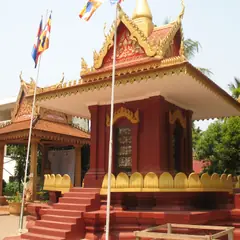
In the centre of the village there is a small island with the only buildings of Kampong Phluk that do not rest on stilts. There stands Wat Kampong Phluk, the pagoda located just above the landing stage, with all its walls and ceiling covered in paintings.
That firm ground is also the centre of the village’s spiritual life. According to the documented tradition of the Tonlé Sap villages, when the rice harvest ends the villagers walk in procession to the temple, circle it three times and give offerings, called kathen, to the monks, who return them with blessings. The festival also serves as a rest after the harvest and an occasion to gather.
The fish nursery beneath the trees
Kampong Phluk Flooded Forest
Summary of this stop
Next to the village stretches a flooded forest explored in rowing boats, for about 10 dollars. The noise of the motor gives way to the silence of the oar among trunks that, in the rains, are half submerged. In the forest there is also a floating platform with a bar.
These waterlogged trees serve an essential function: with the flood, the Mekong’s water carries enormous quantities of fry into the Tonlé Sap, which find shelter and food in the flooded forests and inundated plains. It is a fragile balance. In July 2020, owing to El Niño and the damming of the Mekong’s tributaries, the level of the Tonlé Sap hit its lowest for that time of year in 60 years.
A lake that breathes and a serpent that spits it out
Crocodile Restaurant and Farm
Summary of this stop
On leaving the forest, a floating restaurant offers views of the lake: a sheet of water with no visible shore in the rains, or far away and shallow in the dry season. That annual expansion, from between 2,500–3,000 km² to up to 16,000 km², sustained Angkor, the largest pre-industrial settlement complex in history. Today some 1.2 million people live from its fishing, which provides 60% of the protein consumed by Cambodia’s population.
According to a documented tradition of the Tonlé Sap, the lake’s back-and-forth has someone responsible: the Naga, the serpent of the waters, which at the end of the rainy season spits the lake out towards the sea and pushes the fish towards the Mekong. The canoe regattas that close the water festival are held in honour of that serpent.
Bon Om Touk lasts three days and celebrates the end of the rainy season and the reversal of the river’s flow. It falls on a full moon in late October or early November, and its exact date depends on the end of the monsoon. Already in 1873, in the reign of Norodom, a French publication illustrated a Cambodian racing boat.