10th-century Khmer temple
Banteay Srei Audio Guide (Prasat Banteay Srei)
A Shaivite temple of red sandstone on a miniature scale, consecrated in 967 by a Brahmin and not by a king. Its pediments open the narrative in stone of Khmer art, and its goddesses tempted André Malraux.
- 60 min of audio
- 10th-century red sandstone
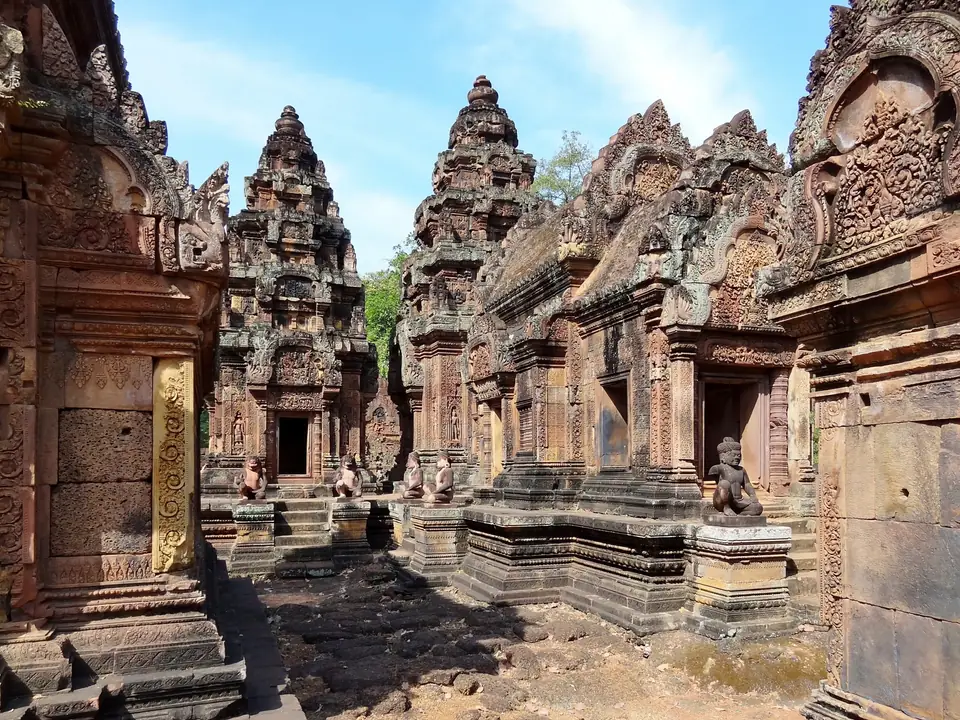
What to see at Banteay Srei starts with a rarity: it is the only major temple of Angkor not built by a king. It was built by the courtiers Vishnukumara and Yajnavaraha, advisers to Rajendravarman II, and consecrated on 22 April 967. Almost everything is hard red sandstone, which is carved like wood, and the decoration covers nearly every surface. Here, complete mythological scenes appear on the pediments for the first time in Khmer architecture.
The history of Banteay Srei also has a novelistic side. Lost in the forest, it was not discovered for archaeology until 1914. In December 1923 André Malraux pried reliefs from the towers and shipped them in crates labelled “chemical products”; the scandal ended in a trial and in a stone-by-stone reconstruction, between 1931 and 1936, applied here for the first time on a large scale at Angkor.
Highlights
- The only major temple of Angkor built by a Brahmin and not by a king
- The first pediments with complete mythological scenes in Khmer art
- 9.80 m central tower and a sanctuary door only 1.08 m high
- The devatas Malraux pried off in 1923 and the trial that followed
- Stone-by-stone reconstruction by anastylosis between 1931 and 1936
The history of Banteay Srei begins on 22 April 967, the date of its consecration, and few temples in Angkor concentrate so much in so little space. It was built by the courtiers Vishnukumara and Yajnavaraha, advisers to Rajendravarman II, and the latter, a Brahmin and guru of the future king Jayavarman V, erected in the central sanctuary the linga of Shiva called Tribhuvanamaheshvara, “Great Lord of the Triple World”, which was the temple’s original name.
The architecture of Banteay Srei surprises with its scale: the central tower measures 9.80 m and the side ones 8.34 m. In exchange, the red sandstone is carved down to the last corner and the pediments tell complete scenes of Hindu mythology. Around this ensemble gather a late discovery in 1914, Malraux’s foiled theft in 1923 and a pioneering restoration. The full experience is best enjoyed by walking it with the audio guide. Against the monumentality of Angkor Wat, this small temple stands apart, and it shares with Ta Prohm its position outside the central circuit.
A gate without a city, a temple without a king
Outer eastern gopura
Summary of this stop
The visit begins before the outer eastern gopura, a cruciform laterite gate that is the only remnant of the wall of the old city of Ishvarapura. Its pediment shows Indra on the three-headed elephant Airavata, and the sockets of the roof beams can still be seen.
This is the point to understand who made the temple. Banteay Srei is the only major temple of Angkor not built by a king, but by the courtiers Vishnukumara and Yajnavaraha, advisers to Rajendravarman II. Yajnavaraha, a Brahmin and guru of the future Jayavarman V, erected with his younger brother the linga of Shiva in the central sanctuary.
The dating was also settled at this entrance. Until 1936 the exuberance of the decoration led the three towers to be dated to around the year 1300, until the foundation stele appeared at the outer east gopura. Inscribed in 968, it fixes the foundation in April–May 967 and proves that the whole complex dates from the 10th century. The most surprising detail of this gate is revealed when listening to the narration right there.
The gap in the pediment that travelled to Paris
Processional causeway
Summary of this stop
Lost in the forest and far from other remains, Banteay Srei was not discovered for archaeology until 1914, by Lieutenant Marec, an officer of the geographical service. The end of the processional causeway keeps that air of a place hidden by vegetation.
What stands out there is above all what is missing. The pediments of the east gopura of the third enclosure are no longer in place: the eastern one, with the abduction of Sita, lies reconstructed on the ground, and the western one never returned.
That second pediment showed the asuras Sunda and Upasunda fighting over the apsara Tilottama. It was offered to France as a testimony of the restoration and has been in the Guimet Museum in Paris since 1936. The gap it left is one of the most eloquent absences of the temple.
Ravana shakes Shiva’s mountain
Southern library
Summary of this stop
On the east face of the southern library, the stone tells a complete scene. Ravana, the ten-headed demon king, shakes Mount Kailasa while Shiva and Parvati remain seated on the summit and the animals flee across three levels of slopes. The four pediments of the libraries inaugurate this narrative model: until then, Khmer pediments showed only isolated figures.
The carving explains the effect. Hard red sandstone is worked like wood, and the decoration covers almost every surface, so that the relief seems closer to cabinetmaking than to stonemasonry.
On the opposite face, the west one, another scene holds a legend. According to tradition, Kamadeva, god of love, shot his arrow at Shiva so that he would take an interest in Parvati; annoyed at the intrusion, the two looked at him with their third eye and reduced him to ashes, although they later resurrected him. What looks like a tender gesture, with Parvati receiving a rosary, is the instant before that catastrophe.
The goddesses Malraux pried off
Central sanctuary towers
Summary of this stop
The south side of the central sanctuary lets one measure the miniature scale with one’s own body. The eastern door is only 1.08 m high and is crossed stooping, and the interior is roped off. On the south face, a boar seen head-on could allude to the name of the founder, Yajnavaraha, “the boar of sacrifice”.
At the corners of the north and south towers the devatas smile, with braids, jewels and flowers. They are the same figures that André Malraux, his wife Clara and his friend Louis Chevasson pried off with chisels and hammers in December 1923. They loaded the reliefs into seven crates labelled “chemical products”. The haul varies according to the sources: five goddesses, two votive tablets and four friezes in one version, four devatas in another, seven bas-reliefs according to the APSARA Authority panel.
George Groslier, director of the Phnom Penh museum, opened the crates on board the steamer at Kampong Chhnang, and the police arrested Malraux and Chevasson in Phnom Penh on Christmas Eve 1923. On 21 July 1924 the court sentenced Malraux to three years in prison and five years’ ban on residence in Indochina, and Chevasson to 18 months. In October, the appeal in Saigon reduced the sentences to one year and six months, suspended.
The episode did not end Malraux’s career. In 1924 French intellectuals such as André Breton and Max Jacob signed a petition in his favour, and in 1930 he published “La Voie royale”, which won the first Prix Interallié that year. In the novel, two adventurers venture into the Cambodian jungle to pry bas-reliefs from a temple. The rest of the story is left for the narration on the spot.
Copy guardians against thieves
Staircase guardians
Summary of this stop
On the north staircase of the sanctuary the kneeling guardians wait, with human bodies and the heads of a monkey, a lion or a garuda. They flank the six staircases of the platform, and almost all are replicas, because the originals were stolen or taken to museums.
This presence of copies points to the temple’s other great story: what is seen today is a reconstruction. The scandal of the theft led to the clearing of 1924 by Henri Parmentier and Victor Goloubew, and between 1931 and 1936 Henri Marchal rebuilt it stone by stone by anastylosis, a method learned from Borobudur in Java and applied here for the first time on a large scale at Angkor. The stolen pieces were returned to their place.
The looting, however, continued. According to what is documented, when original statues were removed and concrete replicas put in place, the looters began to attack the replicas as well. The statue of Shiva and Uma, taken to the National Museum in Phnom Penh to protect it, suffered an attempted theft there itself; the thieves were caught and the statues recovered.