UNESCO World Heritage
Bayon Audio Guide (Prasat Bayon)
A Buddhist temple at the exact centre of Angkor Thom, crowned by towers of giant smiling faces. Its walls preserve in relief the war against the Chams and the daily life of the Khmers.
- 75 min of audio
- Angkorian Buddhist temple
The Bayon was built in the late 12th or early 13th century as the state temple of King Jayavarman VII, in the heart of his capital, Angkor Thom. It is the last state temple raised at Angkor and the only one dedicated mainly to Buddhist deities, a break with the earlier Hindu temple-mountains. Its original name was Jayagiri, “Mountain of Victory”; “Bayon” was given to it by the French explorer Étienne Aymonier in 1880.
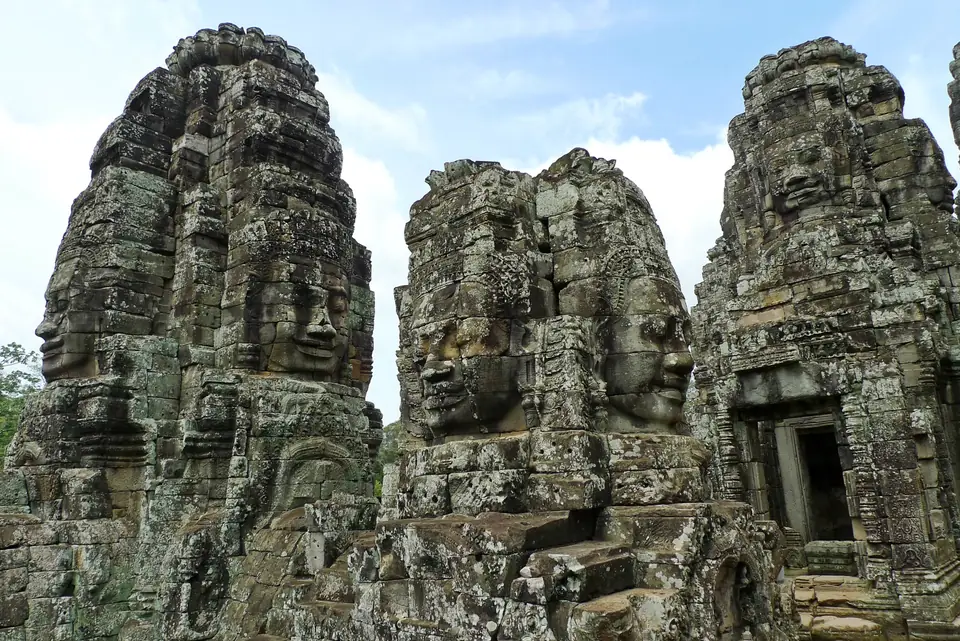
The temple preserves 37 of the 49 face towers it once had, with some 200 smiling giant faces whose identity is still debated: portraits of the king, the bodhisattva Avalokiteshvara or a fusion of both. On the walls, a kilometre of uninscribed reliefs mixes a naval battle against the Chams with markets, open-air kitchens and a cockfight.
Highlights
- Face towers — 37 preserved, some 200 smiling faces
- Relief of the naval battle between Khmers and Chams on the Tonlé Sap
- The Chinese junk and the cockfight in the southern gallery
- Hindu reliefs of the inner gallery and the legend of the Leper King
- 43-metre central tower and the broken Buddha recovered from a well
The history of the Bayon begins in the late 12th or early 13th century, when Jayavarman VII raised it as a state temple at the centre of Angkor Thom. The avenues leaving the gates at the four cardinal points lead straight to it, so that the whole walled city points to this place. Within its walls coexist a great war against the Chams, market scenes, Hindu mythology added a century later and a forest of towers with faces. More than eight hundred years of changes of faith, restorations and debates over who owns those smiles are best covered with the audio guide, stop by stop. Among the great temples of Angkor, Angkor Wat shares with it the scale of the complex and Ta Prohm belongs, like the Bayon, to the work of Jayavarman VII.
The terrace at the exact centre of Angkor Thom
Bayon
Summary of this stop
The visit begins on the east terrace, the access platform that was added after the original plan and through which one enters a temple oriented to the east. From it the position of the Bayon can be sensed: the point where the avenues from the four gates of Jayavarman VII’s capital converge.
Here too what distinguishes it is raised. It is the last state temple built at Angkor and the only one erected mainly for the worship of Buddhist deities. Its original name was Jayagiri, “Mountain of Victory”, and the current one comes from Étienne Aymonier, who christened it so in 1880.
A legend set down in writing in Middle Khmer presents the temple as an earthly reflection of Vejayant, the celestial palace of the god Indra, an explanation that has also been proposed for the name. The audio guide reserves for this point the detail that changes the way the complex is seen.
War on the lake, a market below
Naval battle relief
Summary of this stop
On the eastern stretch of the outer southern gallery, the wall shows a naval battle between Khmers and Chams on the Tonlé Sap lake. The warships occupy the upper band of the relief.
Below, another story unfolds: a market, open-air cooking, hunters and women looking after children and a sick person. The same wall thus brings together the great contest and the ordinary life of those who went on cooking and shopping in the meantime.
The reliefs of the outer gallery carry no inscriptions, so the identification of the episodes depicted, including the specific date of this battle, remains uncertain. That uncertainty is part of what the audio guide explains on the spot.
The Chinese junk and the cockfight
Chinese junk relief
Summary of this stop
Past the courtyard gate, the southern gallery shows a scene of boats and fishermen with a Chinese junk. Below appears a cockfight, a wager that recalls the daily life of any Cambodian village.
In the east gallery a Khmer army marches in which Chinese soldiers figure. These images sketch an open world, with merchants and fighters who came from China sharing the stone with the court and the common people.
Hindu gods on a Buddhist temple
Inner gallery reliefs
Summary of this stop
The inner gallery belongs to another era. Under Jayavarman VIII (1243–1295) the temple was converted to Hinduism: the 16 chapels of the outer gallery courtyard were demolished and the inner walls were covered with reliefs of Hindu mythology featuring Shiva, Vishnu and Brahma. Among these panels, smaller than those of the outer gallery, is the Churning of the Sea of Milk, north of the west gate.
The Bayon was first conceived as a single-level structure, like Ta Prohm and Banteay Kdei, and the upper terrace was added soon after following a change of plan. That is why there is barely any space between it and the inner gallery, a compression that is still visible.
In other panels, a king fights a giant serpent bare-handed and, in later scenes, appears sick in bed. These images are related to the Cambodian legend of the Leper King, a sovereign who is said to have contracted leprosy from the venom of the serpent he fought.
Two hundred smiles with no certain owner
Bayon face towers
Summary of this stop
On the upper terrace rise the face towers. The temple once had 49 and today preserves 37; each carries two, three or, mostly, four smiling giant faces, some 200 in all, a figure impossible to settle because many are only partially preserved.
The identity of the faces remains open. They are read as portraits of Jayavarman VII, as the bodhisattva Avalokiteshvara (Lokesvara) or as a fusion of both, and part of the local population associates them with the four faces of Brahma and calls the temple Prohm Bayon. The tower count also varies according to the sources. According to Khmer tradition, adding the 49 towers of the temple and the 5 of the gates of Angkor Thom, the 54 summits would represent the 54 provinces and cities of the kingdom of the time.
The central tower, originally cruciform in plan and later filled in until it became circular, rises 43 metres above the ground. Around this temple unfolds “The Terrace of the Leper King”, Yukio Mishima’s last play, written before his death in 1970, in which the building grows while leprosy advances across the body of Jayavarman VII.
The broken Buddha that came back from a well
Bayon central tower
Summary of this stop
The tour closes in front of the central tower, on the east side, before an absence. The main image of the sanctuary was a 3.6-metre Buddha seated in meditation, sheltered by the hood of the serpent king Mucalinda. During the reign of Jayavarman VIII it was removed and smashed to pieces, and in 1933 its fragments were recovered from the bottom of a well, although some sources place the find inside the central sanctuary, and there is no conclusive proof of the statue’s origin or of the reason for its destruction.
In 1935, with the Buddha already reassembled, King Sisowath Monivong had it reconsecrated on a Buddhist terrace some 500 metres from the Bayon, today the pagoda Preah Vihear Pram Pi Lveng, which still receives pilgrims.
The temple continues to be repaired. Between early 2023 and January 2024 the southwest platform of the third terrace was restored, damaged because tree roots had displaced the stones and opened a path for water, and a 12-metre naga balustrade was put back in place.