UNESCO World Heritage
Angkor Wat Audio Guide
A 12th-century temple-mountain that reproduces Mount Meru in stone, faces west and never stopped receiving pilgrims.
- 120 min of audio
- Khmer temple-mountain
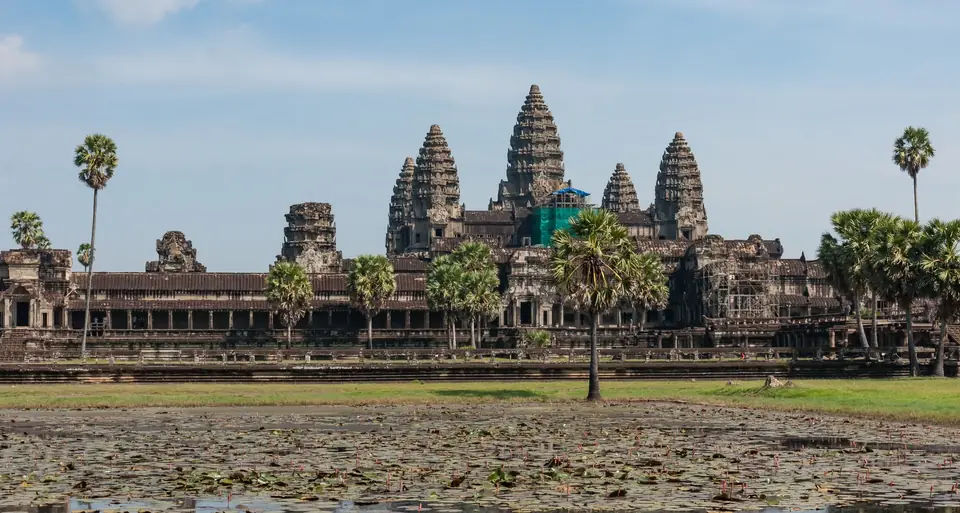
Angkor Wat was built between 1122 and around 1150, under the Khmer king Suryavarman II, as the state temple of the capital Yaśodharapura. A moat 190 m wide represents the cosmic ocean, and five towers in a quincunx evoke the five peaks of Mount Meru, the central one rising 65 m above the ground. Here are the bas-reliefs, the devatas and the shift from a sanctuary of Vishnu to Theravada Buddhist worship.
Despite the myth of Henri Mouhot’s “discovery” in 1860, the temple was never fully abandoned: a Portuguese friar visited it in 1586, Japanese pilgrims venerated it in the 17th century, and today its silhouette appears on Cambodia’s flag. Its walls hold a royal procession, an ocean churned by gods and demons, bullet holes and the signatures of travellers from other centuries.
Highlights
- 350 m western causeway over a moat 190 m wide
- Churning of the Sea of Milk frieze — 49 m, with 92 asuras and 88 devas
- Southern gallery — the only historical relief, with Suryavarman II’s procession
- 65 m central tower and the quincunx of five towers
- Preah Poan gallery — pilgrims’ inscriptions in Khmer, Burmese and Japanese
What to see at Angkor Wat starts with understanding its scale and its idea. The history of Angkor Wat begins in 1122, when King Suryavarman II started the state temple of Yaśodharapura, a work regarded as finished around 1150. The architecture of Angkor Wat translates the Khmer universe into stone: a moat that stands for the ocean, a mountain of terraces and five towers that represent the peaks of Mount Meru. Between five and ten million sandstone blocks, weighing up to 1.5 tonnes each, arrived from Mount Kulen, about 40 km away, by canal.
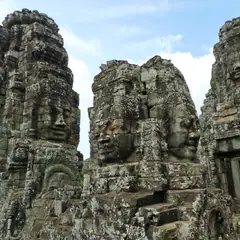
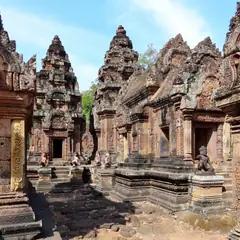
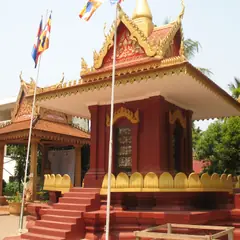
The complex also holds one of the largest collections of reliefs in Khmer art, more than 1,796 inventoried devatas and a later history that took it from a sanctuary of Vishnu to a Buddhist monastery without any break in use. The full experience of this tour of about two hours is best enjoyed with the audio guide, which arranges the temple into six stops. To complete the circuit, the Bayon is the other great temple of Angkor, Banteay Srei contributes the pink sandstone and, from the city, Wat Thmei links its memorial with the history of the temples.
The western causeway over a cosmic ocean
Angkor Wat Causeway
Summary of this stop
The visit begins on the western causeway, made of sandstone and 350 m long, with naga-shaped balustrades. Beneath it stretches the moat, 190 m wide and more than 5 km around: 1.5 km from east to west and 1.3 km from north to south. In the cosmology of the temple, that water is the ocean surrounding Mount Meru.
Angkor Wat faces west, unlike the other temples of the area, which face east. The west is associated with Vishnu and with the land of the dead, and this orientation feeds the debate over its original function: the anticlockwise reading of the reliefs supports the idea of a funerary temple for Suryavarman II, although there is no evidence of a royal burial and another interpretation sees it as a temple for the worship of Vishnu.
There is also an appointment with the calendar. According to a documented tradition, at the spring equinox, around 20 March, the sun rises aligned with the central tower as seen from this causeway, appearing above the summit of the quincunx. The most surprising detail is saved for the narration on the spot.
Ta Reach, the Vishnu who lost his throne
Angkor Wat West Gate
Summary of this stop
Beneath the south tower of the western gate stands Ta Reach, a statue venerated today. Originally it was an eight-armed Vishnu, and it is believed that it may have occupied the central sanctuary of the temple. The chronology helps explain its story: after the sack of Angkor by the Chams in 1178, the temple was gradually converted to Theravada Buddhism.
A trace of the change remains in the main tower: the central sanctuary, open on its four sides and occupied by a statue of Vishnu, was walled up with walls showing standing Buddhas. Thus the place passed from a Hindu temple to a Buddhist place of worship without ever ceasing to be in use.
A humble legend also fits here. The legend says that the king, wishing to raise the temple in a spot pleasing to the gods, released an ox on the plain and decided to build where the animal lay down to rest, next to the ancient Yaśodharapura. It is a popular tale, not a historical fact, and it contrasts with the cosmic grandeur of the complex.
A king on parade towards the hells
Southern gallery of bas-reliefs
Summary of this stop
The southern gallery contains the only historical scene among all the reliefs: a 94 m frieze with the procession of Suryavarman II and his troops. It is followed by a 64 m frieze with the judgement of Yama, with the 37 heavens and 32 Hindu hells, where the heavens occupy the upper band and the hells the lower. In this same gallery there is a coffered ceiling reconstructed in concrete.
The stone also bears more recent wounds. During the Khmer Rouge period the works were abandoned (the Conservation d’Angkor was dissolved in 1975), their troops burned the remaining timber in the building as firewood, and a shoot-out with Vietnamese forces left bullet holes in the bas-reliefs.
The later restoration work is not free of debate either. The Indian intervention from 1986 to 1993 was criticised by specialists from France, Japan and the United States for its use of chemicals and cement, while the Indian team defended its work.
Gods and demons pulling the same serpent
Churning of the Sea of Milk frieze
Summary of this stop
In the east gallery, a 49 m frieze shows the Churning of the Sea of Milk. Ninety-two asuras and 88 devas pull the serpent Vasuki to churn the ocean under Vishnu’s direction, in search of the nectar of immortality.
The scene works as a key to reading the whole temple: the moat as ocean, the mountain as axis of the world and the quest for immortality condensed into a single composition. The asuras on one side, the devas on the other and Vishnu in the centre offer one of the most recognisable reliefs of the complex.
Gold hidden beneath the summit of Meru
Bakan and central tower
Summary of this stop
At the foot of the Bakan, the 60 m square upper terrace with very steep stairs, rises the tower of the central sanctuary. It reaches 65 m above the ground and, unlike earlier temple-mountains, rises above the four corner towers; the five towers in a quincunx represent the five peaks of Mount Meru.
On the walls, especially from the second level up, the devatas appear: full-length female figures carved alone or in groups of up to four, with different hairstyles and jewels. The walls hold more than 1,796 inventoried figures, in addition to small apsaras 30 to 40 cm tall used as a decorative motif on pillars and walls.
Beneath the central tower lies an underground story. In 1934 the conservator George Trouvé excavated the sanctuary shaft: it was full of sand and water and had already been looted, but it contained a sacred foundation deposit with gold leaf two metres above ground level.
Japanese pilgrims’ signatures on the pillars
Preah Poan cruciform gallery
Summary of this stop
The cruciform gallery of Preah Poan, a cross-shaped cloister between the outer gallery and the second enclosure, preserves on its pillars pilgrims’ inscriptions in Khmer, Burmese and Japanese. This second enclosure is known as that of the Thousand Buddhas. In January 1632, Morimoto Ukondayu Kazufusa celebrated the Khmer New Year here and left one of the 14 Japanese inscriptions dated between 1612 and 1632; those pilgrims took the temple for the Jetavana garden of the Buddha.
These signatures dismantle the idea of a “rediscovered” temple. The Portuguese Capuchin friar António da Madalena visited Angkor Wat in 1586, almost three centuries before Henri Mouhot publicised the temple in the West from 1860, and Buddhist monks never stopped living in it.
Today a depiction of Angkor Wat has appeared on Cambodia’s national flag since the first version of 1863, and in 1992 the complex was inscribed as a World Heritage Site and at the same time on the list of heritage in danger, from which it was removed in 2004. Cinema added its own fiction: the film In the Mood for Love (2000) ends with the journalist Chow whispering a secret into a hollow in a wall of the temple and sealing it with mud, an episode that invites a different way of looking at these stones.