UNESCO World Heritage
Ta Prohm Audio Guide (Prasat Ta Prohm)
A 12th-century Buddhist monastery dedicated to a king’s mother, with silk-cotton and fig trees whose roots embrace galleries, towers and gateways. A wild ruin that, at the same time, is preserved on purpose.
- 60 min of audio
- Temple-monastery among roots
Ta Prohm was founded in 1186 under the name Rajavihara, “the king’s monastery”, as one of the first temples of Jayavarman VII’s great building programme. Its foundation stele, bearing that date, details a monastery dedicated to the sovereign’s mother and sustained by 3,140 villages and 79,365 people. The outer wall, of about 1,000 by 650 metres, now encloses a forest where a city once stood.
Ta Prohm was built without mortar, and after the abandonment that followed the fall of the Khmer Empire, in the 15th century, trees took root among the loose stones and the jungle colonised the temple for centuries. In the early 20th century, the École française d’Extrême-Orient decided to leave it almost as it had found it, so the look of an untouched ruin is also the result of careful conservation.
Highlights
- East gopura — a face tower before a wall of 1,000 × 650 m
- Hall of Dancers — reopened in November 2022
- Foundation stele — 615 dancers among the staff
- Central sanctuary — a bare tower once holding the Prajnaparamita image
- Tetrameles on the gallery — the tree that settles like an octopus
What to see at Ta Prohm starts with understanding what it was: a Buddhist monastery founded in 1186 by Jayavarman VII and dedicated to his mother, which came to depend on 3,140 villages and 79,365 people according to its own foundation stele. More than 66,000 peasants produced over 2,500 tonnes of rice a year to feed priests, dancers and workers, and the treasury included gold tableware of more than 500 kg, some 40,000 pearls and 876 veils from China.
The history of Ta Prohm also has a second chapter, that of the jungle. Abandoned after the fall of the Khmer Empire, the temple was left in the hands of the trees, and the École française d’Extrême-Orient chose to keep it that way, as a “concession to the general taste for the picturesque”. The architecture of Ta Prohm, mortarless and pried open by roots of tetrameles and strangler figs, is today a mixture of temple, forest and conservation project. The full experience is best enjoyed walking it from east to west with the audio guide. Founded by Jayavarman VII, like the Bayon, it contrasts with Banteay Srei, another temple located outside the central circuit.
A gate with faces that guards a forest
Ta Prohm East Gate
Summary of this stop
The tour begins before the east gopura, a gateway in the outer wall crowned by a face tower in the Bayon style, added in the 13th century. From that point a long path runs among trees inside an enclosure of about 1,000 by 650 metres, that is, 650,000 m² that once held a considerable city and are today almost entirely forest. Inside, five rectangular enclosures surround the central sanctuary.
The site was founded in 1186 as Rajavihara, “the king’s monastery”, and its foundation stele bears that date. That same stele says the temple depended on 3,140 villages and 79,365 people, a figure that adds up by counting Burmese and Chams among those who served the monastery. The measurements of the wall, incidentally, vary according to the reference work, and the stele’s figures often circulate rounded.
The current name also holds a tangle. Ta Prohm means “ancestor Brahma” in Khmer and has no relation to the original name. According to a documented tradition, for years a statue found in the temple was believed to represent a king called Ta Prohm; in 1904 Étienne Aymonier argued that the face was in fact that of Jayavarman VII, and the École française d’Extrême-Orient agreed in 1922. The full detail of that confusion is saved for the narration at the entrance itself.
The 615 dancers of the stele
Hall of Dancers
Summary of this stop
In the Hall of Dancers, a pillared building between the third and fourth eastern gopuras, the lintels show figures of apsaras. The hall reopened to the public in November 2022 after a two-phase restoration by Indian experts from the Archaeological Survey of India together with the APSARA authority, at a ceremony with India’s Vice President, Jagdeep Dhankhar.
The stone of this corner is read alongside the foundation stele, which reappeared in 1882 in one of the rooms of the sanctuary during Étienne Aymonier’s mission; George Cœdès published its text and translation in 1906. The inscription lists the monastery’s staff: 18 chief officiants, 2,740 officiants and 2,232 assistants, among them 615 dancers, adding up to 12,640 people entitled to lodging within the enclosure.
These figures turn a stone space into the payroll of a small city. The sources also show variants such as 12,500 residents or 2,202 assistants, although the detailed count of the stele gives 12,640 lodged.
The empty tower where the king’s mother once stood
Central sanctuary
Summary of this stop
The central sanctuary is a very bare tower inside, set at the centre of the quincunx it forms with the corner towers of the first enclosure. Here stood the monastery’s main image: Prajnaparamita, the Buddhist personification of wisdom, sculpted with the features of Jayavarman VII’s mother. It was, at heart, a filial portrait dressed in Buddhist wisdom.
Ta Prohm formed a pair with Preah Khan, consecrated in 1191 and whose main image was modelled on the king’s father. The two satellite temples of the third enclosure were dedicated, the northern one, to the king’s guru, Jayamangalartha, and the southern one to his elder brother. Within these walls was kept a treasure of gold tableware of more than 500 kg, some 40,000 pearls (40,620 in the detailed count) and thousands of precious stones.
The bare stone also preserves a popular custom. In a small closed chamber, known as the “room of echoes”, it is said that guides invite visitors to stand with their backs to the wall and strike their chest, and that the blow resounds throughout the chamber. What exactly happens in that echo is left for the audio guide.
The octopus tree devouring the gallery
Tetrameles on the gallery
Summary of this stop
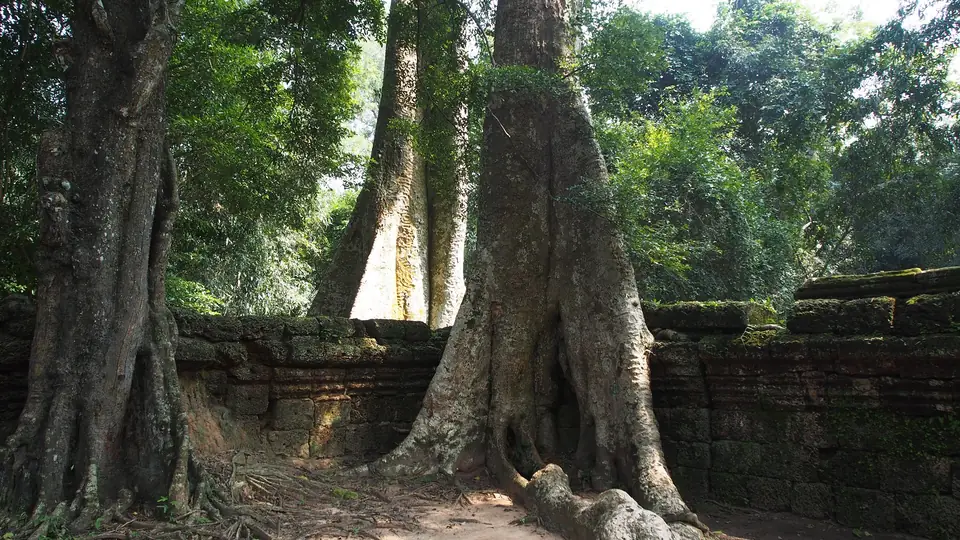
Just after crossing the west gopura of the first enclosure, on the left, an enormous Tetrameles nudiflora settles like an octopus on the roof of a gallery, while its hand-shaped roots descend vertically to the ground. It is one of the most photographed corners of the temple. The two dominant species are this tree and the strangler fig Ficus gibbosa, although the identification of the giants varies according to the sources: the larger one is also described as a kapok or silk-cotton tree (Ceiba pentandra) and the smaller one as Diospyros decandra.
In the second courtyard, isolated towers and stretches of wall appear held or deformed by roots, and some sections have given way under the weight. Since Ta Prohm was built without mortar, the trees took root among loose stones and have been prising the temple open for centuries, a mixture of fascination and alarm.
This setting also gained worldwide fame. In “Lara Croft: Tomb Raider” (2001), Angelina Jolie picks a jasmine flower at Ta Prohm and falls through the floor into the temple’s interior, although the following scenes were shot at Pinewood Studios in England. Since then the place has been popularly known as the “Tomb Raider” or “Angelina Jolie” temple, and its mix of ruins and jungle has become the image many travellers expect to find at Angkor.
A stegosaurus that never existed
Stegosaurus pilaster
Summary of this stop
At the west entrance of the third enclosure, a pilaster with medallions of animals wrapped in a serpent holds one of the most discussed pieces of Angkor. One of the medallions, with a row of pointed shapes along its back, circulates on the internet as the famous “stegosaurus” and as supposed proof that humans and dinosaurs coexisted.
The most prudent reading points to something else: the enormous head, the absence of tail spikes and its six or seven identical “plates” suggest a real animal, such as a buffalo, a Javan rhinoceros or a wild boar, against a plant background, as in the neighbouring medallions.
The dinosaur myth resembles that of the untouched abandonment. In the early 20th century many trees in the enclosure were felled and the structures threatening to collapse were propped up to keep up the appearance of abandonment, and in 2004 the Archaeological Survey of India team, led by K. T. Narasimhan, counted some 145 trees between 150 and 200 years old and proposed a restoration in five phases over ten years, for 5.5 million dollars, without felling any. Piles of numbered stones, props and wooden walkways betray today that conservation beneath the look of an untouched ruin.