Pre-Islamic capital
Dadan Audio Guide
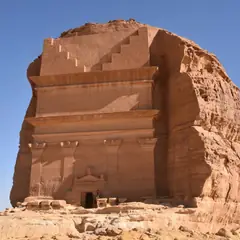
The capital of the kingdoms of Dadan and Lihyan hides behind a modest nickname, ‘the little ruin’, at the foot of a red cliff where four stone lions watch over two tombs hanging 50 metres above the valley.
- 60 min of audio
- Pre-Islamic archaeology
From the late 9th century to the early 1st century BC, Dadan was the capital of two successive kingdoms of pre-Islamic Arabia, first Dadan and then Lihyan. Its kings ruled a caravan oasis with a great sanctuary dedicated to Dhu Ghabat, its chief god, and a necropolis cut at different heights into the mountain face.
Little of the splendour remains standing, and not because of the passing of time: the red sandstone colossi of the sanctuary were found toppled and headless, and one of them had been built into a wall as construction material. Today that absence is the heart of the site's story.
Highlights
- Lion Tombs — two niches crowned by four carved lions, about 50 metres above the valley
- Vertical necropolis — openings of about 80 × 80 cm cut at different heights of the cliff
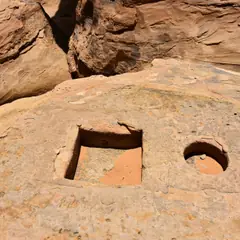
- Mahlab al-Naqa — a 3.75-metre circular basin carved in the rock, with three steps
- Great sanctuary of Dhu Ghabat — a 16 × 13.20 metre plan where the colossi were found
- Lihyanite colossi — beheaded stone kings, one of them now in the Louvre
In AlUla it is called al-Khuraybah, a diminutive of jirba, “ruin”: ‘the little ruin’. In January 2000, a report in the newspaper al-Jazirah said the site lived up to its name, a heap of stones hiding treasures of history beneath, waiting for an excavation that had been halted for years. Under that everyday nickname lies Dadan, the capital of the kingdom of Dadan and later of Lihyan, from the late 9th century to the early 1st century BC.
The history of Dadan is that of a caravan oasis whose fame reached far beyond Arabia. In the mid-6th century BC, the Babylonian king Nabonidus, based at Tayma, attacked the oasis, killed its king and boasted of having defeated the “king of Dadan”. Very few names of that dynasty are known, barely three engraved in stone: Kabir’il, his father Mata’il, who may also have reigned, and an ‘Asi who turned up recently beside the main temple. Then came the kings of Lihyan: at least twelve are known, adding up to 199 years of rule, although exactly when power passed from one dynasty to the other remains a matter of debate among specialists.
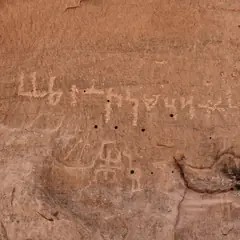
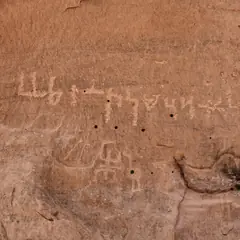
There is even a name that tempts archaeologists: an inscription mentions a certain Gashm, son of Shahr, whom the epigrapher Winnett identified with Geshem the Arab, the chief who in the Book of Nehemiah mocks those rebuilding the walls of Jerusalem. Today that identification is considered doubtful, because Gashm was a very common name in northern Arabia. What to see in Dadan, how its history is read and why almost nothing is left standing are the questions the audio guide unpacks along the route, documented and checked against historical sources.
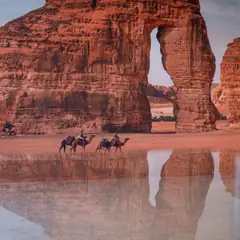
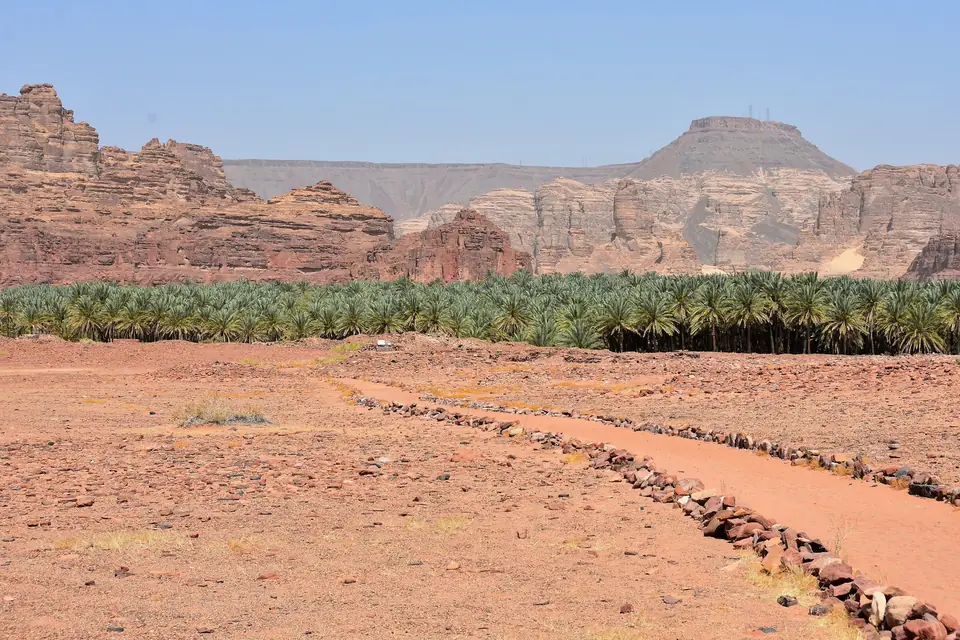
The offerings of its worshippers are still written 3.5 km away, in the gorge of Jabal Ikmah; the palm grove that fed the city is today the AlUla Oasis, and what came later, with the Nabataeans, can be read to the north in the facades of Hegra.
Four lions fifty metres above the valley
Lion Tombs
Summary of this stop
The visit starts at the foot of the red sandstone cliff, facing a vertical necropolis: rows of square openings of about 80 × 80 centimetres and some 2 metres deep, cut at different heights of the mountain wall. Almost all are plain tombs. Only two stand out, about 50 metres above the oasis valley: the Lion Tombs, two niches crowned by four carved lions, two per tomb, which are viewed from below because entering them is forbidden.
They are dated to the 5th century BC, in Lihyanite times, although sources do not always agree: some even present them as Nabataean tombs of nearby Hegra, about 15 kilometres to the north. What is written is that an inscription on one of them attributes it to a member of the Minaean community of Dadan, a colony of merchants originally from Ma’in, in present-day Yemen, who between the 4th and 2nd centuries BC managed the caravans and paid zakat like the other residents.
That link with southern Arabia was nothing new. A bronze plaque in South Arabian script tells of the journey of a merchant in the service of Saba whose expedition passed through Dadan and the “cities of Judah”, reached Gaza and went on to Cyprus. The name of the one who rests beneath the lions and what that route says about the city are told in the narration, in front of the wall.
The basin people filled with milk
Mahlab al-Naqa
Summary of this stop
Beside the remains of the temple stands Mahlab al-Naqa, a circular basin carved in the rock, 3.75 metres in diameter and 2.15 deep, with three steps cut from the same stone leading down to its bottom. Its name, “the she-camel’s milking place”, comes from the popular belief that it was filled with the milk of the prophet Salih’s she-camel; hence some also call it al-Halouba, “the milk-giver”. Archaeologists, by contrast, interpret it as a ritual or purification basin linked to the neighbouring Lihyanite temple.
That temple was part of the religious life of a city that, between 750 and 500 BC, built a great sanctuary at its centre for Dhu Ghabat, its chief god. In his honour a rite was held, the h-ẓll, which some inscriptions associate with the harvests of the late rains and, in one, also with those of the first rains. What it consisted of remains unclear.
The same inscriptions hold another enigma: a formula long read as the title of a magistrate and which another reading, still debated, links to a calendar of stars with local names. One of those names may mean “wolf of the sky”.
Stone kings without heads
Great sanctuary foundations
Summary of this stop
Facing the foundations of the great sanctuary, the site reveals the plan of Dadan’s main religious centre: a rectangular building of 16 × 13.20 metres, built with sandstone cut from the neighbouring mountain, which King Saud University began to uncover in 2005. Between 2005 and 2007, colossal statues of red sandstone appeared here, Lihyanite kings, priests or worshippers, in a style of their own and with similarities to late-period Egyptian statuary.
None is still standing. At least 15 toppled, headless colossi were known, and their breakage was first attributed to an earthquake. In 2021 the statue DDN_B_40_S1 turned up, about 2.7 metres tall with head and feet, lying inside a badly built wall dated between 195 BC and AD 5, without head, hands or feet. Its reuse as building material showed that the destruction was deliberate.
After that wall, Dhu Ghabat disappears from the inscriptions and in the sanctuary Dushara, the chief god of Petra, takes his place, coinciding with the arrival of the Nabataeans. The find casts doubt on the idea of a peaceful handover between Lihyan and the newcomers, and the scene reconstructed before these foundations is one of the most intense moments of the route.
A capital scattered across the world
Dadan excavation trenches
Summary of this stop
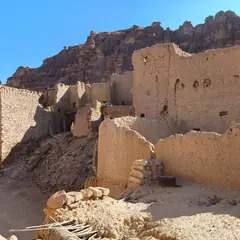
The path in front of the excavation trenches shows a site still under work, with sectors that the Dadan Archaeological Project tackles in phases. The little that remains standing is explained by how much travelled away: the ashlars of Dadan, some with Minaean and Dadanitic inscriptions, ended up in the houses of AlUla’s old town, in walls and thresholds and sometimes upside down, until the quarter was abandoned in the 1980s.
One of the colossi, 2.3 metres tall and about 800 kilos, headless, is on loan in room 314 of the Sully wing of the Louvre in Paris, from 7 September 2022 until 7 September 2027. And the memory of Lihyan survived the Nabataean conquest of the mid-1st century BC: Pliny the Elder called the Gulf of Aqaba Sinus Laeaniticus, the “gulf of Lihyan”.
Even before it was an archaeological site, Dedan was a name in the Hebrew Bible, with two different genealogies in Genesis and a people of merchants among the prophets: Isaiah speaks of the “caravans of the Dedanites” and Ezekiel recalls that Dedan sold Tyre saddle blankets for riding. How all those scattered pieces fit together in a single city is the close of the visit.