


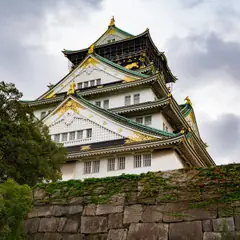
Three castles in one
Osaka Castle
What to see at Osaka Castle: the Ōtemon gate, the Takoishi stone at the Sakuramon, Hideyoshi's buried wall, the 1931 keep with its war scar and the Yamazato-maru.
Osaka, Japan
Explore Osaka with 34 audio stops and documented, fact-checked narration. From Hideyoshi's wall buried beneath the castle to Glico's neon runner, every place tells how a merchant city paid for, lost and raised again its own symbols.
Three castles in one
What to see at Osaka Castle: the Ōtemon gate, the Takoishi stone at the Sakuramon, Hideyoshi's buried wall, the 1931 keep with its war scar and the Yamazato-maru.

Canal of theatres and neon
What to see in Dotonbori: the Glico sign, the Kani Dōraku crab, Kuidaore Tarō, the Hōzenji alley with its green Fudō, Ebisubashi Bridge and the riverside walk.

Osaka's kitchen
What to see in Kuromon Market: the Sennichimae-dōri entrance, the live fugu tanks, the steel arcade, the seafood counters and the Fukahiro fishmonger, from 1905.
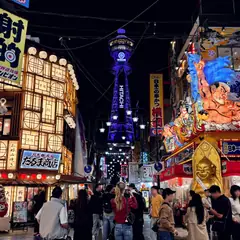
Retro district of 1912
What to see in Shinsekai: the Tsutenkaku tower and its peacock ceiling, the fan-shaped streets of 1912, the lucky Billikens and the Jan-Jan Yokochō arcade.
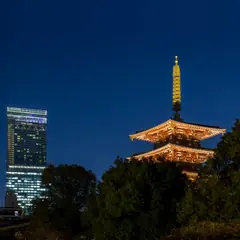
Temple of Prince Shōtoku
What to see at Shitenno-ji Temple: the 1294 stone torii, the central compound in a line, the five-storey pagoda, the Ishibutai facing the Rokujidō and the turtle basin of the Kameidō.
Shrine of the sea gods
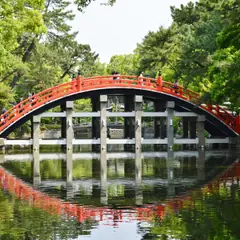
What to see at Sumiyoshi Taisha Shrine: the path of lanterns, the Sorihashi bridge, the four pavilions of 1810, the Ishibutai stage and the sacred rice field of the Otaue.
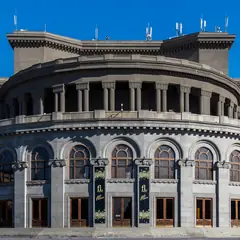
Red brick of 1918
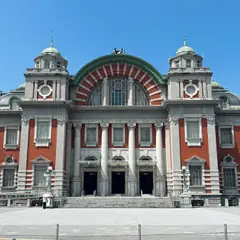
What to see at the Osaka City Central Public Hall: the red-brick facade with Minerva and Mercury, the Main Hall foyer, the Iwamoto room and the donors' relief.
Osaka Audio Guide
Osaka is the merchants' city, and its great monuments were often paid for by the merchants themselves. Osaka Castle stacks three castles on one hill: Hideyoshi's, buried beneath some six metres of earth, the Tokugawa one, with the tallest wall in Japan, and the 1931 keep funded by thousands of townspeople. On the island of Nakanoshima, the red-brick Osaka City Central Public Hall was given in 1911 by a stockbroker who never saw it finished. To the south, Dotonbori was born as a private canal in 1612, was the great theatre district and is now the showcase of the Glico sign and the mechanical crab, and a step away Kuromon Market has sold the fish of the city's cooks since the 19th century. Shinsekai, opened in 1912 with Parisian streets, keeps the Tsutenkaku tower its neighbours rebuilt in 1956; very close, Shitenno-ji Temple preserves a 6th-century layout and a stone torii of 1294, and further south Sumiyoshi Taisha Shrine lines up its four pavilions of 1810 toward a sea that can no longer be seen.
With the EarGuide Osaka audio guide, every place reveals its history through documented narration checked against historical sources. Unlike a free walking tour or a conventional guided visit, you set the pace, the order and the stops. No groups, no timetables, no internet connection.
No internet needed
Download the routes before you head out and explore without using data.
Smart geolocation
The narration starts by itself when you reach the point of interest.
Frequently asked questions
The EarGuide app is free. The Osaka audio guide includes 7 independent routes with more than six hours of narration spread across 7 sites and 34 audio stops, and it is found inside the app itself.
No. EarGuide works entirely offline. Download the routes over WiFi before you set out and you can use the audio guide with no connection and no data use throughout your visit. The map shows your GPS position in real time even without coverage.
The Osaka audio guide is available in Spanish and English, with documented, fact-checked narration on the castle of the Toyotomi and the Tokugawa, the theatre and entertainment districts, the markets and the city's oldest temples and shrines.
The audio guide brings together 7 independent routes with more than six hours of narration in total, from half an hour to an hour and a half per route. The most comfortable way is to split them over two or three days: Osaka Castle and the Central Public Hall, about two kilometres apart, on one; Dotonbori, Kuromon Market, Shinsekai and Shitenno-ji Temple on another, and Sumiyoshi Taisha Shrine, further south, on a separate outing or at the end of the second day.
They are different experiences. The EarGuide audio guide lets you explore Osaka without timetables or groups, pause and resume whenever you like, and replay any explanation as often as you need. It suits independent travellers, families and anyone who prefers to understand the city at their own pace, with no prior knowledge of Japan.
The Osaka audio guide covers 7 main sites: Osaka Castle, Dotonbori, Kuromon Market, Shinsekai, Shitenno-ji Temple, Sumiyoshi Taisha Shrine and the Osaka City Central Public Hall.
Not entirely. Dotonbori, Kuromon Market, Shinsekai and Shitenno-ji Temple make up a walking route through the south of the centre, with less than a kilometre and a half between each. Osaka Castle and the Central Public Hall lie about three kilometres to the north, and Sumiyoshi Taisha Shrine about four and a half kilometres south of Shinsekai: for these stretches the practical choice is the metro, the train or the tram.
Yes. Purchases belong to your EarGuide account, not to one app or one phone. A city unlocked in the EarGuide app is also unlocked in that city's own app, and the other way round, on both iPhone and Android. Just sign in with the same account on the other device. The store's “restore purchases” button only covers the app the purchase was made in, so signing in is what carries it across.
The Osaka audio guide is inside the EarGuide app, free and ready to use offline. Carry it in your pocket and explore the city at your own pace.
More destinations
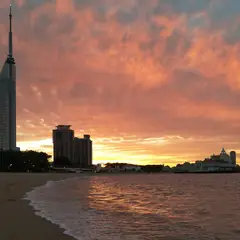
The Hakata of the merchants and the castle town of the Kuroda: the Yamakasa race, a shrine that still pleads for the Mongols' surrender and the yatai beside the Naka river. Explore Fukuoka with audio guides.
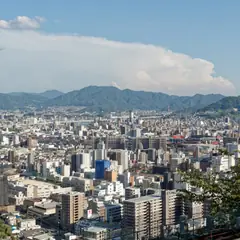
The ruin the city decided to save, a park over a buried district, a castle that fell without burning and a torii in the sea at Miyajima. Explore Hiroshima with audio guides.
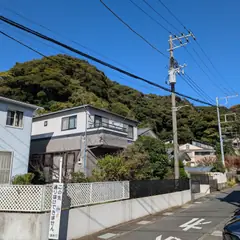
The capital of the Minamoto shoguns and the Hōjō regents: an open-air bronze Great Buddha, Japan's first Zen temple and a cave where money is washed. Explore Kamakura with audio guides.
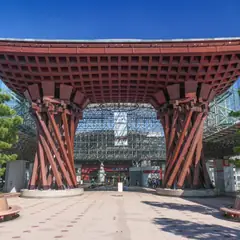
The city of the Maeda: a garden that unites six virtues, a castle with lead roofs, geiko and samurai districts and a temple full of traps. Explore Kanazawa with audio guides.
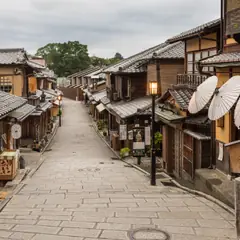
The old imperial capital: a mountain covered in torii, a wooden stage without nails, a golden pavilion reborn from the ashes and the district of the geiko. Explore Kyoto with audio guides.
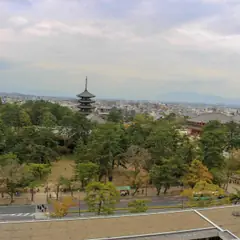
Japan's first great capital: a bronze Buddha of almost 15 metres, thousands of stone lanterns, bowing deer and a palace rescued from the rice fields. Explore Nara with audio guides.
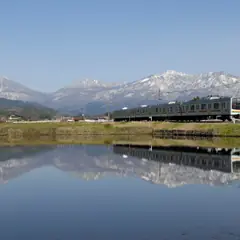
From the golden shrine where Ieyasu was made a god to the vermilion bridge only shoguns once crossed and a 97-metre waterfall that empties a lake. Explore Nikko with audio guides.
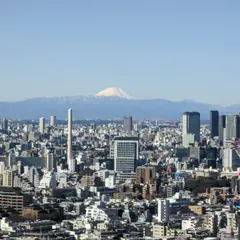
The capital that remade itself again and again: a temple around a Kannon nobody sees, a forest planted by hand, the Tokugawa's towerless castle and a crossing with a single diagonal. Explore Tokyo with audio guides.

3 cities
7 routes · ~6.5h of audio
7 routes · ~6.5h of audio
14 cities
3 cities
7 routes · ~7h of audio
7 routes · ~7.5h of audio
3 cities
3 cities

7 routes · ~5h of audio
4 cities
5 cities
7 routes · ~5.9h of audio
3 cities
5 cities
4 cities

7 routes · 8h of audio

3 cities
4 cities

6 cities
3 cities
7 routes · ~5.5h of audio
7 routes · ~7.5h of audio

7 routes · ~5h of audio
7 routes · ~8.5h of audio

6 routes · 6h of audio

7 routes · ~6h of audio
7 routes · ~5h of audio
3 cities
7 routes · ~8.5h of audio
7 routes · ~7h of audio
3 cities
10 cities
3 cities
7 routes · ~9h of audio
7 routes · ~5h of audio
7 routes · ~9h of audio
7 routes · ~6.5h of audio
8 cities
7 routes · ~9.5h of audio
4 cities
7 cities
7 routes · ~6h of audio