


Unfinished minaret of 1855
Kalta Minor
What to see at the Kalta Minor in Khiva: the unfinished turquoise-tiled minaret, its 14-metre base, the truncated top of 1855 and Ogahiy's verses beside Muhammad Amin Khan's madrasa.
Khiva, Uzbekistan
Explore Khiva with 30 audio stops and documented, fact-checked narration. From the minaret meant to be the tallest in the world to the citadel where the khan received nomads in a yurt, every place explains how a desert khanate shut itself in behind its adobe walls.
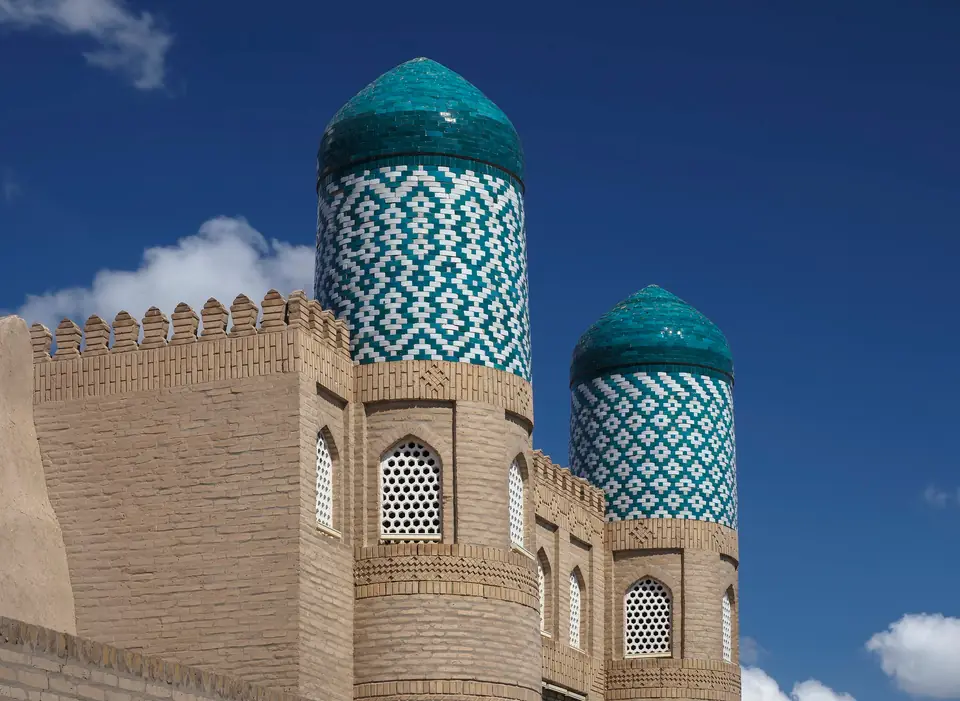
Unfinished minaret of 1855
What to see at the Kalta Minor in Khiva: the unfinished turquoise-tiled minaret, its 14-metre base, the truncated top of 1855 and Ogahiy's verses beside Muhammad Amin Khan's madrasa.
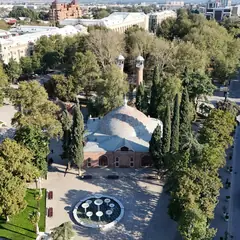
Friday Mosque of Itchan Kala
What to see at the Juma Mosque in Khiva: the forest of 212 carved wooden columns, the medieval Kufic columns, the mihrab with the waqf slab and the 32.5-metre minaret.
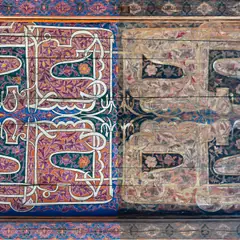
Palace of the khans of Khiva
What to see at the Tash Hauli Palace: the harem of five aiwans, the yurt platform of the Ishrat Hovli, the court of the Arz Hovli and Abdulla jin's blue majolica.
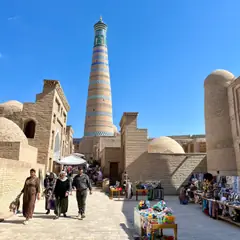
Minaret of 1910
What to see at the Islam Khoja Minaret: the tile-girdled shaft, the lantern at 45 metres, Khiva's smallest madrasa with the Applied Arts museum and the story of the vizier murdered in 1913.
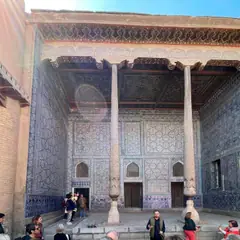
Citadel of the khans
What to see at the Kunya Ark in Khiva: the tiled summer mosque, the mint of the silk banknotes, the khan's yurt platform, the throne room and the Oqshayx Bobo lookout.
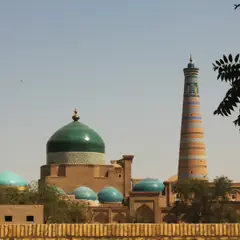
Shrine of Khiva's patron saint
What to see at the Pahlavan Mahmud Mausoleum: the only turquoise dome in Itchan Kala, the courtyard of the well, the majolica khanqah with khans' tombs and the sarcophagus of the wrestler saint.

West gate of Itchan Kala
What to see at the Ota Darvoza Gate: the two-tower façade, the carved leaves brought from the Angarik palace, the statue of al-Khwarizmi and the vaulted passage of the old customs house.
Khiva Audio Guide
Khiva fits entirely inside a wall. You enter Itchan Kala, the inner city, through the Ota Darvoza Gate, an old customs gate rebuilt in the 1970s, and a few steps on appears the Kalta Minor, the minaret clad in turquoise tile that was to outdo the Qutb Minar in Delhi and stopped at 29 metres when work halted in 1855. Beside it, the Kunya Ark, the khans' citadel, keeps the platform of the yurt where nomads were received and the mint that in 1918 went as far as printing silk banknotes. At the centre, the Juma Mosque is a single dim hall held up by 212 carved wooden columns, some from the 10th century. To the south, the Islam Khoja Minaret, the tallest in the city, rises beside the smallest madrasa, and very close by the Pahlavan Mahmud Mausoleum, the patron saint's tomb, wears the only turquoise dome in the old town. To the east, the Tash Hauli Palace hides behind a blind wall three courtyards clad in blue majolica: the harem, the reception court and the tribunal.
With the EarGuide Khiva audio guide, every place reveals its history through documented narration checked against historical sources. Unlike a free walking tour or a conventional guided visit, you set the pace, the order and the stops. No groups, no timetables, no internet connection.
No internet needed
Download the routes before you head out and explore without using data.
Smart geolocation
The narration starts by itself when you reach the point of interest.
Frequently asked questions
The EarGuide app is free. The Khiva audio guide includes 7 independent routes with more than three and a half hours of narration spread across 7 sites and 30 audio stops, and it is found inside the app itself.
No. EarGuide works entirely offline. Download the routes over WiFi before you set out and you can use the audio guide with no connection and no data use throughout your visit. The map shows your GPS position in real time even without coverage.
The Khiva audio guide is available in Spanish and English, with documented, fact-checked narration on the khans, madrasas and minarets of the walled city.
The audio guide brings together 7 independent routes with more than three and a half hours of narration in total, from 20 to 50 minutes per route. They fit comfortably into one day: in the morning, the Ota Darvoza Gate, the Kalta Minor and the Kunya Ark, by the west wall; in the afternoon, the Juma Mosque, the Islam Khoja Minaret, the Pahlavan Mahmud Mausoleum and the Tash Hauli Palace.
They are different experiences. The EarGuide audio guide lets you explore Khiva without timetables or groups, pause and resume whenever you like, and replay any explanation as often as you need. It suits independent travellers, families and anyone who prefers to understand the city at their own pace, with no prior knowledge of Central Asia.
The Khiva audio guide covers 7 main sites: the Ota Darvoza Gate, the Kalta Minor, the Kunya Ark, the Juma Mosque, the Islam Khoja Minaret, the Pahlavan Mahmud Mausoleum and the Tash Hauli Palace.
Yes, and without effort. All seven sites are inside Itchan Kala, the walled inner city, and none is more than about 400 metres from another in a straight line: from the Ota Darvoza Gate, in the west wall, to the Tash Hauli Palace, on the east side, you cross the whole old town in a few minutes.
Yes. Purchases belong to your EarGuide account, not to one app or one phone. A city unlocked in the EarGuide app is also unlocked in that city's own app, and the other way round, on both iPhone and Android. Just sign in with the same account on the other device. The store's “restore purchases” button only covers the app the purchase was made in, so signing in is what carries it across.
The Khiva audio guide is inside the EarGuide app, free and ready to use offline. Carry it in your pocket and explore the walled city at your own pace.
More destinations
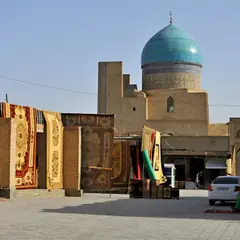
The Silk Road city: a minaret that survived Genghis Khan, the emirs' citadel, a thousand-year-old mausoleum and the last great pool. Explore Bukhara with audio guides.
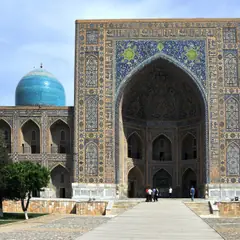
Tamerlane's capital: three madrasas face to face on the Registan, a street of blue domes towards the Living King and the observatory of an astronomer prince. Explore Samarkand with audio guides.

From Chorsu Bazaar under its blue dome to the Hazrati Imam Complex and the opera house finished by Japanese prisoners: the Uzbek capital between madrasas and Soviet modernism, with audio guides.
3 cities
7 routes · ~6.5h of audio
7 routes · ~6.5h of audio

14 cities

3 cities

7 routes · ~7h of audio
7 routes · ~7.5h of audio
3 cities
3 cities

7 routes · ~5h of audio
4 cities
5 cities
9 cities

7 routes · ~5.9h of audio
3 cities
5 cities
4 cities
7 routes · 8h of audio

3 cities

4 cities

6 cities
3 cities
7 routes · ~5.5h of audio
7 routes · ~7.5h of audio

7 routes · ~5h of audio

7 routes · ~8.5h of audio

6 routes · 6h of audio

7 routes · ~6h of audio

7 routes · ~5h of audio
3 cities

7 routes · ~8.5h of audio

7 routes · ~7h of audio

3 cities
10 cities
3 cities

7 routes · ~9h of audio

7 routes · ~5h of audio

7 routes · ~9h of audio
7 routes · ~6.5h of audio
8 cities

7 routes · ~9.5h of audio
7 cities

7 routes · ~6h of audio