


UNESCO oral heritage
Jemaa el-Fnaa
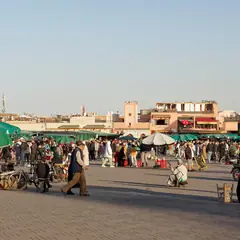
What to see at Jemaa el-Fnaa: storytellers’ circles, the trace of a ruined mosque, Café Argana and the terraces where Hitchcock filmed.
Marrakech
Walk Marrakech with 33 audio stops and researched, fact-checked narration. From the square born in 1070 before the Almoravid fortress to the blue garden rescued by Yves Saint Laurent, every route explains how the Almoravids, Almohads, Saadians and Alaouites built, plundered and reinvented the red city.
UNESCO oral heritage
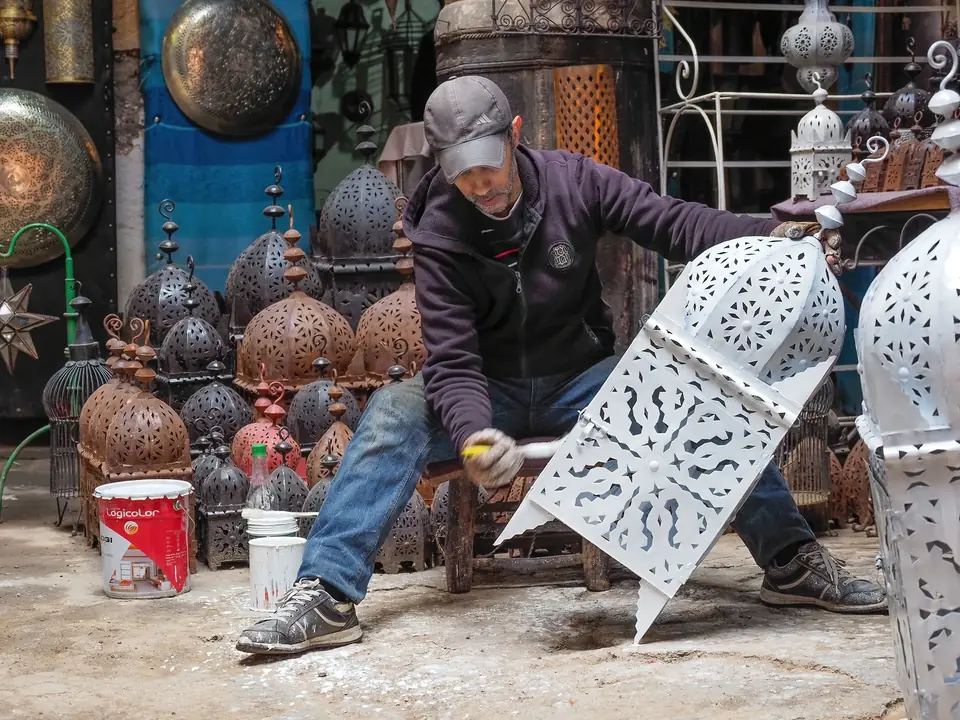
What to see at Jemaa el-Fnaa: storytellers’ circles, the trace of a ruined mosque, Café Argana and the terraces where Hitchcock filmed.
Almohad architecture
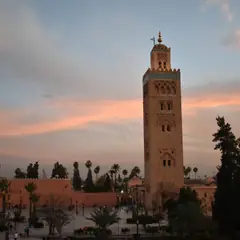
Marrakech’s great Almohad mosque: a 77-metre minaret, the model for the Giralda, 12th-century zellige and the ruins of the first mosque.
Saadian art
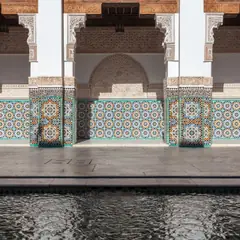
What to see at the Ben Youssef Madrasa in Marrakech: a courtyard of marble, carved plaster and cedar, a prayer hall with a Córdoban basin and student cells.
Medina palace and garden
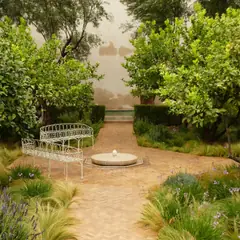
A 19th-century palace-riad in the Marrakech medina with a four-bed Islamic garden, an exotic garden, water channels and a 17-metre tower.
19th-century palace
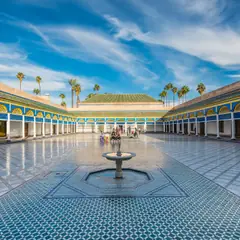
A 19th-century viziers’ palace in Marrakech: marble courtyards, orange-tree gardens, a harem and painted cedar ceilings.
Saadian palace
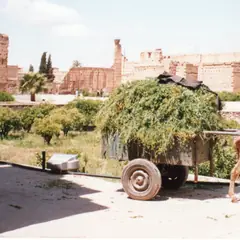
What to see at the El Badi Palace: the 90-metre pool, the sunken gardens, the Saadian throne room, the Koutoubia minbar and the storks of its walls.
Garden and museum
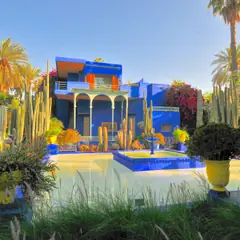
The painter Jacques Majorelle’s garden in Marrakech: an Art Deco blue villa, cacti, bamboo, the Yves Saint Laurent memorial and a Berber art museum.
Marrakech Audio Guide
Jemaa el-Fnaa has no architecture to enclose it: it was born in 1070 as an esplanade before the Almoravid fortress, took its name from a mosque that was never finished and is rebuilt every night by storytellers, musicians and cooking fires, to the point of inspiring UNESCO’s concept of oral and intangible heritage. Beside it, the Koutoubia was raised twice in a decade next to the ruins of the first, and its 77-metre minaret served as the pattern for the Giralda of Seville. In the heart of the medina, the Ben Youssef Madrasa, the largest residence for Quranic students in the Maghreb, surrounds a courtyard of plaster, cedar and zellige with more than a hundred bare cells, while Le Jardin Secret, rescued in 2016 from ruin and from 130 heirs, preserves a four-part Islamic garden and the water of its own khettara. To the south, the Bahia Palace grew house by house between 1866 and 1900 for two great viziers of slave descent, and the El Badi Palace, Ahmad al-Mansur’s reception palace after his victory over Portugal in 1578, was reduced to a 135-metre courtyard of rammed earth where storks nest. Outside the walls, in Gueliz, the Majorelle Garden is the cobalt-blue canvas of an obsessive painter, saved by Yves Saint Laurent.
With the EarGuide Marrakech audio guide, every landmark reveals its history through narration researched and fact-checked against historical sources. Unlike a free walking tour or a conventional guided visit, you set the pace, the order and the stops. No groups, no timetables, no internet connection.
No internet needed
Download the routes before you head out and explore without using data.
Smart geolocation
The narration starts by itself when you reach the point of interest.
Frequently asked questions
The EarGuide app is free. The Marrakech audio guide includes 7 independent routes with about six hours of narration spread across 7 landmarks and 33 audio stops, and it is found inside the app itself.
No. EarGuide works entirely offline. Download the routes over WiFi before you set out and you can use the audio guide with no connection and no data use throughout your tour of Marrakech. The map shows your GPS position in real time even without coverage, which is very useful in the alleys of the medina.
The Marrakech audio guide is available in Spanish and English, with narration on the city’s history, from the Almoravid foundation to the viziers’ palaces and the Marrakech of the Protectorate, researched and fact-checked against sources.
The audio guide brings together 7 independent routes with about six hours of narration in total, from half an hour to an hour per route. They are designed to be spread over two or three days: you can do them separately or string together the ones that lie close, such as Jemaa el-Fnaa, the Koutoubia, Le Jardin Secret and the Ben Youssef Madrasa, in a single outing.
They are different experiences. The EarGuide audio guide lets you explore Marrakech without timetables or groups, pause and resume whenever you like, and replay any explanation as often as you need. It suits independent travellers, families and anyone who prefers to understand the city at their own pace, with no prior knowledge of its history.
The Marrakech audio guide covers 7 landmarks: Jemaa el-Fnaa, the Koutoubia Mosque, the Ben Youssef Madrasa, Le Jardin Secret, the Bahia Palace, the El Badi Palace and the Majorelle Garden, with stops that range from the halqa circles and the Almohad minaret to the students’ cells, the courtyard of the storks and the cobalt blue of the painter Jacques Majorelle.
Almost all of it. Jemaa el-Fnaa, the Koutoubia, Le Jardin Secret, the Ben Youssef Madrasa and the Bahia and El Badi palaces are inside the medina, a little over a kilometre from one another. The Majorelle Garden is outside the walls, in Gueliz, a little over 2 km from the square: it can be reached on foot, although in the heat a taxi is advisable.
Yes. Purchases belong to your EarGuide account, not to one app or one phone. A city unlocked in the EarGuide app is also unlocked in that city’s own app, and the other way round, on both iPhone and Android. Just sign in with the same account on the other device. The store’s “restore purchases” button only covers the app the purchase was made in, so signing in is what carries it across.
The Marrakech audio guide is inside the EarGuide app, free and ready to use offline. Carry it in your pocket and explore the red city at your own pace, from Jemaa el-Fnaa to the Koutoubia and the Majorelle Garden.
More destinations
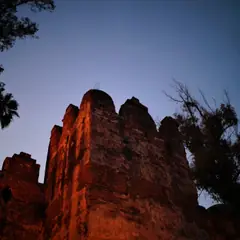
From the rammed-earth kasbah of 1471 to the Jewish quarter where, by tradition, the blue was born, and the Protectorate mosque watching over the medina. The Rif’s blue city, with audio guides.
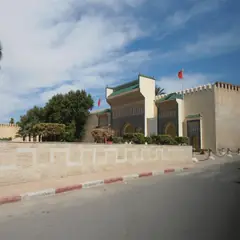
From the Blue Gate of Bab Boujloud to the stopped water clock of the Bou Inania Madrasa and the coloured vats of the Chouara tannery. A medina where cars cannot enter, with audio guides.
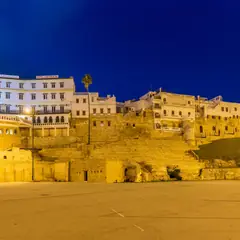
From the sultans’ palace at the top of the kasbah to the first US property outside its own country and the minaret-shaped lighthouse of Cape Spartel. Tangier, with audio guides.

3 cities
7 routes · ~6.5h of audio
7 routes · ~6.5h of audio
14 cities

3 cities
7 routes · ~7h of audio
7 routes · ~7.5h of audio
3 cities
3 cities

7 routes · ~5h of audio

4 cities
5 cities
9 cities

7 routes · ~5.9h of audio
3 cities
5 cities

7 routes · 8h of audio

3 cities

4 cities

6 cities
3 cities
7 routes · ~5.5h of audio
7 routes · ~7.5h of audio

7 routes · ~5h of audio

7 routes · ~8.5h of audio

6 routes · 6h of audio

7 routes · ~6h of audio

7 routes · ~5h of audio
3 cities

7 routes · ~8.5h of audio
7 routes · ~7h of audio
3 cities
10 cities

3 cities
7 routes · ~9h of audio
7 routes · ~5h of audio

7 routes · ~9h of audio

7 routes · ~6.5h of audio
8 cities

7 routes · ~9.5h of audio
4 cities
7 cities

7 routes · ~6h of audio