


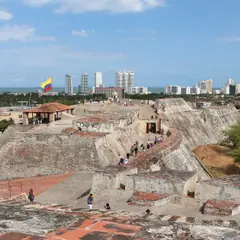
Colonial fortress
San Felipe Castle
Stepped fortress of Cartagena de Indias: the statue of Blas de Lezo, the ramps of the 1741 assault, the Santa Bárbara battery, the tunnels and the bonnet of 1657.
Cartagena de Indias, Colombia
Explore Cartagena de Indias with 34 audio stops and a documented, source-checked narration. From the fortress that stopped the British assault of 1741 to the tribunal of the Holy Office and the quarter that pushed the city towards independence in 1811, each place tells how the great walled port of the Caribbean was defended and lived in.
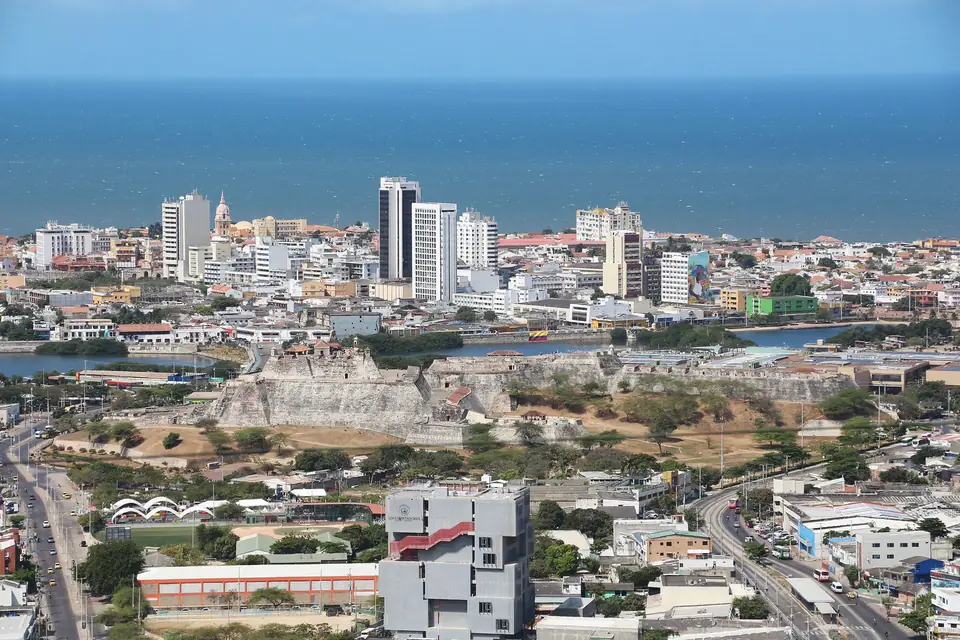
Colonial fortress
Stepped fortress of Cartagena de Indias: the statue of Blas de Lezo, the ramps of the 1741 assault, the Santa Bárbara battery, the tunnels and the bonnet of 1657.
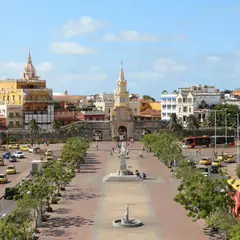
City wall gate
Main gate of walled Cartagena: the arch by Herrera y Sotomayor, the octagonal tower of 1888, the former armoury vaults and the Plaza de los Coches.
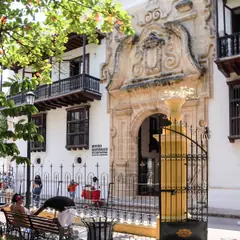
Colonial architecture
Seat of the Holy Office in Cartagena de Indias: the window of denunciation, the dungeons, the autos-da-fé and the Act of Independence in the Historical Museum.
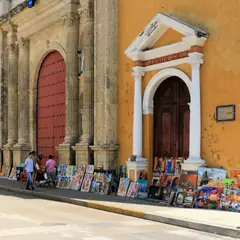
Colonial cathedral
Coral-stone cathedral of Cartagena de Indias: a doorway with marble saints, Lelarge's tower, Tuscan columns, a timber roof and a gilded altarpiece.
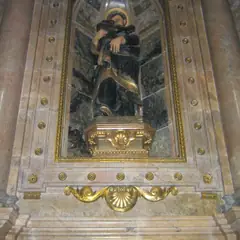
Afro-descendant memory site
Jesuit church and former college in Cartagena de Indias: the square, the cloister with its cistern, Pedro Claver's cell, the choir under the dome and the urn with his remains.
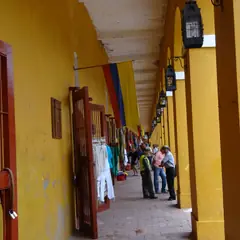
Military architecture
Barracks of 23 vaults and 47 arches in the wall of Cartagena de Indias: the 1798 coat of arms, the bombproof interior, the crafts market and the artillery roof.
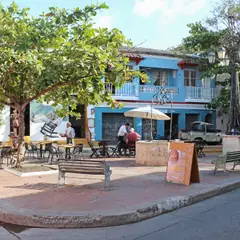
Historic quarter
What to see in Getsemaní: Plaza de la Trinidad and the monument to Pedro Romero, the El Reducto bastion by the water, the former convent of San Francisco and Callejón Angosto.
Cartagena de Indias Audio Guide
Cartagena de Indias is a walled city on the Colombian Caribbean coast whose history can be read in coral stone. Outside the walls, the Castillo de San Felipe de Barajas turns an entire hill into a stepped fortress of batteries and tunnels, and it was here that Vernon's British assault was stopped in April 1741. The main gate into the city is the Clock Tower, the old Boca del Puente, crowned in 1888 with the octagonal tower that is now its emblem. Inside, the Cathedral of Saint Catherine of Alexandria, built between 1577 and 1612, survived Drake's cannon fire; opposite Plaza de Bolívar, the Palace of the Inquisition keeps in its wall the window for anonymous denunciations, and beside the slave port the Sanctuary of San Pedro Claver holds the remains of the Jesuit who called himself “the slave of the Black people forever”. Las Bóvedas, 23 bombproof vaults that were the last work on the city walls, and the Getsemaní quarter, home to the artisans and freedmen who in 1811 pushed Cartagena towards absolute independence, close the route.
With the EarGuide Cartagena de Indias audio guide, each place reveals its history through a narration documented and checked against historical sources. Unlike a free tour or a conventional guided visit, you decide the pace, the order and the stops. No groups, no schedules, no internet connection.
No internet connection
Download the routes before you set out and explore without using data.
Smart geolocation
The narration starts on its own when you reach the point of interest.
Frequently asked questions
The EarGuide app is free. The Cartagena de Indias audio guide includes 7 independent routes with more than five and a half hours of narration spread across 7 places and 34 audio stops, and is found inside the app itself.
No. EarGuide works completely in offline mode. Download the routes over WiFi before you set out and you can use the audio guide with no connection or data use throughout the route. The map shows your GPS position in real time even without coverage.
The Cartagena de Indias audio guide is available in Spanish and English, with a narration about the city's fortifications, the Inquisition, the slave trade and independence, documented and checked against sources.
The audio guide brings together 7 independent routes with more than five and a half hours of narration in total, from 20 minutes to an hour and a half per route. The easiest way is to spread it over two days: San Felipe Castle, the longest route, and Getsemaní on one, and the walled city, from the Clock Tower to Las Bóvedas, on the other.
They are different experiences. The EarGuide audio guide lets you tour Cartagena de Indias without schedules or groups, pause and resume whenever you like, and listen again to any explanation as many times as you need. It is ideal for independent travellers, families and those who prefer to understand the city at their own pace, with no prior knowledge of its history.
The Cartagena de Indias audio guide covers 7 main places: the Castillo de San Felipe de Barajas, the Clock Tower, the Palace of the Inquisition, the Cathedral of Saint Catherine of Alexandria, the Sanctuary of San Pedro Claver, Las Bóvedas and the Getsemaní quarter.
Yes. The walled city and Getsemaní can be explored on foot: from the Clock Tower to Las Bóvedas it is about a kilometre in a straight line. San Felipe Castle lies outside the walls, a little over a kilometre from the Clock Tower across Getsemaní, and can also be reached on foot.
Yes. Purchases are tied to your EarGuide account, not to a specific app or phone. A city unlocked in the EarGuide app is also unlocked in that city's own app, and vice versa, on both iPhone and Android. You only need to sign in with the same account on the other device. The store's “restore purchases” button only covers the app where the purchase was made, so what carries it over is signing in.
The Cartagena de Indias audio guide is inside the EarGuide app, free and ready to use offline. Carry it in your pocket and tour the walled city at your own pace.
More destinations

From the Muisca raft of El Dorado in the Gold Museum to the Christ of Monserrate at 3,152 metres, via the founding square and the Boteros of La Candelaria: Bogotá, with audio guides.
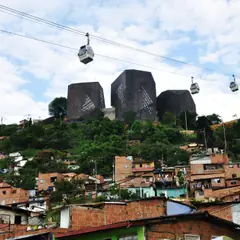
From the 23 bronzes Botero wanted within arm's reach to the outdoor escalators of Comuna 13 and the forest of 300 light poles at Plaza Cisneros: Medellín, with audio guides.
3 cities
7 routes · ~6.5h of audio

7 routes · ~6.5h of audio

14 cities

7 routes · ~7h of audio

7 routes · ~7.5h of audio
3 cities
3 cities

7 routes · ~5h of audio

4 cities
5 cities

9 cities
7 routes · ~5.9h of audio
3 cities

5 cities

4 cities

7 routes · 8h of audio

3 cities

4 cities

6 cities
3 cities

7 routes · ~5.5h of audio
7 routes · ~7.5h of audio

7 routes · ~5h of audio

7 routes · ~8.5h of audio

6 routes · 6h of audio

7 routes · ~6h of audio
7 routes · ~5h of audio

3 cities

7 routes · ~8.5h of audio

7 routes · ~7h of audio

3 cities
10 cities

3 cities
7 routes · ~9h of audio

7 routes · ~5h of audio

7 routes · ~9h of audio
7 routes · ~6.5h of audio

8 cities

7 routes · ~9.5h of audio

4 cities
7 cities

7 routes · ~6h of audio