


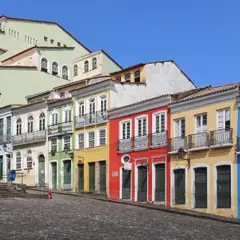
UNESCO heritage
Largo do Pelourinho
What to see at the Largo do Pelourinho: Jorge Amado's blue house, the gap left by the whipping post, the pastel façades of the Michael Jackson video and a 17th-century wall.
Salvador da Bahia, Brazil
Walk Salvador da Bahia with 30 audio stops and narration that is documented and checked against sources. From the sloping square named after a whipping post to the Art Deco elevator that spans 72 metres of escarpment, each place tells how a colonial city was built on the gold, the port and the faith of enslaved Africans.
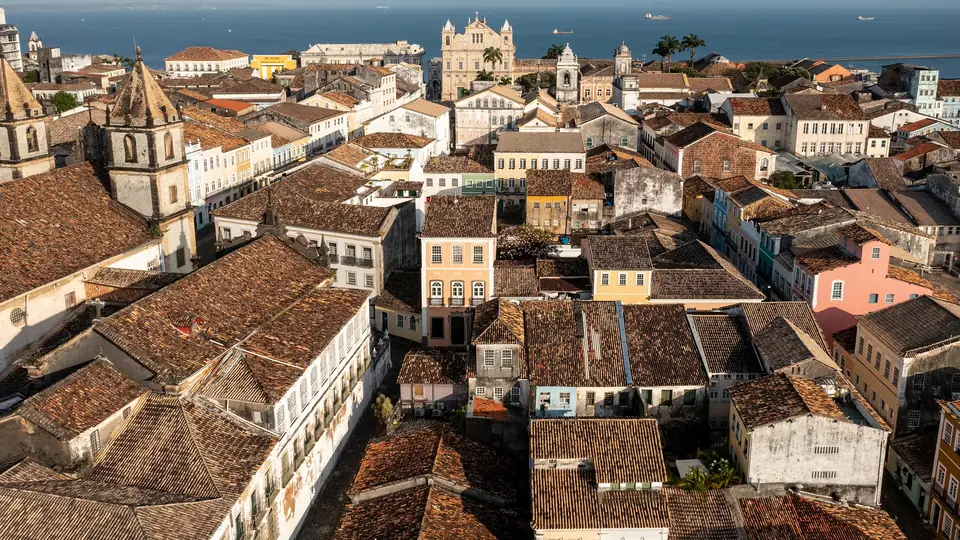
UNESCO heritage
What to see at the Largo do Pelourinho: Jorge Amado's blue house, the gap left by the whipping post, the pastel façades of the Michael Jackson video and a 17th-century wall.
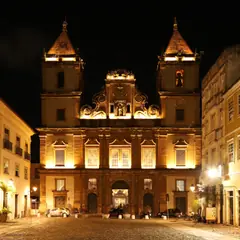
Golden Baroque
What to see at São Francisco Church in Salvador da Bahia: the gilded-carving nave, the cloister azulejos, the 1720 façade and the Ordem Terceira.
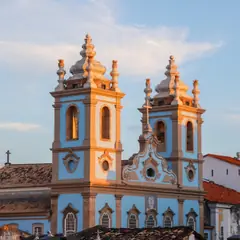
18th-century Black brotherhood
What to see at the Rosário dos Pretos Church: an 18th-century blue façade, towers with azulejo bulbs, a painted ceiling of 1870 and altars of Black saints.
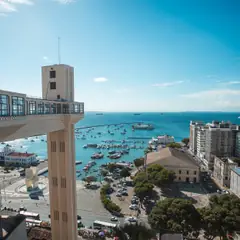
Historic elevator
What to see at the Lacerda Elevator: the 72-metre Art Deco tower, the viewpoint over the bay, the plaque of the demolished courthouse and its cabins with Otis motors.
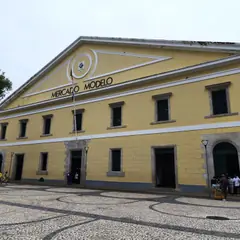
Historic market
What to see at the Mercado Modelo in Salvador: the 1861 customs house, the Fonte da Rampa, the painted false windows, the Galeria Mercado and its historic restaurants.
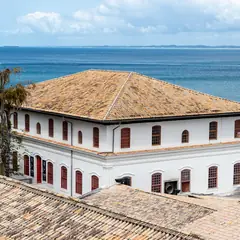
Modern art museum
What to see at the Solar do Unhão: the 1794 chapel, Lina Bo Bardi's screwless staircase, the quay of the old trapiche and the MAM facing the bay.
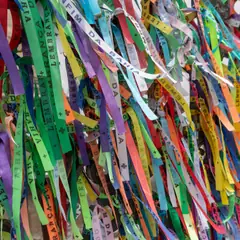
Afro-Brazilian sanctuary
What to see at Bonfim Church: the staircase the baianas wash, the fitinha railings, the founder's tomb, the 1855 azulejos and the Room of Miracles.
Salvador da Bahia Audio Guide
Salvador is read on two levels. Above, in the Cidade Alta, the Largo do Pelourinho slopes down between colourful mansions on the site of an old city-wall gate, and took its name from the post where enslaved people were whipped between 1807 and 1835. At its lower end, the blue Rosário dos Pretos Church was raised through almost the whole 18th century by a brotherhood of enslaved and freed Africans in their free hours, and a few steps away São Francisco Church lines every surface with gilded carving, with a cloister of Portuguese azulejos. The Lacerda Elevator, opened in 1873 and extended in Art Deco in 1930, climbs the escarpment to the Cidade Baixa in about twenty seconds, where the Mercado Modelo occupies the old port customs house facing the bay. Further south, the Solar do Unhão juts over the water as a colonial estate turned by Lina Bo Bardi into a modern art museum, and to the north, on the Sacred Hill, the Senhor do Bonfim Basilica is covered in thousands of coloured fitinhas.
With the EarGuide Salvador da Bahia audio guide, each place reveals its story through narration that is documented and checked against historical sources. Unlike a free tour or a conventional guided visit, you decide the pace, the order and the stops. No groups, no schedules, no internet connection.
No internet connection
Download the routes before you set out and explore without using data.
Smart geolocation
The narration starts on its own when you reach the point of interest.
Frequently asked questions
The EarGuide app is free. The Salvador da Bahia audio guide includes 7 independent routes with about five hours of narration spread across 7 places and 30 audio stops, and it sits inside the app itself.
No. EarGuide works fully offline. Download the routes over WiFi before you leave and you can use the audio guide with no connection or data use throughout the walk. The map shows your GPS position in real time even without coverage.
The Salvador da Bahia audio guide is available in Spanish and English, with narration on the colonial city, the golden Baroque of its convents, the African heritage of its brotherhoods and the life of its port, documented and checked against sources.
The audio guide brings together 7 independent routes with about five hours of narration in total, from 25 to 60 minutes per route. It works best spread over two days: one for the Cidade Alta, with the Largo do Pelourinho, the Rosário dos Pretos and São Francisco, then going down by the Lacerda Elevator to the Mercado Modelo; and another for the Solar do Unhão and the Senhor do Bonfim Basilica.
They are different experiences. The EarGuide audio guide lets you walk Salvador with no schedules or groups, pause and resume whenever you like, and replay any explanation as often as you need. It suits independent travellers, families and anyone who prefers to understand the city at their own pace, with no prior knowledge of Brazil.
The Salvador da Bahia audio guide covers 7 main places: the Largo do Pelourinho, São Francisco Church and Convent, the Rosário dos Pretos Church, the Lacerda Elevator, the Mercado Modelo, the Solar do Unhão and the Senhor do Bonfim Basilica.
Almost everything. The Largo do Pelourinho, the Rosário dos Pretos and São Francisco are a few minutes' walk apart in the Cidade Alta, and the Lacerda Elevator drops in seconds to the Mercado Modelo in the Cidade Baixa. The Solar do Unhão lies a little further south, beside the bay, and the Senhor do Bonfim Basilica is on the Itapagipe peninsula, several kilometres away: the most practical way is to get there by taxi or bus.
Yes. Purchases are tied to your EarGuide account, not to a particular app or phone. A city unlocked in the EarGuide app is also unlocked in that city's own app, and the other way round, on both iPhone and Android. Just sign in with the same account on the other device. The store’s “restore purchases” button only covers the app where the purchase was made, so what carries it over is signing in.
The Salvador da Bahia audio guide lives inside the EarGuide app, free and ready to use offline. Carry it in your pocket and walk the Cidade Alta and the Cidade Baixa at your own pace.
More destinations

From Christ the Redeemer on Corcovado to the Sugarloaf cable car, the tiled Selarón Steps and the samba of Pedra do Sal: Rio de Janeiro, with audio guides.
3 cities
7 routes · ~6.5h of audio
7 routes · ~6.5h of audio

14 cities
3 cities

7 routes · ~7h of audio

7 routes · ~7.5h of audio
3 cities
3 cities

7 routes · ~5h of audio

4 cities
5 cities
9 cities

7 routes · ~5.9h of audio
3 cities
5 cities
4 cities

7 routes · 8h of audio

3 cities

4 cities

6 cities
3 cities
7 routes · ~5.5h of audio
7 routes · ~7.5h of audio

7 routes · ~5h of audio

6 routes · 6h of audio

7 routes · ~6h of audio
3 cities

7 routes · ~8.5h of audio
7 routes · ~7h of audio

3 cities
10 cities

3 cities

7 routes · ~9h of audio
7 routes · ~5h of audio

7 routes · ~9h of audio
7 routes · ~6.5h of audio

8 cities
7 routes · ~9.5h of audio
4 cities
7 cities

7 routes · ~6h of audio