


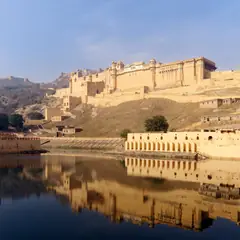
Rajput fortress-palace
Amber Fort
What to see at Amber Fort: the Jaleb Chowk parade ground, the Shila Devi temple, the Diwan-i-Aam with elephant capitals, the Sheesh Mahal and the palace of Man Singh I.
Jaipur, India
Explore Jaipur with 33 audio stops and researched, fact-checked narration. From the fortress above Lake Maota that the Kachwahas left behind to found a new city, to the palace where the royal family still lives, and the stone observatory of a king who distrusted small astrolabes, every place tells how the pink city of Rajasthan was invented.
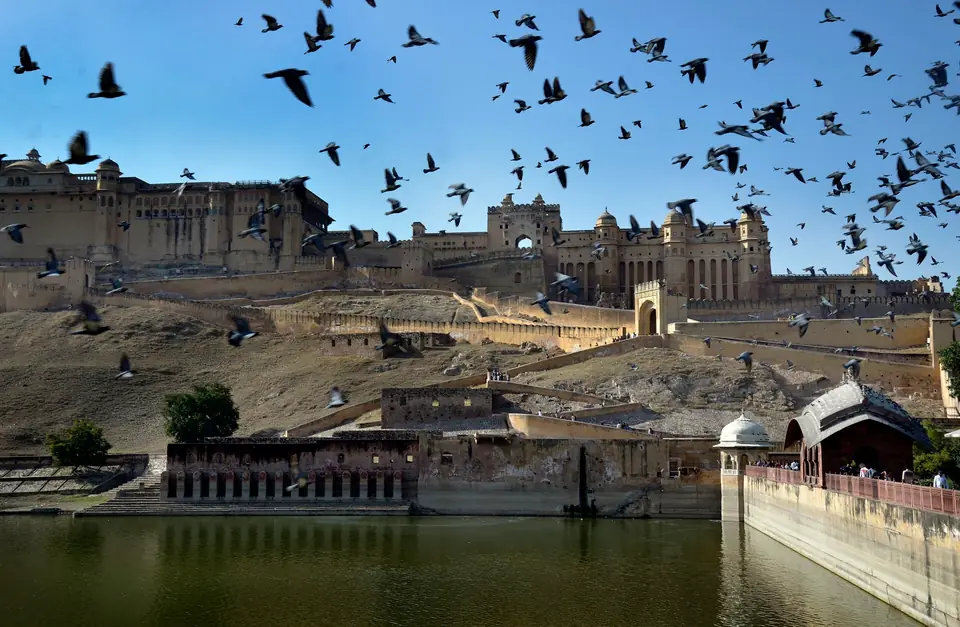
Rajput fortress-palace
What to see at Amber Fort: the Jaleb Chowk parade ground, the Shila Devi temple, the Diwan-i-Aam with elephant capitals, the Sheesh Mahal and the palace of Man Singh I.
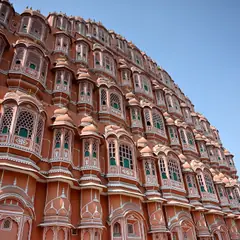
18th-century royal viewing gallery
What to see at the Hawa Mahal in Jaipur: the façade of 953 lattice windows, the courtyard of the royal gate, the stained glass of the Sharad Mandir and the viewing gallery on the upper floors.
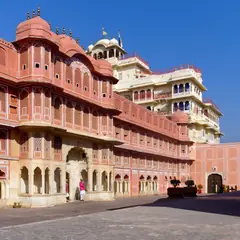
Royal palace still lived in
What to see at the City Palace in Jaipur: Mubarak Mahal, the silver jars of Sarvato Bhadra, the four gates of the seasons and the Chandra Mahal tower.

UNESCO World Heritage Site
What to see at the Jantar Mantar in Jaipur: the 27-metre sundial, the Jai Prakash bowls, the twelve zodiac instruments and the great bronze astrolabe.
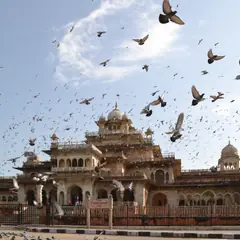
Rajasthan's oldest museum
What to see at the Albert Hall Museum in Jaipur: Swinton Jacob's Indo-Saracenic façade, the Mahabharata murals, the display cases of 1883, the Persian garden carpet and the mummy of Tutu.
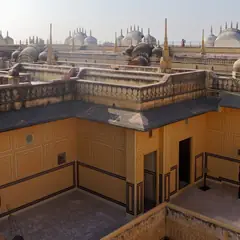
Fortress of 1734 above Jaipur
What to see at Nahargarh Fort: the Tadigate gate, the Madhavendra Bhawan palace with its queens' suites, the corridors with frescoes and the terrace above Jaipur.
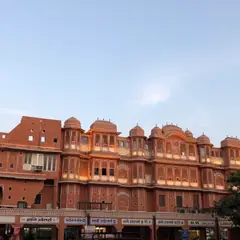
The jewellers' bazaar
What to see at Johari Bazaar in Jaipur: the Sanganeri Gate, the pink arcades, the gem workshops behind the kundan display cases, LMB's ghewar and Badi Chaupar.
Jaipur Audio Guide
Jaipur begins outside Jaipur, on the hill of Amber, where the Rajput Kachwaha dynasty had its capital for centuries. There Raja Man Singh I, a general of the Mughal emperor Akbar, commissioned Amber Fort in 1592, with a parade ground for the spoils of war, a goddess brought from Bengal in 1604 and a hall of mirrors with Belgian glass of 1623. In 1727 Sawai Jai Singh II left the hill and founded a new city on the plain, and between 1729 and 1732 he built at its centre the City Palace, where his descendants still live: a flag of a quarter size at the top of the tower signals that the maharaja is at home. Beside it, the same king built the Jantar Mantar, a garden of astronomical instruments in stone presided over by a 27-metre sundial, a World Heritage Site since 2010. In 1799 his grandson Sawai Pratap Singh added the Hawa Mahal, five storeys of pink sandstone with 953 lattice windows so that the women of the court could watch the bazaar without being seen. The city is completed by Nahargarh Fort, which from the ridge set Jaipur's clocks by cannon fire, the Albert Hall Museum, the oldest in Rajasthan, with a Persian carpet of 1632 and an Egyptian mummy, and Johari Bazaar, the jewellers' street laid out in 1727 under pink arcades.
With the EarGuide Jaipur audio guide, every place reveals its history through narration researched and fact-checked against historical sources. Unlike a free walking tour or a conventional guided visit, you set the pace, the order and the stops. No groups, no timetables, no internet connection.
No internet needed
Download the routes before you head out and explore without using data.
Smart geolocation
The narration starts by itself when you reach the point of interest.
Frequently asked questions
The EarGuide app is free. The Jaipur audio guide includes 7 independent routes with about nine hours of narration spread across 7 sites and 33 audio stops, and it is found inside the app itself.
No. EarGuide works entirely offline. Download the routes over WiFi before you set out and you can use the audio guide with no connection and no data use throughout your visit. The map shows your GPS position in real time even without coverage.
The Jaipur audio guide is available in Spanish and English, with narration on the Rajput forts, the maharajas' palaces, the astronomy of Jai Singh II and the bazaars of the pink city, researched and fact-checked against sources.
The audio guide brings together 7 independent routes with about nine hours of narration in total, from 45 minutes to two hours per route. It can be spread over two or three days: one for Amber Fort, which has the longest route, another for the City Palace, the Jantar Mantar, the Hawa Mahal and Johari Bazaar, and a third for the Albert Hall Museum and Nahargarh Fort.
They are different experiences. The EarGuide audio guide lets you explore Jaipur without timetables or groups, pause and resume whenever you like, and replay any explanation as often as you need. It suits independent travellers, families and anyone who prefers to understand the city at their own pace, with no prior knowledge of Indian history.
The Jaipur audio guide covers 7 main sites: Amber Fort, the Hawa Mahal, the City Palace, the Jantar Mantar, the Albert Hall Museum, Nahargarh Fort and Johari Bazaar.
The old city, yes. The City Palace, the Jantar Mantar, the Hawa Mahal and Johari Bazaar are a few hundred metres from one another, and the Albert Hall Museum is less than two kilometres to the south. Nahargarh Fort sits high on the ridge that overlooks the city, and Amber Fort is about seven kilometres to the north as the crow flies, so both are best reached by car or taxi.
Yes. Purchases belong to your EarGuide account, not to one app or one phone. A city unlocked in the EarGuide app is also unlocked in that city's own app, and the other way round, on both iPhone and Android. Just sign in with the same account on the other device. The store's “restore purchases” button only covers the app the purchase was made in, so signing in is what carries it across.
The Jaipur audio guide is inside the EarGuide app, free and ready to use offline. Carry it in your pocket and explore the city at your own pace.
More destinations
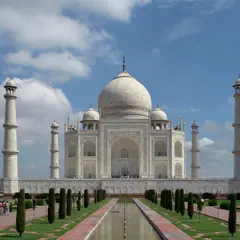
From the Taj Mahal that Shah Jahan watched as a prisoner from Agra Fort to the red city of Fatehpur Sikri and the jewel-box tomb of Itimad-ud-Daulah. Agra, with audio guides.
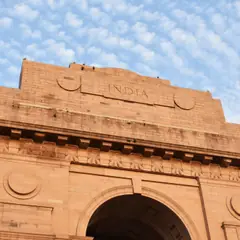
From Shah Jahan's red wall to the Jama Masjid courtyard, the Sikh kitchen that feeds thousands for free every day and the Qutub Minar victory tower. New Delhi, with audio guides.

From Shiva's temple plated with a tonne of Sikh gold to the pyres burning day and night at Manikarnika and the Sarnath stupa that marks the Buddha's first sermon. Varanasi, with audio guides.

3 cities
7 routes · ~6.5h of audio

7 routes · ~6.5h of audio
14 cities

3 cities

7 routes · ~7h of audio

7 routes · ~7.5h of audio
3 cities

3 cities

7 routes · ~5h of audio
5 cities
9 cities

7 routes · ~5.9h of audio
3 cities

5 cities

4 cities

7 routes · 8h of audio

3 cities

4 cities

6 cities
3 cities
7 routes · ~5.5h of audio
7 routes · ~7.5h of audio

7 routes · ~5h of audio

7 routes · ~8.5h of audio

6 routes · 6h of audio

7 routes · ~6h of audio

7 routes · ~5h of audio

3 cities

7 routes · ~8.5h of audio

7 routes · ~7h of audio
3 cities
10 cities

3 cities

7 routes · ~9h of audio

7 routes · ~5h of audio

7 routes · ~9h of audio

7 routes · ~6.5h of audio
8 cities

7 routes · ~9.5h of audio
4 cities

7 cities

7 routes · ~6h of audio