UNESCO Memory of the World
Jabal Ikmah Audio Guide
A sandstone gorge near Dadan where worshippers of the kingdom of Lihyan carved into the rock their offerings to Dhu Ghaybat and their pleas for rain for the palm trees. It is called an ‘open-air library’, but it was a sanctuary.
- 45 min of audio
- Dadanitic epigraphy
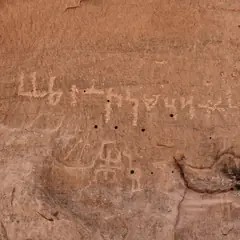
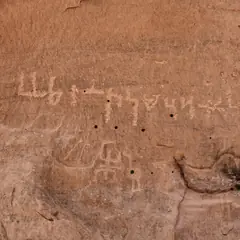
Jabal Ikmah is a crevice in the mountain, 3.5 km from Dadan, whose two walls are covered in inscriptions in Dadanitic, the script of the kingdom of Lihyan. Its hundreds of texts, some up to 2,500 years old, belong mostly to the period when that kingdom flourished, roughly between the 5th and 1st centuries BC. Some are carved in relief, with each letter standing out from the stone, and others are simply scratched. On 24 May 2023 UNESCO included Jabal Ikmah in its Memory of the World Register.
The ‘library’ nickname is misleading: most of the formal texts were not written to be studied, but to record ceremonies and offerings to Dhu Ghaybat, the chief god of Dadan. Priests, caravan traders and women who owned land sign them, and they ask for early and late rains for the oasis palms. Its modern rediscovery began in 1968, when an eight-year-old boy led a German epigrapher by the hand to the mouth of the gorge.
Highlights
- Relief inscriptions — Dadanitic letters standing out from the sandstone
- The zll ceremony — the most repeated formula, in honour of Dhu Ghaybat
- Priestesses — 29% of the priestly offices cited are held by women
- Altar on the east slope — a rock platform identified in 2021
- Memory of the World — inscribed by UNESCO in 2023
In the AlUla desert, 3.5 km from Dadan, a short walk leads to a crevice in the sandstone mountain. Inside, the two walls are written on from top to bottom. The story of Jabal Ikmah is that of a sanctuary of the kingdom of Lihyan, which flourished roughly between the 5th and 1st centuries BC: here its worshippers recorded ceremonies for Dhu Ghaybat, the chief god of Dadan, and requests for rain for the oasis palms. Caravan leaders and traders from afar also passed along its route, on the incense road that crossed Dadan.
How many inscriptions there are depends on who is counting: published figures range from “more than 300” to more than 500, depending on whether graffiti and symbols are included or whether Ikmah is credited with a doubtful provenance. What is not disputed is their value, recognised by UNESCO in 2023 when it added the site to the Memory of the World. Walking the gorge with the audio guide, from the mouth to the altar and from there to the view over the palm groves, turns those walls into voices with names of their own, in an account documented and checked against historical sources.
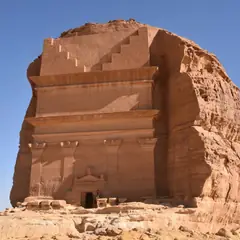
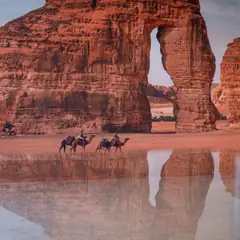
The sanctuary depended on Dadan, the capital of Lihyan; the inscriptions of its Nabataean successors are on the facades of Hegra, and a few kilometres away the wind has done something very different with sandstone at Elephant Rock.
The crevice a boy found
Jabal Ikmah
Summary of this stop
At the entrance of the gorge, loose blocks with inscriptions wait, and at the far end the two written walls open up. Today it is known as the “open-air library”, a nickname at odds with the place’s original function: Jabal Ikmah was born as a place of worship, not study, and most of its formal texts are religious records.
Its modern rediscovery has an unexpected protagonist. In the summer of 1968, the German epigrapher Ruth Stiehl searched for days for the gorge of the inscriptions, until Reja Alabdullah, an eight-year-old boy, led her by the hand from his family’s farm. Stiehl published 9 inscriptions that same year and 40 in 1971.
According to a documented tradition, the epigrapher never forgot her guide: for years she wrote to him from Germany, and his childhood photo was projected at scientific conferences. In 2021, more than half a century later, Reja returned to this same gorge mouth with the King Saud University team reviewing the site. What he remembered of that first day is told in the narration, right there.
Letters in relief for Dhu Ghaybat
Relief inscriptions of the gorge
Summary of this stop
On the walls, multi-line Dadanitic texts show letters standing out from the rock. To achieve this, the stonecutter lowered the sandstone around each sign, a technique that allowed no mistakes. Alongside them appear incised graffiti, finer and less careful, with isolated names and short phrases, such as those of “Blns the horseman”.
The most repeated formula records the zll ceremony in honour of Dhu Ghaybat. One of these inscriptions is signed by Ssn, priestess of the god, who organised it for her palm trees in Dmn, a place name whose location is still disputed.
Some texts also work as a calendar: they are dated by the regnal year of a king of Lihyan. A priest named Hny left it written that he celebrated the zll “in year 20 of Tlmy”, and in the published corpus of Ikmah there are five dated inscriptions naming Lihyanite kings.
An altar and a disputed word
Carved altar on the east slope
Summary of this stop
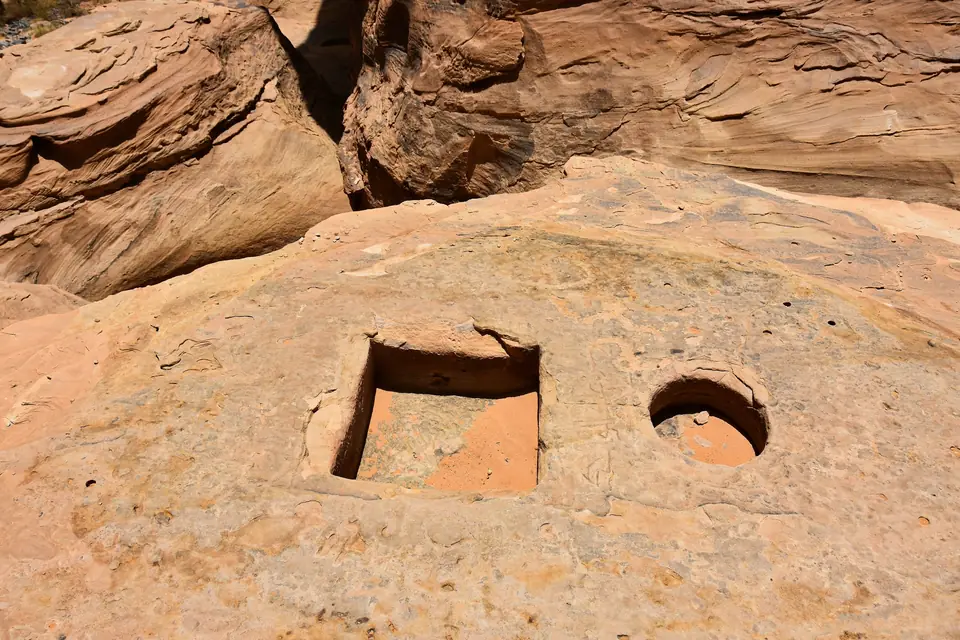
On the east slope of the gorge, beside the inscriptions, a horizontal rock platform was carved as an altar. It was identified in the 2021 survey and probably served for offerings or sacrifices. What exactly was offered is a question the stone itself leaves open.
An incised inscription records four brothers, sons of S’d’l, who celebrated the zll “h-nq” for Dhu Ghaybat. That word divides epigraphers: one reading interprets it as a sacrifice of she-camels; another, as “the top of the mountain”, because the texts that use it appear along the way up. The discussion remains open, and the audio guide sets out the arguments of each side on the spot.
The rock also holds layers of time. On the north face, drawings of animals with darker grooves predate the letters, which in places were engraved on top of them. And writing continued after the arrival of Islam: south of the gorge, an Arabic inscription from the year 223 AH (AD 837–838) records how Ahmad b. Muhammad b. Khalaf declared his trust in God.
The palm trees people prayed for
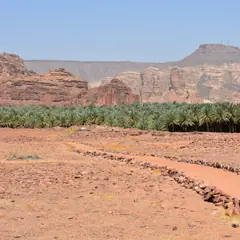
Palm groves of the AlUla valley
Summary of this stop
From the gorge and the nearby heights, the palm groves of the AlUla oasis come into view, heirs of those that appear in the inscriptions. The texts ask for early and late rains for the palms and the harvests; one relief inscription, U 023, records 145 palm trees planted in Bdr and Bnl by a priest of Dhu Ghaybat, his son and his wife.
Among those who sign offerings are women who owned land: of the 28 inscriptions that mention a priestly office, 29% refer to priestesses. Thbb, daughter of Abddktb, celebrated the zll for what she owned in Bdr. And the gorge has its own spectacle, recorded by the photographer Rakan AlAnizi: after a heavy downpour, the sandstone gathers the water and lets it fall in cascades down the walls. That geology, which collects the water and greens the place, may have weighed in the choice of this corner for concentrating prayers.
The writing of Ikmah is being taught again today. In 2017 the Royal Commission for AlUla closed the mountain to prepare it for visitors, and within the Winter at Tantora programme the night-time experience “Ikmah After Dark: Secrets of the Scribe” walks the gorge by candlelight and teaches visitors to carve their own name in the ancient alphabet on a block of stone.