


World Heritage 2026
Chorsu Bazaar
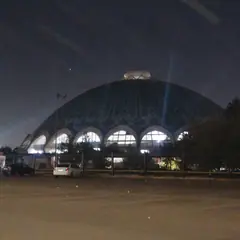
What to see at Chorsu Bazaar in Tashkent: the great 86-metre blue dome, its ceramic arabesques, the spice and dried-fruit gallery and the food market beside the Kukeldash madrasa.
Tashkent, Uzbekistan
Explore Tashkent with 32 audio stops and documented, fact-checked narration. From the tomb of the locksmith scholar in the old town to the split cube marking the epicentre of the 1966 earthquake, every place explains how a caravan city became a Soviet showcase and then the capital of Uzbekistan.
World Heritage 2026
What to see at Chorsu Bazaar in Tashkent: the great 86-metre blue dome, its ceramic arabesques, the spice and dried-fruit gallery and the food market beside the Kukeldash madrasa.
Religious heart of Tashkent
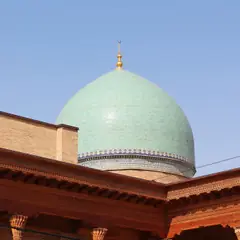
What to see at the Hazrati Imam Complex in Tashkent: the Kaffal Shashi Mausoleum, the Barak Khan madrasa turned bazaar, the Muyi Muborak madrasa that kept the Uthman Quran and the Friday mosque of 2007.
16th-century madrasa
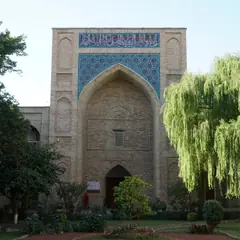
What to see at the Kukeldash Madrasa in Tashkent: the staircase on the old wall, the majolica portal rebuilt from 19th-century photos, the poets' courtyard of hujras and the trace of its lost domes.
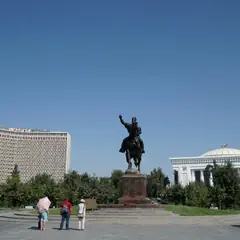
Garden of 1882
What to see at Amir Timur Square in Tashkent: Timur's equestrian statue, the chimes with their twin tower, the radial paths of the 1882 garden and the curved façade of the Hotel Uzbekistan.
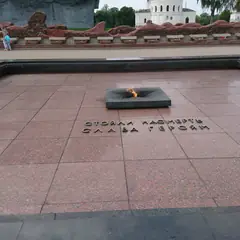
Memorial to the 1966 earthquake
What to see at the Courage Monument in Tashkent: the labradorite cube split over the 1966 epicentre, the zigzag crack, the bronze family and the 14 steles of the reconstruction.
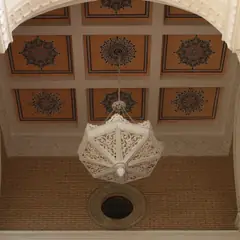
Shchusev's opera house, 1947
What to see at the Navoi Theatre in Tashkent: the fountain over the old bazaar, Shchusev's three-arched portal, the plaque to the Japanese builders, the Bukhara hall with stucco over mirror and the Navoiy murals.
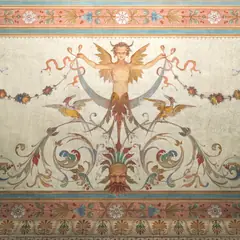
House-museum of Uzbek crafts
What to see at the Museum of Applied Arts in Tashkent: the ayvan on the façade, the kundal-ceilinged hall with mihrab and fireplaces, the Persian inscription, the Rishtan ceramics and the craft salons.
Tashkent Audio Guide
Tashkent reads as two halves. To the west lies the old town: Chorsu Bazaar, whose 86-metre blue dome covers the crossroads where the four ancient districts met and which has been a World Heritage Site since 2026; just above it, on the embankment of the city wall, the Kukeldash Madrasa, which has been a school, a caravan inn, a fortress and a museum of atheism; and a little to the north the Hazrati Imam Complex, five centuries of mosques and madrasas around the tomb of Kaffal Shashi, the 10th-century “locksmith” scholar. To the east stretches the city the Russians laid out and the Soviets remade: Amir Timur Square, whose central pedestal has held a tsarist general, Lenin, Stalin and Marx before Timur; the Navoi Theatre, designed by the architect of Lenin's Mausoleum and finished by Japanese prisoners; and the Courage Monument, a split black stone cube over the epicentre of the 1966 earthquake. Halfway between, the Museum of Applied Arts hides behind the façade of a Russian merchant's house a hall of openwork ganch and Rishtan tiles.
With the EarGuide Tashkent audio guide, every place reveals its history through documented narration checked against historical sources. Unlike a free walking tour or a conventional guided visit, you set the pace, the order and the stops. No groups, no timetables, no internet connection.
No internet needed
Download the routes before you head out and explore without using data.
Smart geolocation
The narration starts by itself when you reach the point of interest.
Frequently asked questions
The EarGuide app is free. The Tashkent audio guide includes 7 independent routes with about five hours of narration spread across 7 sites and 32 audio stops, and it is found inside the app itself.
No. EarGuide works entirely offline. Download the routes over WiFi before you set out and you can use the audio guide with no connection and no data use throughout your visit. The map shows your GPS position in real time even without coverage.
The Tashkent audio guide is available in Spanish and English, with documented narration, checked against sources, on the city's madrasas, bazaars and Soviet architecture.
The audio guide brings together 7 independent routes with about five hours of narration in total, from 25 to 60 minutes per route. The easiest way is to spread them over one long day or two mornings: one for the old town, with Chorsu Bazaar, the Kukeldash Madrasa and the Hazrati Imam Complex, and another for the centre, with Amir Timur Square, the Navoi Theatre, the Courage Monument and the Museum of Applied Arts.
They are different experiences. The EarGuide audio guide lets you explore Tashkent without timetables or groups, pause and resume whenever you like, and replay any explanation as often as you need. It suits independent travellers, families and anyone who prefers to understand the city at their own pace, with no prior knowledge of Central Asia.
The Tashkent audio guide covers 7 main sites: Chorsu Bazaar, the Hazrati Imam Complex, the Kukeldash Madrasa, Amir Timur Square, the Courage Monument, the Navoi Theatre and the Museum of Applied Arts.
By area, yes. Chorsu Bazaar and the Kukeldash Madrasa are side by side, and the Hazrati Imam Complex is a little over a kilometre to the north. Amir Timur Square and the Navoi Theatre are less than a kilometre apart, and the Courage Monument and the Museum of Applied Arts lie halfway between the two zones. From the bazaar to Amir Timur Square it is about four kilometres: for the long hops the practical choice is the metro, which has a station next to the bazaar.
Yes. Purchases belong to your EarGuide account, not to one app or one phone. A city unlocked in the EarGuide app is also unlocked in that city's own app, and the other way round, on both iPhone and Android. Just sign in with the same account on the other device. The store's “restore purchases” button only covers the app the purchase was made in, so signing in is what carries it across.
The Tashkent audio guide is inside the EarGuide app, free and ready to use offline. Carry it in your pocket and explore the capital of Uzbekistan at your own pace.
More destinations
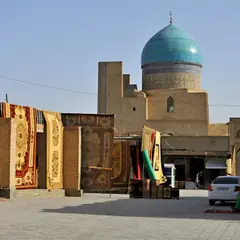
The Silk Road city: a minaret that survived Genghis Khan, the emirs' citadel, a thousand-year-old mausoleum and the last great pool. Explore Bukhara with audio guides.
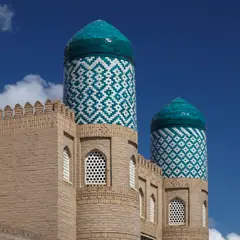
The walled city of Itchan Kala: a turquoise minaret left unfinished, a mosque of 212 wooden columns and the khans' citadel. Explore Khiva with audio guides.
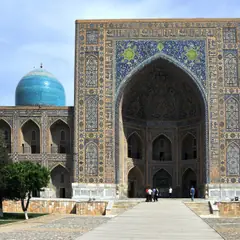
Tamerlane's capital: three madrasas face to face on the Registan, a street of blue domes towards the Living King and the observatory of an astronomer prince. Explore Samarkand with audio guides.
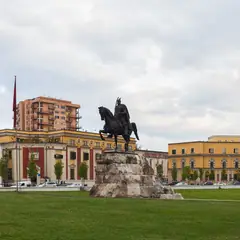
3 cities
7 routes · ~6.5h of audio
7 routes · ~6.5h of audio
14 cities
3 cities
7 routes · ~7h of audio
7 routes · ~7.5h of audio
3 cities
3 cities

7 routes · ~5h of audio
4 cities
5 cities
9 cities
7 routes · ~5.9h of audio
3 cities
5 cities
4 cities
7 routes · 8h of audio
3 cities

4 cities

6 cities
3 cities
7 routes · ~5.5h of audio
7 routes · ~7.5h of audio

7 routes · ~5h of audio

7 routes · ~8.5h of audio

6 routes · 6h of audio
7 routes · ~6h of audio
7 routes · ~5h of audio
3 cities
7 routes · ~8.5h of audio
7 routes · ~7h of audio
3 cities
10 cities
3 cities
7 routes · ~9h of audio
7 routes · ~5h of audio
7 routes · ~9h of audio
7 routes · ~6.5h of audio
8 cities

7 routes · ~9.5h of audio
7 cities

7 routes · ~6h of audio